EXTRACT 1: An endless supply of data, probably unparalleled in its breadth and depth, flows from every continent to a cluster of buildings on the edge of the English Garden in Munich. An encyclopedia of life, its dangers, its injustices, its coincidences, is being assembled there. There is probably no other place on Earth where the risks of the modern world are being studied more intensively and comprehensively than at the headquarters of Munich Re, the world's risk center.
EXTRACT 2: Today Munich Re wins accolades for its restraint, while its shareholders are eagerly awaiting the results of a new project. The goal of the project under development in Oechslin's department, more comprehensive than any other project before it, is to redefine the limits of knowledge by developing a global risk model.
Full Story Online
Phi Beta Iota: This is a superb article that ably documents how much can be known–and shared–that most governments and international organizations are simply not conscious of, or if conscious, exploiting microscopic bits of the data for nefarious purposes. These are the kind of people that could and should be at the heart of creating a World Brain and Global Game.
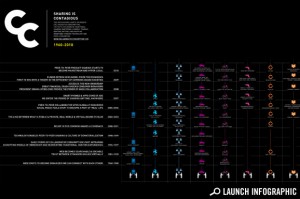
“Sharing is Contagious” charts how we are increasingly growing up sharing files, photos, knowledge, and daily thoughts—and how these collaborative behaviors are moving into other areas of our lives. From bike-sharing to co-working to peer-to-peer rental, a dotted line is forming between “what’s mine,” “what’s yours,” and “what’s ours.” Technology and peer communities are enabling old market behaviors including bartering, swapping, trading, renting, lending, and sharing to be reinvented in ways and on a scale never possible before.
Phi Beta Iota: The authors of the book are on a marketing buzz curve–we are actually entering the age of collection production of just enough just in time everything, and “consumption” of every sort is passe. Less than a minute ago. Our Collective Intelligence will create infinite wealth in part by exposing and eradicating all fraud, waste, and abuse.
Dr. Nafeez Ahmed is a bestselling author and political analyst specialising in the study of mass violence in the context of international security issues. His doctoral thesis examined genocides sponsored by the European powers from the 15th through the 19th centuries. He is Executive Director of the Institute for Policy Research & Development in London, and Strategy Director for the Creative Education Programme at Arts Versa Consultants where he has consulted for projects funded by the UK Department for Communities & Local Government and the US Embassy in London. He has taught international relations, globalization, and empire at the University of Sussex and Brunel University.
NEVER confuse our passion for public intelligence with a desire to eliminate the secret world. On the contrary, Rule 1 for our multinational concept is “Feed the High Side First.” Rule 2 prohibits the high side from controlling open source sharing among all multinational stake-holders. This is all outlined in Search: The Future of OSINT [is M4IS2-Multinational].
We also distinguish between getting OSINT right within the all-source secret environment, and getting public intelligence right outside of and completely independent from the secret environment. Within the secret intelligence world, OSINT is still at the fourth-grade level, as least in the USA and outside the Nordics and Netherlands, here are a few graphics understood by but not yet accepted in contradistinction to the current paradigm within that community. Absent Integrity, no one will get to where we need to be.
Here are the core elements of the new model as promulgated by this web site as a front end of the Earth Intelligence Network (EIN), a 501c3 Public Charity. Our integral consciousness is reflected in our logo.
The good of this is that the circle is gradually widening.
The bad is that this is still kum-ba-ya on steroids, all about hand-holding and soul searching with little attention to multinational information-sharing and sense-making, or to creating actionable public intelligence.
Too many of these people are merely on the talk circuit, while others are doing righteous work at the micro-level that is not scalable or migratable without a global concept of operations and doctrine for transforming from the culture of war to the culture of peace through Information Operations (IO).
Ibn Qayyim wrote: “The Islamic law is all about wisdom and achieving people’s welfare in this life and the afterlife. It is all about justice, mercy, wisdom, and good. Thus any ruling that replaces justice with injustice, mercy with its opposite, common good with mischief, or wisdom with nonsense, is a ruling that does not belong to the Islamic law.”
This introductory essay defines the highest level framework, akin to constitutional principles, and introduces various schools of fiqh or schools of thought (madhahib) that have been established by leading Islamic scholars or Imams, namely, Hanafi, Maliki, Shafi’i, Hanbali, Ja’fari, and Zaidi. Regardless of the school(s) of thought one may follow, the discussion of the universal human responsibilities and rights culminates in what is the essence of Islam, i.e., truth, love, and justice.
EXTRACT:
The classical five maqasid (al dururiyat al khamsah) or huquq (sing. haqq) of Al Ghazali in the 4th Islamic century were the protection of din (faith and religion), haya (life), mal (private property), karama (dignity and honor), and ‘ilm (mind and knowledge). Later scholars, especially Al Shatibi, added nasl or nasab (family and community) and hurriyah (self-determination or political freedom). Some twenty-first century scholars have added an eighth maqsad, known as haqq al mahid or respect for the physical environment.
Phi Beta Iota: We love Cryptome, it renders a public service. We appreciate being listed there as a public service ourselves. We do NOT, however, under any circumstances, violate our lifetime secrecy oath or ever reveal anything that is remotely classified or sensitive. We derive intelligence (decision support) exclusively from open sources and methods. When we write about traditional intelligence sources and methods (e.g. on Human Intelligence) our work is reviewed by both DoD and CIA in advance of publication. Our mission is to help create public intelligence in the public interest. That said, we point with respect to Cryptome, where the following statement appears, and then a long list of existing web sites full of sensitive sources and methods information….including, erroneously, our own.
From Cryptome DOI 4 September 2010
Sensitive Information Security Sources and Breaches
In response to Wikileaks background inquiries Cryptome offers that there are hundreds of online and offline sources of sensitive information security breaches which preceded Wikileaks beginning about 120 years ago. This outline traces the conflict between technological capabilities for sensitive information breaches and control by law enforcement when technical countermeasures are insufficient — a few examples among many others worldwide: