Last week, the chairman of President Barack Obama’s Council of Economic Advisers — a position that carried the title “chief economist” until Larry Summers took up residence in the White House — testified to the Joint Economic Committee on the economic crisis and the efficacy of the policy response.
Here’s the executive summary in case you missed it:
Metadata in State Documents Is Public Record, Court Rules
Kim Zetter, 30 October 2009
Arizona’s Supreme Court, in a surprising but welcome ruling, has declared that electronic metadata is part of the public record under state law, in a case involving an Arizona police officer who suspects his superiors of backdating a document related to his work performance.
The city argued that metadata — digital information that can reveal when a document was created and subsequently accessed or modified — was not part of the public record. Releasing such information to the public would result in an “administrative nightmare” and force public officials to spend “countless hours” trying to identify the metadata, the city claimed.
My good friend Werther had this to say about David Brookes' op-ed, “The Tenacity Question,” in the 29 October 09 of the New York Times, which argued that the solution to Afghanistan was a simple question of mustering willpower.
Full Story Online
Sola Fide
“The sleep of reason breeds monsters.”
Francisco Goya
By Werther*ElectricPolitics.com
As yet more evidence for why the newspaper industry is in an apparently terminal decline, yesterday the New York Times published neoconservative columnist David Brooks' justification for more quagmire in Afghanistan.
There are so many things wrong with his reasoning that we can only skim the surface.
Editor’s Note: In this modern age – and especially since George W. Bush declared the “war on terror” eight years ago – the price for truth-telling has been high, especially for individuals whose consciences led them to protest the torture of alleged terrorists.
From the Story:
I tell you that partly because this whole question of personal morality is a complicated one. I would never, ever, no one would have ever pointed at me as someone likely to become or to be a person of conscience. And yet eventually I found myself on the outside and treated in a way that challenged my whole view of the world.
Phi Beta Iota: As we enter our third and last full life of public service, stories such as this are inspiring, not depressing. The world is about to be flipped right-side up. We will have no difficulty identifying those individuals whose integrity was sufficient unto the challenges we all face, every day, as a rotten system without honor seeks to treat individuals as cogs of the wheel rather than the central foci they should be. Robert Steele signed the letter to Senator McCain against torture–no one now serving President Obama did so.
If one takes the “battlefield” to include all challenges, not just the challenge of a battle in a singular time and place, then this search is the mother of all searches.
We like to use the analogy of sailboat racing, something we learned from a video, DVD: THE ART OF RACING SAILING. This DVD begins with an inspection of the hull of the sailboat out of the water and the point is that the race is often won or lost BEFORE THE RACE EVEN BEGINS. If you have failed to assure a correct hull; if you have failed to train, equip, and organize the right forces for the right mission, if you have failed to understand the historical, cultural, and geographical reality you are entering into a context with; then no amount of excellence on the field itself will prevail.
One of the great things about being the touchstone for public intelligence is the contacts that are made by students, officers and enlisted personnel serving in the field, and so many others.
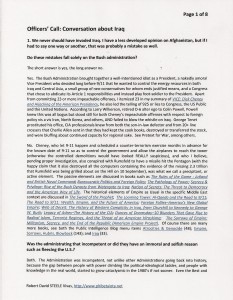
While we were in Denmark, an officer now serving in Iraq sent us some questions that we answered to the best of our ability. The questions alone are listed here. For the answers, click on the cover.
1. We never should have invaded Iraq. I have a less developed opinion on Afghanistan, but if I had to say one way or another, that was probably a mistake as well.
Do these mistakes fall solely on the Bush administration?
Was the administrating that incompetent or did they have an immoral and selfish reason such as fleecing the U.S.?
Was it shortsighted political gain objectives with an underestimation of the downside?
We will have at least double the amount of dead service members before these conflicts are over as were killed during the 9/11 attacks. I read somewhere that we have 75,000 amputees due to the two conflicts not to mention the amount of PTSD. Who has the blood on their hands? Certainly nobody is willing to admit mistakes.
I don't understand how Cheney can even think about spouting off after how the conflicts have gone. Where is the cost vs gain analysis?
2. Once we did invade, we didn't have a solid plan and we didn't bring nearly enough troops if we planned on staying. Was this mainly Rumsfeld's fault?
Over the past year or so, a new movement, the “NoSQL” movement has emerged promoting the advantages of doing a variety of kinds of analytics without using any relational database technologies at all.