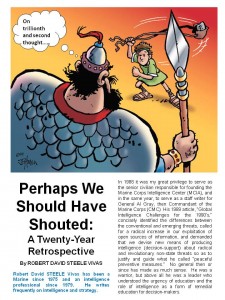
Click on the covers to reach the original postings (dated to conform to the date of the issuance of each document) with today's Phi Betea Iota Editorial Comments on each of the two documents.
Of special relevance is the fact that this document assigns chairmanship of the National Open Source Council (NOSC) to the ADDNI/OS, who has delegated that role to the Director of the CIA/DNI Open Source Center. We recommend the ADDNI/OS rescind that delegation immediately in as much as it is in explicit violation of Intelligence Community Directive 300 E.2.d.
Phi Beta Iota has begun a review of all publicly-available documents and directives pertaining to the hybrid discipline of Open Source Intelligence (OSINT). Click on the cover to access both the full document online and the Phi Beta Iota comment.
OSINT is a hybrid discipline, unique in that it is both a complete discipline in its own right, while also being the essential foundation for both the traditional collection disciplines and the long-suffering consumer missions that have never gotten decision-support from the secret world–Agriculture, Commerce, Energy are but a few of them.
Vision 2015 is sheer genius, gifted articulation, and
Click to Read Full Comment
implementable now, but not within the US Intelligence Community (US IC). It is time for the Director of National Intelligence (DNI) to work with the Undersecretary of Defense for Intelligence (USD(I)) to fully fund the Open Source Agency under diplomatic auspices with an Office of Information Sharing Treaties and Agreements, a UN Assistant Secretary General for Decision Support, a Multinational Decision Support Center that implements Vision 2015 at the unclassifed level as a baseline for unilateral all-source advances on that foundation; and regional mission-oriented Whole of Government/broad coalition networks and centers corresponding to each Combatant Command (COCOM), each of whom should become both a US Whole of Government integrated campaign management center, and a regional multinational stabilization & reconstruction information-sharing and decision-support hub.
To begin on a positive note: Google has both computational mathematics that are out of this world, an order of magnitude better than anything IBM or the other usual suspects can muster, and it has cracked the cloud storage and heat and throughput issues in a way that is now an almost insurmountable barrier to entry for corporations (China and India are emergent and Brazil and Russia might have some anti-Google surprises in the making).
Google lacks human and intelligence-oriented leadership, and suffers from the usual problems associated with a bureaucracy that grew too fast on the fantasy cash from credulous investors. “Zooglers” is the term of art now used for Google people that have vested and leave to create new capabilities that “surf” on Google while doing things the Google bureaucracy could not countenance as an internal active.
Then there is evil Google. Click on the Google Evil-Bad Google logo for a page of links, or choose from among the links below. We know Larry Page personally, through the Silicon Valley Hackers Conference. He is a nice person, an engineer, with zero ethics in the sense that dorks do not know anything about etiquette. Eric Schmidt is the new monopolist in town, and Eric Schmidt has absolutely zero interest in the public interest.
I received this from a friend who didn't know that Mitch “Taco” Bell is the son of very good friends from my church. He is an airline pilot who was in the USMC reserves and several years ago volunteered to return to active duty and requested service in Iraq. He's got a great web site, the link to which he provides in his message, that is well worth looking at. I'm not sure who is the original sender of Mitch's message. Best, Jim
1. Mitch “Taco” Bell, our area Marines For Life Commander, gives his AARep/SitRep of the situation in Afghanistan. This is not some superficial product of a dilitante, but rather an insightful, unvarnished, and candid analysis that shows the military professionalism that exits in our field grade officer Corps.
These are some of my thoughts on Afghanistan. It's long, but if you think the others would like to read it, please pass it on or send the link www.thesandgram.com
Semper Fi,
Taco
Afghanistan?
“How do you fix a problem like Maria???”
The song from the Sound of Music reverberates in my head as I sit here thinking about the situation in Afghanistan. How do you fix a problem like Afghanistan? When I tell folks that I served in Kabul, I think the number one question asked of me is, “What do you think will happen in Afghanistan?” I hate to say that my reply isn’t always positive. Our job there, and in Iraq, has come at a great price for America and her allies, and I firmly believe there are still lots of bad guys there who need to be given the chance to meet their maker, but maybe we need to change how we do business. These are my personal insights on the war there, good, bad or indifferent. They do not reflect the opinions of the Marine Corps or the administration.
After appointing Gen. Stanley McChrystal the new commander in Afghanistan, Defense Secretary Robert Gates gave him two months to write an analysis of the situation there in yet another review of U.S. strategy. But after rumors leaked out that McChrystal would ask for another increase in U.S. troops, it appears that Gates decided he would not wait for McChrystal's finished report. On Aug. 2, he summoned McChrystal and his deputy, Lt. Gen. David Rodriguez, to a hastily arranged meeting in Belgium which also included Joint Chiefs Chairman Adm. Michael Mullen, NATO commander Admiral James Stavridis, McChrystal's direct boss Gen. David Petraeus, and under secretary of defense for policy Michele Flournoy.
On Aug. 5, Pentagon spokesman Geoff Morrellbriefed reporters on the results of the unusual Sunday meeting. According to Morrell, Gates instructed McChrystal to consider a few additional, and unspecified, issues in his report. Gates also instructed McChrystal to take more time, likely postponing the delivery of the report into September.
Finally, Morrell explained that McChrystal's report will not include any discussion or request for additional “resources” (meaning U.S. troops and money) for Afghanistan. If McChrystal wants to make such a request, Morrell said, he will do so separately and at a later time.
Climate change and reduced sea ice cover may result in opening up the Arctic to vastly increased resource development and commercial traffic. These trends will inevitably spark international conflicts and create a need for more military forces to provide security and protect interests in the Arctic region. This is bad news for the U.S. Navy, already hard-pressed by shrinking fleets and rising challenges elsewhere.
In an era when changes to the Earth that used to take 10,000 years now take three;
In an era when all information in all languages all the time is the non-negotiable first step to achieving holistic understanding of the Earth's system of systems as well as all the chaotic sub-systems;
In an era when the Nordics are far ahead of everyone else in thinking about Multinational, Multiagency, Multidisciplinary, Multidomain Information-Sharing and Sense-Making (M4IS2),
it is helpful to have a sense of what the U.S. Department of Defense is going with respect to it's own Global Information Grid (GIG).
Below are a few headlines as well as pointers to a couple of devastatingly critical reviews from the General Accountability Office (GAO).
Phi Beta Iota has just one question: when, if ever, will DoD plan, program, budget, and implement for a world in which 96% of the information DoD needs to exploit is not secret, not in English, and not originating from a DoD device?
After the GAO reports, click on the Frog Left to read what we said to the National Research Council about the Army Communications Architecture in the early 1990's and Frog Right to read about our recommendations for National Information Infrastructure (NII) cyber-security in the mid-1990's.
DoD needs a Chief Knowledge Oficer (CKO)–someone that knows the difference between knowledge management, network management, content capture and exploitation, and the Holy Grail, organizational intelligence.