For those of you with experience or interest in such things, State's Bureau of Diplomatic Security (DS, long ago SY), has developed for itself a very negative reputation in personnel security arena.
Through AFSA, American Foreign Service Association (I am not a member having never been a FSO), I have read numerous accounts of horror show DS cases.
Overall, DS comes across as an internal State Dept Gestapo, much different from the RSOs I dealt with in embassies in LATAM and Africa.
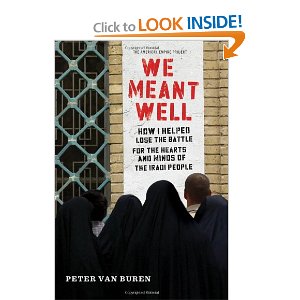
Peter Van Buren, a foreign service officer who wrote anunflattering bookabout his year leading two reconstruction teams in Iraq, was stripped of his security clearance, banned from State Department headquarters for a time and transferred to a telework job that consists of copying Internet addresses into a file.
Phi Beta Iota: Most Departmental “security” services turn into little Gestapos, but they do so on command from the top. Peter van Buren's book was APPROVED by the proper Department of State publication review process, which has integrity. Evidently now someone at the top, probably not the Secretary of State but one of the top six mandarins, is abusing their authority and perhaps giving Peter van Buren a $10 million lawsuit on a platter. When governments stop telling the truth they lose legitimacy. When they begin persecuting people who tell the truth they lose authority. We're there.
#UgandaSpeaks: Al-Jazeera uses Ushahidi to Amplify Local Voices in Response to #Kony2012
Invisible Children’s #Kony2012 campaign has set off a massive firestorm of criticism with the debate likely to continue raging for many more weeks and months. In the meantime, our colleagues at Al-Jazeera have repurposed our previous #SomaliaSpeaks project to amplify Ugandan voices responding to the Kony campaign: #UgandaSpeaks.
Together with GlobalVoices, this Al-Jazeera initiative is one of the very few seeking to amplify local reactions to the Kony campaign. Over 70 local voices have been shared and mapped on Al-Jazeera’s Ushahidi platform in the first few hours since the launch. The majority of reactions submitted thus far are critical of the campaign but a few are positive.
The Obama administration simulated a cyber attack on New York City's power supply in a Senate demonstration aimed at winning support for legislation to boost the nation's computer defenses. Senators from both parties gathered behind closed doors in the Capitol Wednesday for the classified briefing attended by Homeland Security Secretary Janet Napolitano, FBI Director Robert Mueller and other administration officials. The mock attack on the city during a summer heat wave was “very compelling,” said Sen. Susan Collins, R-Maine, who is co-sponsoring a cybersecurity bill supported by President Barack Obama. “It illustrated the problem and why legislation is desperately needed,” she said as she left the briefing. Bloomberg.
The US defense industry is in a full court press to get tens of billions in funding for cyberwarfare.
To get that funding, they need to dramatize the potential threat of cyberwarfare. Here's how. The central method of attack in cyberwarfare is systems disruption. Systems disruption is a way to break networks to achieve extremely high levels of damage (or, in financial terms, high ROIs). One of the best ways to demonstrate that type of attack is through a disruption of the power supply (usually with NYC as a target).
Two John Robb posts, comment, and see also — university grants at risk.
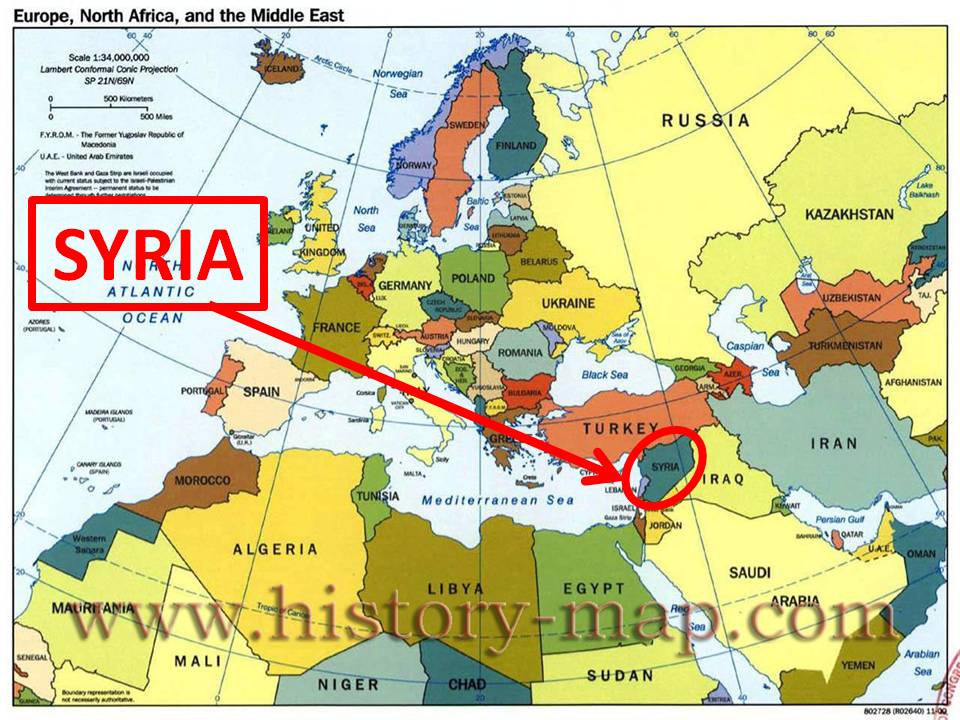
Syria: Deputy Oil Minister Abdo Hussameddin announced his resignation and departure from the Ba'ath Party to side with the opposition against President Al-Asad's regime. If confirmed, he would be the highest-ranking official to defect, and the third member of the administration to do so. A video of his declaration was posted on YouTube and repeated around the world.
Comment: Most news outlets reported this man as the highest-level official to defect, which means very little. A lengthy search showed the man was a Baath Party member for a long time, but failed to discover whether the defector was a Christian, Druze, Sunni, Alawite or member of another group. The implications of the defection hinge largely on details not available in the public domain.
Syria celebrated the 49th anniversary of the Syrian coup by Hafez al-Asad on 8 March 1963. Revolution Day is 8 March.
Correction: The place names cited by the Red Crescent official and reported in the 7 March edition of NightWatch are governates, not cities and towns. Syria has 14 governates – often translated as provinces – which administer 61 districts.
It is important to enter an instability problem at the right level, meaning at the level of political organization that provides diagnostic and prognostic results. The international press persists in describing unrest in terms of governates. Entering the instability problem at this level results in distorted narratives and exaggerated reports about the strength of the opposition and the weakness of the government.
Readers are justified in wondering why the government in Damascus has not collapsed. The reason is that the government is not now and has never been threatened by a governate-level insurrection. The fight is in local neighborhoods and most are on the political or geographic periphery of the governates, posing little threat to central authority.
Syria is about the size of North Dakota, according to the CIA World Factbook, with a few differences. Syria has 61 districts which more or less correspond to North Dakota's 53 counties. North Dakota's counties, however, are not organized into governates or provinces.
Syria supports more than 22.5 million people in the same space that North Dakota supports just under 700,000, but with a lot less water. North Dakota has no cities as populous as Syria's Homs which contains over a million people. North Dakota has no sea ports or borders with hostile enemy states.
NightWatch has sought to enter the Syrian instability problem at the district or sub-district level so as to guard against bias and get finer ground truth granularity about just what is happening in Syrian neighborhoods.
For example, a careful survey shows that today the Free Syrian Army and its supporting web sites posted situation reports indicating that this force engaged in six operations in five different governates on 7 March. Several were exchanges of gunfire in which no one was injured and one was erection of a roadblock, in a territory the size of North Dakota.
This data supports leaked information attributed to US intelligence persons that there isn't much of a Free Syrian Army. There is unrest in Syria, but there really isn't much of an insurgency. For the purposes of comparison, in Iraq in 2006, more than 300 firefights occurred daily. In Afghanistan last spring, there were around 50 firefights daily and hundreds of incidents involving makeshift explosives.
Syrian security forces were busy. Opposition sources reported dozens of activities in nine of the 14 governates. A closer look showed that the activities were concentrated in about a dozen of the 61 districts.
Nine governates sounds like a big insurrection. Unrest in 12 districts presents a far more manageable security problem than nine governates supposedly out of control, but in fact not. No governates are out of control and apparently neither are any of the 61 districts.
A still finer focus showed that most of the opposition activities were small, brief street demonstrations (which were not further defined), according to the opposition's own postings. There were no clashes except as noted above; no bombings and no terror attacks on 7 March.
Most of the government operations were local neighborhood sweeps that encountered no resistance. Other reported government actions included over flights of aircraft, some vague armor movements and shelling. The opposition sources that posted the reports were not careful to distinguish whether the operations were by law enforcement and police personnel, paramilitary militias or the Syrian armed forces. Most were attributed to “thugs,” which suggests the paramilitary militias.
Unfortunately the sources also were not specific about which sub-districts or neighborhoods were under stress from government operations. Each of the 61 Syrian districts has multiple sub-districts what are called, nawahi. It is not yet possible to track activity at the nawahi level, but it would show a more fine grained definition of the status of the instability problem in Syria.
Phi Beta Iota: CNN and BBC both appear to be taking direction from US covert operations / media influence staffs. Both appear unintelligent and dishonest. We hold NIGHTWATCH and its editor in the highest regard, consistently superior to the larger organizations that lack both intelligence and integrity. We note with interest that the Syrian Diaspora and the crisis mapping communities are relatively silent on this matter.
1. When you're setting a record for the longest modern war, cutting it short just increases the chances of somebody breaking your record some day.
2. When Newt Gingrich, Cal Thomas, and Lindsey Graham turn against a war, keeping it going will really confuse Republicans.
3. If we pull U.S. troops out after they have shot children from helicopters, kicked in doors at night, waved Nazi flags, urinated on corpses, and burned Korans it will look like we're sorry they did those things.
4. U.S. tax dollars have been funding our troops, and through payments for safe passage on roads have also been the top source of income for the Taliban. Unilaterally withdrawing that funding from both sides of a war at the same time would be unprecedented and could devastate the booming Afghan economy.
5. The government we've installed in Afghanistan is making progress on its torture program and drug running and now supports wife beating. But it has not yet mandated invasive ultrasounds. We cannot leave with a job half-finished, not on International Women's Day.
6. We have an enormous prison full of prisoners in Afghanistan, and closing it down would distract us from our essential concentration on pretending to close Guantanamo.
7. Unless we keep “winning” in Afghanistan it will be very hard to generate enthusiasm for our wars in Syria and Iran. And with suicide the top killer of our troops, we cannot allow our men and women to be killing themselves in vain.
8. If we ended the war that created the 2001 authorization to use military force, how would we justify our special forces operations in over 100 other countries, the elimination of habeas corpus, or the legalization of murdering U.S. citizens? Besides, if we stay a few more years we might find an al Qaeda member.
9. A few hundred billion dollars a year is a small price to pay for weapons bases, a gas pipeline, huge profits for generous campaign funders, and a perfect testing ground for weapons that will be absolutely essential in our next pointless war.
Sad as the comment might be, this makes sense. Every state should do doing similar planning. The next major collapse is scheduled for 2013-2014. The next step up would be regional (nine nations) planning boards for agriculture, energy, food, and water. This summer may be the last calm period for some time.
CHEYENNE — State representatives on Friday advanced legislation to launch a study into what Wyoming should do in the event of a complete economic or political collapse in the United States.
House Bill 85 passed on first reading by a voice vote. It would create a state-run government continuity task force, which would study and prepare Wyoming for potential catastrophes, from disruptions in food and energy supplies to a complete meltdown of the federal government.
The task force would look at the feasibility of
Wyoming issuing its own alternative currency, if needed. And House members approved an amendment Friday by state Rep. Kermit Brown, R-Laramie, to have the task force also examine conditions under which Wyoming would need to implement its own military draft, raise a standing army, and acquire strike aircraft and an aircraft carrier.
The bill’s sponsor, state Rep. David Miller, R-Riverton, has said he doesn’t anticipate any major crises hitting America anytime soon. But with the national debt exceeding $15 trillion and protest movements growing around the country, Miller said Wyoming — which has a comparatively good economy and sound state finances — needs to make sure it’s protected should any unexpected emergency hit the U.S.
Several House members spoke in favor of the legislation, saying there was no harm in preparing for the worst.
“I don’t think there’s anyone in this room today what would come up here and say that this country is in good shape, that the world is stable and in good shape — because that is clearly not the case,” state Rep. Lorraine Quarberg, R-Thermopolis, said. “To put your head in the sand and think that nothing bad’s going to happen, and that we have no obligation to the citizens of the state of Wyoming to at least have the discussion, is not healthy.”
Wyoming’s Department of Homeland Security already has a statewide crisis management plan, but it doesn’t cover what the state should do in the event of an extreme nationwide political or economic collapse. In recent years, lawmakers in at least six states have introduced legislation to create a state currency, all unsuccessfully.
The task force would include state lawmakers, the director of the Wyoming Department of Homeland Security, the Wyoming attorney general and the Wyoming National Guard’s adjutant general, among others.
The bill must pass two more House votes before it would head to the Senate for consideration. The original bill appropriated $32,000 for the task force, though the Joint Appropriations Committee slashed that number in half earlier this week.
University of Wyoming political science professor Jim King said the potential for a complete unraveling of the U.S. government and economy is “astronomically remote” in the foreseeable future.
But King noted that the federal government set up a Continuity of Government Commission in 2002, of which former U.S. Sen. Al Simpson, R-Wyo., was co-chairman. However, King said he didn’t know of any states that had established a similar board.
There's an animal virus that's spreading in the UK. They may never know where it came from or why it's suddenly a threat. But I wonder if it has to do with genetic engineering, either with livestock or food products.
It's possible that such genetic engineering introduces a weakness in the animal or plant that makes it vulnerable to a common virus or bacteria or other pest that it was never vulnerable to before. The potential for epidemics scares me.
A new animal disease which causes birth defects and miscarriages in livestock has now been found on 74 farms in England.
The Schmallenberg virus first emerged in the Netherlands and Germany last year, causing mild to moderate symptoms in adult cattle, including reduced milk yield and diarrhoea, and late abortions and birth deformities in newborn sheep, goats and cattle.
It is thought the virus is spread by midges, and has crossed the Channel from the Continent. Adult animals that contract the virus usually recover, but the young born with birth defects have to be destroyed.
Phi Beta Iota: In our view bio-chemical “experiments” are proliferating and out of control. The cucumber attack is suspected by some to have been a bio-war experiment. The mounting evidence that we create many of our own problems, and that viruses may often be constructed in ways that are against the public interest (e.g. built-in sterilization as a form of eugenics), is troubling.