Invite your attention to following generally overstated (IMHO) article and my accompanying comments in yellow-highlighted red.
Happy Veterans' Day
How the military isolates itself — and hurts veterans
By Phillip Carter and David Barno, Published: November 8
Phillip Carter and retired Lt. Gen. David Barno are veterans of Iraq and Afghanistan, respectively, and senior fellows at the Center for a New American Security.
In Afghanistan and Iraq, the wire ringing our bases divided two starkly different worlds. Inside the wire, life revolved around containerized housing units, cavernous dining facilities, well-appointed gyms and the distant but ever-present risk of a falling rocket or mortar round. Outside the wire, Afghans and Iraqis tried to live their lives amid relative chaos. They didn’t fully understand what we were doing there. And when we ventured out, we struggled to navigate their world.
Almost a complete blackout across the board when we there should be a national mobilization of state and local civil officialdom including schools to begin the measured precautions to protect our kids, particularly on the West Coast.
Pakistan-Pakistani Taliban: The Pakistani Taliban rejected peace talks with the government on Thursday after electing hardline militant Mullah Fazlullah as their new leader.
Earlier this month militant sources said that the consultative Shura council of the Tehrik-i-Taliban Pakistan (TTP) chose Khan Said Mehsud known as Sajna as the new leader. But the election of Sajna, who leads the Pakistani Taliban in South Waziristan, reportedly was opposed by Taliban's other groups. Fazlullah was reported to have strongly objected to the choice of Sajna.
Shahidullah Shahid, the main spokesman for the TTP said talks with the government were a “waste of time” and the new chief Maulana Fazlullah was against them. “Holding of peace talks is not even an issue to discuss — this government has no authority, it is not a sovereign government, it is a slave, a slave of America. Holding peace talks is a waste of time.”
Fazlullah's men shot and wounded Malala Yousafzai last year, instantly turning Malala into a global hero for the education of girls.
Comment: Fazlullah's election does not necessarily mean that negotiations will never occur. Hardline leaders often are the only ones capable of negotiating with credibility. But that is for the future. Meanwhile, no peace talks are likely in the near term. Pakistani Pashtun savagery against Pashtun women will increase, including murder attempts against Malala in the UK.
Fazlullah's election signifies rejection of Prime Minister Sharif's peace overture. It also highlights a degenerative leadership pattern resulting from the US program of leadership decapitation. First, there is always someone waiting for the chance to be leader. Second, the new leaders are less experienced and wise than the men they replace. Third, the new generation of leaders is more extreme and theologically rigid than its predecessors. Finally, the new leaders tend to be unknown to intelligence relative to their predecessors. Decapitation is not a permanent solution to an insurgency or an uprising.
From: Kevin Kelley <kwk@thehomegalaxy.com> Date: Sat, 2 Nov 2013 10:31:11 -0700 Subject: NSA Files: Decoded – Truly Stunning! & ESSENTIAL! (From The Guardian)
This is truly stunning in many ways! Not in order:
It's stunningly beautiful as a graphic piece and typography
It's a stunning cutting edge of digital reporting converging interactive media
It stunning in it's brilliant and cogent making of it's case
It's stunning in the story it tells and conveys and in it's impact.
A collection of videos, text snap-shots, and images, across many authoritative personalities. This is a MAJOR contribution to the public dialog about mass surveillance and out of control government agencies.
Baker, Stewart (former NSA general counsel)
Drake, Thomas (former senior executive, NSA)
Greenwald, Glenn (Journalist)
Jaffer, Jameel (Deputy legal director, ACLU)
Levison, Ladar (Founder of Lavabit)
Lofgren, Zoe (US congresswoman)
Scalhill, Jeremy (National security journalist)
Soghoian, Chris (Principal technologies, ACLU)
Stepanovich, Amie (Lawyer, Electronic Privacy Information Center)
Wyden, Ron (US senator)
This article focuses on high-level pederasts in the UK. But if judges, politicians, Cabinet ministers, corporate executives and other “respectable” people are frequently found to be child molesters, surely their counterparts in other first world countries, such as the US, Germany, France, etc., must have similar numbers representative of high-level pedos? So much rot at the top must stink very badly, but unlike garbagemen dealing with garbage cans on the street, the police – a specialized sort of garbageman – is blocked from doing their job when the trash is high-level.
“POLICE chiefs are turning a blind eye to members of the Establishment abusing children in care, a former child protection officer claimed last night. The whistleblower said he was warned by his superiors not to investigate suspected paedophiles, including a senior politician and a judge. He said the justice system was “corrupt” and “rotten to the core” and told how vulnerable boys and girls as young as nine were plied with heroin and raped by rich and powerful men. Agreeing to speak anonymously, the police insider warned: “There is a massive cover-up going on and those who are abusing children are being protected by the powers that be. “When I was investigating abuse at low levels, street prostitution, everything was fine but as soon as the evidence started taking me to a higher level, I was told to wind my neck in and not go any further.
“Among the names given to me by abuse victims were a former Cabinet minister and a judge who had been handing paedophiles soft sentences. I was warned by a senior officer to back off and it has to be because the clients of these children were very well-connected people.” Our source has more than 20 years’ experience working with abused children. During his investigations for one of the country’s biggest police forces, victims mentioned a number of prominent names.”
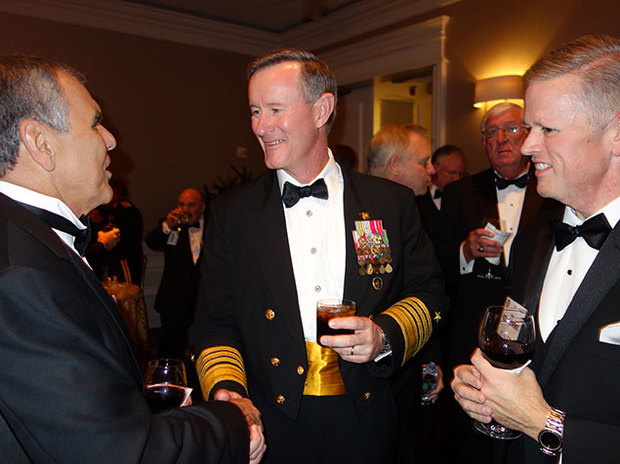
No one in the ballroom came right out and shouted, “William McRaven for elected office!” but the idea hovered like a thought bubble over the OSS Society’s William J. Donovan Award Dinner Saturday night, where the commander of US Special Operations was honored—including by President Obama—and even sounded himself a bit like a candidate.
US special operations commander, Adm. William H. McRaven, greets guests at the annual OSS Society dinner, where he was honored with the William J. Donovan Award. Photograph by Carol Ross Joynt.
The annual celebration commemorating the World War II spy agency and predecessor of the CIA—for the intelligence and special operations communities, it’s the prom and the Oscars wrapped in one—is a time for reminiscing and gossiping for both the smooth-skinned, ramrod-spined young operatives and the retired spies and warriors with more medals than hair or teeth. But McRaven, the Navy admiral who oversaw the 2011 Navy SEAL mission that resulted in the death of Osama bin Laden and who received the Donovan award, gave this year’s gathering a political edge.
President Obama addressed the audience and the honoree via taped video, his image filling three ceiling-high screens. He called McRaven “one of the finest special operators our nation has ever produced. Few Americans will ever see what you do, but every American is safer because of your service.” Also lauding him in taped messages were two other individuals who were directly involved in the bin Laden mission, former CIA director Leon Panetta and Defense Secretary Robert Gates.
A third official who was a player in that historic episode, John Brennan, now director of Central Intelligence, relived the experience in his remarks. He said the deliberations to undertake the mission were “difficult and fraught with uncertainty.” He said there was “a key moment in those deliberations when President Obama seemed to move a step closer to his final decision. It was when Adm. McRaven looked at the President and said, ‘Sir, we can get this job done.’ You could hear a pin drop. It was at that time that everyone in that room knew the decision was made and we were going forward.”
Effects – Death and Horrific Sickness – of First Waves of the Radioactive Tsunami in Japan
World Network For Saving Children From Radiation, Oct. 26, 2013: […] A case like this is just a tip of iceburg […] IKKO is a Buddhist monk. His life is ending. He is only 34 years old and lives in Hiwada town [near Koriyama] in Fukushima. He had a heart attack two days ago, and his doctor announced brain death. He is now connected to life-support. My sister in Fukushima knows him through her student […] She and IKKO got engaged and were planning to get married next year. She has just lost her father from cancer last April. He had worked at Fukushima Nuclear Power Plant […] My sister was present when IKKO had a heartattack and is in disbelief of what is taking place since he was fine before this […] There have been many cases of sickness and death among young generations in Fukushima although it is not reported by media…Mother from Tokyo, Japan during Q & A at Cinema Forum Fukushima, Published July 3, 2013 (at 2:20 in): In Japan, it’s really a total blackout of media, even though there are lots and lots of people who have been developing symptoms…I was outside on the 15th of March in Tokyo, and then about 1 month later, I had fever of like 103ºF for 8 days. And this [baby] boy, he was totally healthy, now he’s OK, but at the time he had 101ºF fever on and off for 13 times in the duration of 3 months. He had rash all over and he was really, really sick […] he became real skinny and he stopped growing for 3 or 4 months. It is really happening. I have 2 nodules in my thyroid, and my boy has countless number of minor nodules.”
“The coordination of the multibillion dollar Fukushima decontamination operation relies on Japan’s organized crime, the Yakusa, which is actively involved in the recruitment of “specialized” personnel for dangerous tasks. “The complexity of Fukushima contracts and the shortage of workers have played into the hands of the yakuza, Japan’s organized crime syndicates, which have run labor rackets for generations.” (Reuters, October 25, 2013) The Yakuza labor practices at Fukushima are based on a corrupt system of subcontracting, which does not favor the hiring of competent specialized personnel. It creates an environment of fraud and incompetence, which in the case of Fukushima could have devastating consequences. The subcontracting with organized crime syndicates is a means for major corporations involved in the clean-up to significantly reduce their labor costs. This role of Japanese organized crime also pertains to the removal of the fuel rods from Reactor no. 4. As documented in several GR articles, this undertaking –if mishandled– by careless workers under the lax supervision of corrupt subcontractors (linked to the Yakusa) creates an environment which could potentially lead to a massive radioactive fallout:
An operation with potentially “apocalyptic” consequences is expected to begin in a little over two weeks from now – “as early as November 8″ – at Fukushima’s damaged and sinking Reactor 4, when plant operator TEPCO will attempt to remove over 1300 spent fuel rods holding the radiation equivalent of 14,000 Hiroshima bombs from a spent fuel storage tank perched on the reactor’s upper floor. While the Reactor 4 building itself did not suffer a meltdown, it did suffer a hydrogen explosion, is now tipping and sinking and has zero ability to withstand another seismic event. A recent Reuters report documents in detail the role of Japan’s Yakuza and its insidious relationship to both TEPCO as well as agencies of the Japanese government including the Ministry of Health, Labor and Welfare. Nearly 50 gangs with 1,050 members operate in Fukushima prefecture dominated by three major syndicates – Yamaguchi-gumi, Sumiyoshi-kai and Inagawa-kai, police say.
Ministries, the companies involved in the decontamination and decommissioning work, and police have set up a task force to eradicate organized crime from the nuclear clean-up project. Police investigators say they cannot crack down on the gang members they track without receiving a complaint. They also rely on major contractors for information. In a rare prosecution involving a yakuza executive, Yoshinori Arai, a boss in a gang affiliated with the Sumiyoshi-kai, was convicted of labor law violations. Arai admitted pocketing around $60,000 over two years by skimming a third of wages paid to workers in the disaster zone. In March a judge gave him an eight-month suspended sentence because Arai said he had resigned from the gang and regretted his actions. Arai was convicted of supplying workers to a site managed by Obayashi, one of Japan’s leading contractors, in Date, a town northwest of the Fukushima plant. Date was in the path of the most concentrated plume of radiation after the disaster. A police official with knowledge of the investigation said Arai’s case was just “the tip of the iceberg” in terms of organized crime involvement in the clean-up.”