General and Ambassador Karl Eikenberry on the Persistent Failure of US Understanding in Afghanistan

02 Diplomacy, 03 Economy, 08 Wild Cards, 09 Justice, 10 Security, 11 Society, Corruption, Director of National Intelligence et al (IC), DoD, Government, Idiocy, Ineptitude, IO Deeds of War, Lessons, Military, Officers Call, Peace Intelligence
Karl W. Eikenberry
Karl W. Eikenberry

使用谷歌翻译在下一列的顶部。

गूगल अगले स्तंभ के शीर्ष पर अनुवाद का प्रयोग करें.

Google sonraki sütunun üstünde Çevir kullanın.

Используйте Google Translate на вершине соседней колонке.

گوگل اگلے کالم میں سب سے اوپر ترجمہ کا استعمال کریں.

Emphasis below added by Milt Bearden, former CIA chief in Pakistan also responsible for the field aspects of the CIA's covert support against Soviet forces in Afghanistan.

Foreign Affairs, September/October 2013

ESSAY

The Limits of Counterinsurgency Doctrine in Afghanistan
The Other Side of the COIN

Karl W. Eikenberry
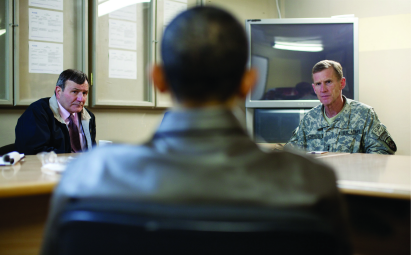
Eikenberry, Obama, and General Stanley McChrystal in Afghanistan, March 2010. (Pete Souza / White House)

KARL W. EIKENBERRY is William J. Perry Fellow in International Security at the Center for International Security and Cooperation at the Freeman Spogli Institute for International Studies at Stanford University. He served as Commanding General of the Combined Forces Command–Afghanistan from 2005 to 2007 and as U.S. Ambassador to Afghanistan from 2009 to 2011.

Since 9/11, two consecutive U.S. administrations have labored mightily to help Afghanistan create a state inhospitable to terrorist organizations with transnational aspirations and capabilities. The goal has been clear enough, but its attainment has proved vexing. Officials have struggled to define the necessary attributes of a stable post-Taliban Afghan state and to agree on the best means for achieving them. This is not surprising. The U.S. intervention required improvisation in a distant, mountainous land with de jure, but not de facto, sovereignty; a traumatized and divided population; and staggering political, economic, and social problems. Achieving even minimal strategic objectives in such a context was never going to be quick, easy, or cheap.

Of the various strategies that the United States has employed in Afghanistan over the past dozen years, the 2009 troop surge was by far the most ambitious and expensive. Counterinsurgency (COIN) doctrine was at the heart of the Afghan surge. Rediscovered by the U.S. military during the wars in Afghanistan and Iraq, counterinsurgency was updated and codified in 2006 in Field Manual 3-24, jointly published by the U.S. Army and the Marines. The revised
doctrine placed high confidence in the infallibility of military leadership at all levels of engagement (from privates to generals) with the indigenous population throughout the conflict zone. Military doctrine provides guidelines that inform how armed forces contribute to campaigns, operations, and battles. Contingent on context, military doctrine is
meant to be suggestive, not prescriptive.

Broadly stated, modern COIN doctrine stresses the need to protect civilian populations, eliminate insurgent leaders and infrastructure, and help establish a legitimate and accountable host-nation government able to deliver essential human services. Field Manual 3-24 also makes clear the extensive length and expense of COIN campaigns:  “Insurgencies are protracted by nature. Thus, COIN operations always demand considerable expenditures of time and resources.

Continue reading “General and Ambassador Karl Eikenberry on the Persistent Failure of US Understanding in Afghanistan”

Marcus Aurelius: Conflicted About Ethics, Secrecy, & the Public Interest

10 Security, 11 Society, Ethics, IO Secrets, Officers Call
Marcus Aurelius
Marcus Aurelius

COMMENTS:

1.  This is one of more internally contradictory pieces I can remember reading;
2.  Mark Bowden certainly knows a thing or three about perpetuating compromise of classified information since he's done bunch of it;
3.  Bowden harkens back to old saying, “.. there are good secrets, there are bad secrets, and there are non-secrets …”, but people at working level don't have luxury of playing that game.  If something is classified, it's classified and there are only two lawful options:  get it declassified through established process or protect it;
4.  Impact of Bradley Manning is broad and deep.  Manning impacts me throughout every working day.  Despite clearances, less information is available to me.  Like every Federal employee, I now  have fewer tools to work with.  Formerly routine procedures are now either totally proscribed or so laden with requirements for pre-approval, two-person control, and so forth that cost vastly exceeds benefit.  I am under automated surveillance as I perform my official duties.  And we have not yet seen impacts of Snowden, which will surely come;
5.  Thus, I strongly DISAGREE with Bowden that Bradley's 35-year sentence was excessive but forced to strongly AGREE that it will likely be reduced.

TheAtlantic.com, August 23, 2013

What Snowden And Manning Don't Understand About Secrecy

Government often finds bad reasons to keep information hidden, but the recent indiscriminate leaks are foolish.

By Mark Bowden

As an old reporter who has from time to time outed classified information, I have watched the cases of Bradley Manning and Edward Snowden with professional interest.

What troubles me about them is not that they broke the oaths they swore when they took their classified government jobs, the thing that makes them liable to prosecution. Government finds all kinds of dubious reasons to keep secrets, sometimes nefarious reasons, and conscience can force one to break a promise. My problem is with the indiscriminate nature of their leaks.

Continue reading “Marcus Aurelius: Conflicted About Ethics, Secrecy, & the Public Interest”

Berto Jongman: Brookings Evaluates the NSA Documents

07 Other Atrocities, 09 Justice, 11 Society, Corruption, Government, Idiocy, Ineptitude, IO Deeds of War, IO Impotency, Media
Berto Jongman
Berto Jongman

The NSA Documents, An Introduction

Benjamin Wittes

Brookings, 22 August 2013

Rather than starting with what I—or anyone else—think and believe about the remarkable cache of documents the intelligence community declassified yesterday, I thought we should begin with a detailed account of what these documents actually are and the story they tell, individually and collectively.

The press stories that follow a document release like this often do not bother to do this. They look, instead, for a key—or the key—fact, around which the news story then develops. In this case, unsurprisingly, the key fact is that the NSA gathered tens of thousands of email communication by Americans before the FISA Court declared its actions unconstitutional. As the Washington Post puts it in its lead:

For several years, the National Security Agency unlawfully gathered tens of thousands of e-mails and other electronic communications between Americans as part of a now-revised collection method, according to a 2011 secret court opinion.

Read full article.

John Perry Barlow: Electronic Frontier Foundation Calls for New [Congressional] Church Committee to Probe NSA Violations of Constitution, Law, and Regulation

07 Other Atrocities, 09 Justice, 11 Society, Corruption, Director of National Intelligence et al (IC), Government, Idiocy, IO Deeds of War, Law Enforcement, Military
John Perry Barlow
John Perry Barlow

Three Illusory “Investigations” of the NSA Spying Are Unable to Succeed

By Mark M. Jaycox

Since the revelations of confirmed National Security Agency spying in June, three different “investigations” have been announced. One by the Privacy and Civil Liberties Oversight Board (PCLOB), another by the Director of National Intelligence, Gen. James Clapper, and the third by the Senate Intelligence Committee, formally called the Senate Select Committee on Intelligence (SSCI).

All three investigations are insufficient, because they are unable to find out the full details needed to stop the government's abuse of Section 215 of the PATRIOT Act and Section 702 of the Foreign Intelligence Surveillance Act. The PCLOB can only request—not require—documents from the NSA and must rely on its goodwill, while the investigation led by Gen. Clapper is led by a man who not only lied to Congress, but also oversees the spying. And the Senate Intelligence Committee—which was originally designed to effectively oversee the intelligence community—has failed time and time again. What's needed is a new, independent, Congressional committee to fully delve into the spying.

The PCLOB: Powerless to Obtain Documents

The PCLOB was created after a recommendation from the 9/11 Commission to ensure civil liberties and privacy were included in the government's surveillance and spying policies and practices.

But it languished. From 2008 until May of this year, the board was without a Chair and unable to hire staff or perform any work. It was only after the June revelations that the President asked the board to begin an investigation into the unconstituional NSA spying. Yet even with the full board constituted, it is unable to fulfill its mission as it has no choice but to base its analysis on a steady diet of carefully crafted statements from the intelligence community.

As we explained, the board must rely on the goodwill of the NSA's director, Gen. Keith Alexander, and Gen. Clapper—two men who have repeatedly said the NSA doesn't collect information on Americans.

Continue reading “John Perry Barlow: Electronic Frontier Foundation Calls for New [Congressional] Church Committee to Probe NSA Violations of Constitution, Law, and Regulation”

Greg Palast: Larry Summers the Sum of All Evil — the “End-Game” Memo Proposing the Destruction of Financial Regulation Across the Globe

03 Economy, 07 Other Atrocities, 10 Transnational Crime, 11 Society, Commerce, Corruption, Government, Law Enforcement, Media
Greg Palast
Greg Palast

Larry Summers and the Secret “End-Game” Memo

By Greg Palast for Vice Magazine

When a little birdie dropped the End Game memo through my window, its content was so explosive, so sick and plain evil, I just couldn't believe it.

The Memo confirmed every conspiracy freak's fantasy:  that in the late 1990s, the top US Treasury officials secretly conspired with a small cabal of banker big-shots to rip apart financial regulation across the planet.  When you see 26.3% unemployment in Spain, desperation and hunger in Greece, riots in Indonesia and Detroit in bankruptcy, go back to this End Game memo, the genesis of the blood and tears.

The Treasury official playing the bankers' secret End Game was Larry Summers.  Today, Summers is Barack Obama's leading choice for Chairman of the US Federal Reserve, the world's central bank.  If the confidential memo is authentic, then Summers shouldn't be serving on the Fed, he should be serving hard time in some dungeon reserved for the criminally insane of the finance world.

Click on Image to Enlarge

The memo is authentic.

To get that confirmation, I would have to fly to Geneva  and wangle a meeting with the Secretary General of the World Trade Organization, Pascal Lamy.  I did.  Lamy, the Generalissimo of Globalization, told me,

“The WTO was not created as some dark cabal of multinationals secretly cooking plots against the people…. We don't have cigar-smoking, rich, crazy bankers negotiating.”

Then I showed him the memo.

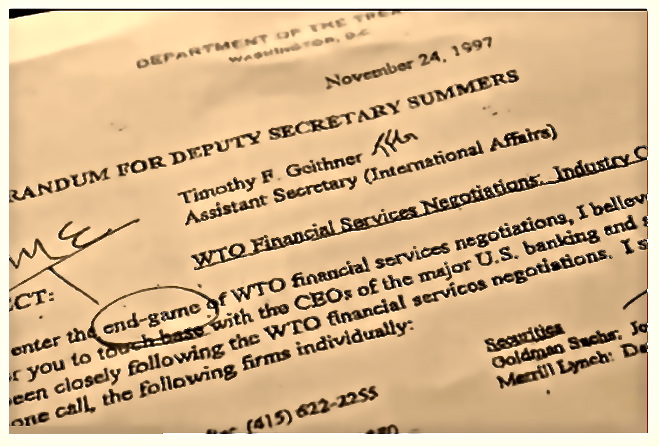
It begins with Summers’ flunky, Timothy Geithner, reminding his boss to call the then most powerful CEOs on the planet and get them to order their lobbyist armies to march:

“As we enter the end-game of the WTO financial services negotiations, I believe it would be a good idea for you to touch base with the CEOs….”

To avoid Summers having to call his office to get the phone numbers (which, under US law, would have to appear on public logs), Geithner listed their private lines.  And here they are:

Continue reading “Greg Palast: Larry Summers the Sum of All Evil — the “End-Game” Memo Proposing the Destruction of Financial Regulation Across the Globe”

Berto Jongman: Detained in the U.S.: Filmmaker Laura Poitras Held, Questioned Some 40 Times at U.S. Airports

07 Other Atrocities, 09 Justice, 11 Society, Corruption, DHS, Government, Idiocy, Ineptitude, IO Deeds of War
Berto Jongman
Berto Jongman

Detained in the U.S.: Filmmaker Laura Poitras Held, Questioned Some 40 Times at U.S. Airports

The Academy Award-nominated filmmaker Laura Poitras discusses how she has been repeatedly detained and questioned by federal agents whenever she enters the United States. Poitras said the interrogations began after she began working on her documentary, “My Country, My Country,” about post-invasion Iraq. Her most recent film, “The Oath,” was about Yemen and Guantánamo and follows the lives of two past associates of Osama bin Laden. She estimates she has been detained approximately 40 times and has had her laptop, cellphone and personal belongings repeatedly searched. Tonight she is leading a surveillance teach-in at the Whitney Museum in New York City with our other guests, computer security researcher and government target Jacob Appelbaum and National Security Agency whistleblower William Binney. Poiras is currently at work on a film about post-9/11 America. This interview is part of a 5-part special on growing state surveillance.. Click here to see segment 1, 3, 4 and 5. [includes rush transcript]

Transcript [Also Available as Video]

This is a rush transcript. Copy may not be in its final form.

AMY GOODMAN: Our guests are William Binney, who was technical director of the NSA’s World Geopolitical and Military Analysis Reporting Group. He worked with the NSA for almost 40 years, National Security Agency. We’re also joined by Laura Poitras, the Oscar-nominated filmmaker, and Jacob Appelbaum, a computer security researcher.

You two have something in common with each other. You—every time you come into the United States by plane, you are stopped, you are searched, you are interrogated. Laura Poitras, tell us about your experience. Your latest one?

Continue reading “Berto Jongman: Detained in the U.S.: Filmmaker Laura Poitras Held, Questioned Some 40 Times at U.S. Airports”

SchwartzReport: War and Hate

01 Poverty, 02 Infectious Disease, 03 Environmental Degradation, 04 Inter-State Conflict, 05 Civil War, 06 Genocide, 07 Other Atrocities, 08 Proliferation, 09 Justice, 09 Terrorism, 10 Security, 10 Transnational Crime, 11 Society, Cultural Intelligence, Government, IO Deeds of War, Military, Officers Call

Endless war is the basis for the abrogation of our civil liberties, the suspension our legal guarantees, and the assault on journalism. It is the cancer that is destroying our democracy, and our passivity is what makes it possible.

Legal War?
WILLIAM BOARDMAN – Nation of Change

We are in the endless war because of the stupidity of American foreign policy beginning with the Reagan Administration, which was notably inept. And, thanks to Dick Cheney and the Neocons, we have transformed what was once a deep affection for Americans in the Arab world, which I experienced in the two years I lived in Egypt in the 70s, into! a deep and abiding hatred which will endure for generations.

They Hate Us, They Really Hate Us
MARC LYNCH, Associate Professor of Political science and International Affairs at George Washington University – Foreign Policy

noble gold