I gave a little talk at a financial conference (Casey Research) that included the following very simple economic scenario:
Oil prices are going up (inexorably). China + Peak Oil + Financial diversification. Oil doesn't stop going up until GDP goes down. It's an inexorable force until then.
The US middle class is broken. A hollow husk unable to withstand the slightest gust. Regardless, it's the ultimate source of demand for the global economy. It's an immovable barrier.
When oil hits ~$150 a barrel the impact occurs between inexorable force and immovable barrier. The combo of higher prices at the pump and for everything else (food and other essentials) starts to crush middle class budgets and force defaults. The economy shrinks until the price of oil goes down enough to be affordable again (for those still left in the middle class).
We keep repeat the pattern above until we're in the second depression (D2). Long term low demand.
Phi Beta Iota: This is precisely why the BRICS (now including South Africa) and a new coalition, perhaps led by Cuba and Venezuela since Chile is refusing to lead, should focus on the immediate challenge of creating infinite free renewable energy–the foundation for global non-zero advances. Such a strategy would be inherently ethical, legal, citizen-centered, and non-violent as well as non-intrusive on any conceivable concept of sovereignty or indigenous privilege.
From BSA listserve: Excellent article on integration of 3G, LTE, Wifi and land lines i.e.- 5G networking. The only thing missing is this article is the 5th “G” – green networking. With so much overlapping coverage from the different wireless and wired nodes you don’t need five nines reliability for each node. Individual nodes can therefore be powered with small solar panels and micro wind mills. This is also great opportunity for R&E networks to partner with carriers like Vodafone and others who are building integrated Wifi/LTE networks and use Eduroam to extend reach of their networks for personal health research applications, sensor networks built around smart phone etc. For more details please see http://goo.gl/W9mla and http://goo.gl/a1Lpz – BSA]
21st Century Triple Networks: Ubiquitous 4G, WiFi, & Wires
The best engineers on the planet are coming to the same conclusion: a hybrid 4G/WiFi/landline network is the way to meet mobile demand. Folks like John Donovan of AT&T and Masayoshi Son of Softbank in Japan
had this vision around 2007-2008. As the iPhone/iPad/Android made the coming demand clear, networks planners around the world evolved similar strategies.
• 4G gives wide coverage but is limited in capacity.
• WiFi actually provides far more capacity, because the range of perhaps 100 meters means the spectrum can be reused thousands of times in a major city. (China Mobile is putting 20,000 WiFi hotspots across
Beijing.) A network builder tells me “WiFi is a solution to off load ‘portable' traffic where possible and rely on 3G/4G for ‘mobile' traffic.” Femtos and perhaps small cells will play a significant part.
• Landlines effectively have 10x the capacity of a similar wireless network and are already ubiquitous from both telco and cable. A top engineer tells me “The general rule is the quicker you can get the byte of information onto a hard facility (copper, fiber) the cheaper it is to operate the network.” Randall Stephenson of AT&T explains “You're always going to have to have a fixed line capability to offload this traffic.”
[…]
So cell tower 3G/4G ideally is supplemented with local WiFi/femto. Cell towers cover large areas, allowing comprehensive coverage except for a few dead spots. They offer limited bandwidth over that entire
area, with a network like Verizon's LTE offering perhaps 35 megabits to share. WiFi is much lower power, limiting range to a typical 100 meters or so, less with obstructions. Within that range, the capacity is high; 3×3 MIMO 802.11N can carry 100's of megabits in a small area. Locally, 802.11 uses spectrum more efficiently, incorporated a limited set of “spread-spectrum” type features.
WiFi was in few phones two years ago because it ran down batteries too quickly and cost too much. Moore's Law now enables low power, low cost WiFi. The latest chips from RALINK/Trendchip, for example, cost
less than $5. Off mode power consumption is 0.012 mw, transmit power is 19dBm, and the chips are 5 to 7 mm square. Easily 3/4ths of the phones sold by a carrier like Verizon will soon have WiFi as do just
about all tablets. As Qualcomm, Broadcom and others include WiFi on their primary cellphones chips it will become ubiquitous.
[…]
Carriers are choosing different strategies to get from where they are today to triple networks. Vodafone, Europe's largest wireless company, is adding millions of DSL customers through unbundling and giving them
femto+WiFi gateways. Sky in Britain is buying a WiFi network named “The Cloud.” Free.fr enables WiFi on their millions of DSL connections and bought a wireless license. AT&T is putting WiFi hotspots from Times Square NY to San Francisco with expansion plans. China Mobile is adding 1,000,000 hotspots.
——
Tip of the Hat to original poster Bill St. Arnaud.
Phi Beta Iota:Gordon Cook thinks very highly of Bill St. Arnaud, and observes that Mr. Arnaud is a consultant for Surfnet in the Netherlands working out their wireless cloud for the research and education community in that country of some 1,000,000 out of 16,000,000 people. He is describing some of what he is building that is based on the Netherlands national fiber backplane.
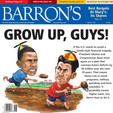
Last Saturday's issue of Barron's ran a cover story on the deficit and their own take on how to address it. In contrast to the recent recommendations from President Obama and the House Republicans, defense was actually “on the table,” not “at” it. In the absence of any adult thinking on the deficit since the Deficit Commission in December, Barron's addresses a void that remains vast and empty in Congress and the Executive branch. The article puts on the table a defense recommendation — which I urged to them — that goes significantly deeper than even the Deficit Commission's — in truth fuzzy — recommendation on “security” spending.
Almost immediately, Forbes published at its website a related piece on defense spending and The Pentagon Labyrinth that contains some interesting private sector views on how the public might be beginning to perceive the current size of the defense budget and condition of our armed forces: note the references to “defense entitlement,” “defense bubble,” and “parade ground military.” It would seem that the paradigm is changing, at least outside Washington DC. (If you think that the recent killing of bin Laden proves the “parade ground” moniker wrong, I urge you to read the introduction essay in The Pentagon Labyrinth: “Why Is This Handbook Necessay?“.
Grow Up, Guys!
By GENE EPSTEIN
Barron's Cover SATURDAY, APRIL 30, 2011
While the President and GOP sling mud at each other, the debt crisis is growing. Barron's offers some tough-but necessary-ways to alleviate it.
Phi Beta Iota: It is possible to eliminate the deficit by making Medicare prices honest and stopping the borrowing of money for corporate pork that feeds political pork. It is possible to eliminate personal income taxes by adopting the Automated Payment Transaction (APT) Tax, which actually produces a great deal more revenue which is desperately needed to bail out the equally irresponsible state governments and pension funds (both government and corporate). America is hosed. It is not possible to “reset” until Washington can combine intelligence and integrity, and that may require a public revolt on both taxes and the fraudulent corrupt Electoral System that keeps the two-party tyranny in a position to continue looting the Commonwealth.
Cooperation to Control Non-State Nuclear Proliferation: Extra-Territorial Jurisdiction and UN Resolutions 1540 and 1373
This workshop will explore theoretical options and practical pathways to extend states' control over non-state actor nuclear proliferation through the use of extra-territorial jurisdiction and international legal cooperation.
UNSC Resolution 1373 and the raft of counter-terrorism treaties related to non-state based nuclear terrorism allow for states to exercise extra-territorial criminal jurisdiction in certain ways. UNSC Resolution 1373 even requires the exercise of such jurisdiction in certain cases. UNSC Resolution 1540, in contrast, focuses on domestic controls.
Phi Beta Iota: Extra-judicial anything is a crime against humanity. While the International Tribunals have done some extraordinary work, the reality is that most non-state proliferation is actively aided and condoned by specific states including the permanent members of the UN Security Council. This is a very troubling line of inquiry.
On Thursday, Gallup reported that “More than half of Americans say the U.S. economy is in a recession or a depression despite official data that show a moderate recovery…..The April 20-23 Gallup survey… found that only 27 percent said the economy is growing. 29 per cent said the economy is in a depression and 26 per cent said it is in a recession, with another 16 per cent saying it is “slowing down,” Gallup said.”
55 percent of Americans believe we are in a depression or a recession a full 5 years after the housing bubble burst (2006) and 3 years after Lehman Brothers collapsed. (2008) Gallup's findings jibe with other surveys that indicate growing desperation among the public. For example, Globescan found that a large number of Americans have given up on free-market capitalism altogether, while other polls show dwindling confidence in government institutions, the Federal Reserve, the Congress, the judicial system and the media.
. . . . . . .
Do you have any idea how bad unemployment really is? Take a look at this from Calculated Risk:
“There are currently 130,738 million payroll jobs in the U.S. (as of March 2011). There were 130,781 million payroll jobs in January 2000. So that is over eleven years with no increase in total payroll jobs.
“And the median household income in constant dollars was $49,777 in 2009. That is barely above the $49,309 in 1997, and below the $51,100 in 1998……
EBD, or ‘emergent by design,’ was the phrase I chose when naming this blog to describe what I was seeing around me in the most inspiring and passionate people and organizations making positive change in themselves and the world around them. To me, that means not being a passive bystander to life and letting it happen to you, but really grabbing life by the short and curlies and manifesting greatness in this epic adventure!
I’ve been on Twitter now for about 2 years, and love finding people doing amazing things. It gives me hope & energizes my spirit. I shared my technique for Twitter a while back – with “How to Use Twitter to Build Intelligence.” Let this be the 2011 curated update.
Here are some people I’d recommend following for their passion, creativity, wisdom, empathy, intelligence, and love. Some I’ve met in real life, many I simply admire from a far. I would be so curious to see what would happen if we got all them together in the same room. (how bout at Contact?) 😉
Who’s on your list of awesome? Let us know in the comments below. And here we are, in no particular order: