Uniting the Left–With the Wrong Question As Usual

11 Society, Cultural Intelligence, IO Sense-Making
John Steiner

Politics

The big question: What story about America’s future can unite the U.S. left?

David Roberts, 9 May 2011

grist: a beacon in the smog

U.S. politics is at an interesting inflection point.

On one side, the American right grows ever more homogeneous: ethnically, socioculturally, and ideologically. On the other, the American left is an unwieldy coalition of minorities, unions, single working mothers, Blue Dogs, feminists, young people, knowledge workers, culture and entertainment elites, scientists, GLBT folks, environmentalists, social justice groups, Jews, Muslims, atheists, moderates, socialists … even Joe Lieberman for a while.

Precisely because it is homogeneous, the right is intense. There is no political force more potent than a privileged class in the process of losing its privilege. The right base sees itself as an Us beset on all sides by Thems; cries Michele Bachmann, “are we going to take our country back?” The status quo does not go gentle into that good night. The right speaks with a common voice, around a core set of narratives: small government, big military, low taxes, family values. Most importantly, they organize, vote, and donate.

The left, by contrast, is a contentious coalition of Thems, speaking with a cacophony of voices, often at cross purposes, perpetually less than the sum of its parts. Make no mistake: if that coalition can hold together, it will win in the end. It's demographic destiny: The U.S. is becoming more diverse, less religious, more socially liberal, less nuclear-family, and more urban. And it's happening faster than predicted. We're on our way to an America with more Thems than Us's.

Read complete article and call for inputs….

Phi Beta Iota: The author misses the incoherence of the right on substance.  And this is, for the left, the wrong question, as usual.  The correct question is:   America the Beautiful is the original vision, the vision lost.  What narrative can bring us all back together and restore the Republic, Of, By, and For all of the people all of the time?


Ideological Underpinnings of the “Great Society”

03 Economy, 07 Other Atrocities, 11 Society, Corruption, Cultural Intelligence, Government
Robert Higgs

Ideological Underpinnings of the “Great Society”

By Robert Higgs

Campaign for Liberty, 05/10/11

[The Freeman (March 2011). An MP3 audio file of this article, narrated by Steven Ng, is available for download.]

The surge of federal economic interventions that occurred during Lyndon B. Johnson's presidency — the much-ballyhooed Great Society, whose centerpiece was the War on Poverty — differed from the four preceding surges, each of which had been sparked by war or economic depression. No national emergency prevailed when Johnson took office following John F. Kennedy's assassination on November 22, 1963. The nation was not engaged in a major shooting war, and the economy was on the mend after the mild recession of 1960-61. For the most part, the Great Society represented simply the culmination of economic, political, and intellectual developments stretching back as far as the 19th century.

Read full article….

Continue reading “Ideological Underpinnings of the “Great Society””

NATO Says AF Insurgency Weakened–Really?

04 Inter-State Conflict, 05 Civil War, 07 Other Atrocities, 08 Wild Cards, 10 Security, 11 Society, Corruption, Cultural Intelligence, Government, IO Impotency, Military, Peace Intelligence
DefDog Recommends....

It is amazing that nowhere in this article does it mention the media coup that the Taliban scored.  I also am not sure that the information released by NATO is accurate.  If so, it contradicts previously reported Taliban strength levels.  Nor does NATO address the recent high profile security breaches…..

NATO says insurgency weakened

By PATRICK QUINN

The Associated Press

KABUL, Afghanistan — NATO said Monday that it has significantly weakened the Taliban insurgency, capturing or killing thousands of militants in Afghanistan during the past three months.

Read full article….

Patrick Meier: Ushahadi Election Monitoring

11 Society, Advanced Cyber/IO, Civil Society, Collective Intelligence, Corruption, Counter-Oppression/Counter-Dictatorship Practices, Cultural Intelligence, Ethics, Geospatial, Government, info-graphics/data-visualization, InfoOps (IO), IO Mapping, IO Sense-Making, Journalism/Free-Press/Censorship, Methods & Process, Open Government, Reform, Standards, Tools
Patrick Meier

Analyzing U-Shahid’s Election Monitoring Reports from Egypt

Posted on May 8, 2011 by Patrick Meier| Leave a comment

I’m excited to be nearing the completion of my dissertation research. As regular iRevolution readers will know, the second part of my dissertation is a qualitative and comparative analysis of the use of the Ushahidi platform in both Egypt and the Sudan. As part of this research, I am carrying out some content analysis of the reports mapped on U-Shahid and the SudanVoteMonitor. The purpose of this blog post is to share my preliminary analysis of the 2,700 election monitoring reports published on U-Shahid during Egypt’s Parliamentary Elections in November & December 2010.

Read full posting with links & graphic…

Cynthia McKinney is NOT Happy with NATO

02 Diplomacy, 05 Civil War, 07 Other Atrocities, 08 Immigration, 08 Wild Cards, 09 Justice, 10 Security, 11 Society, Civil Society, Corruption, Cultural Intelligence, Government, IO Sense-Making, Military, Peace Intelligence
Click on Image to Enlarge

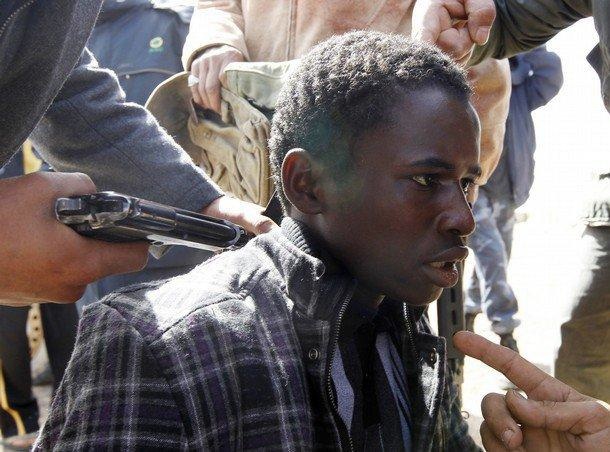
Sent to me by a Libyan who hates what his country is becoming due to the racists now supported by NATO and who are in control of part of his  country.

Cynthia McKinney

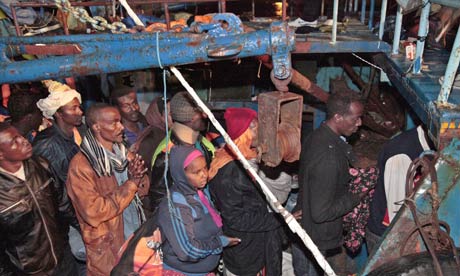
Nato units left 61 African migrants to die of hunger and thirst

Jack Shenker, Guardian, 8 May 2011

Boat trying to reach Lampedusa was left to drift in Mediterranean for 16 days, despite alarm being raised

Dozens of African migrants were left to die in the Mediterranean after a number of European and Nato military units apparently ignored their cries for help, the Guardian has learned.

Click on Image to Enlarge

A boat carrying 72 passengers, including several women, young children and political refugees, ran into trouble in late March after leaving Tripoli for the Italian island of Lampedusa. Despite alarms being raised with the Italian coastguard and the boat making contact with a military helicopter and a Nato warship, no rescue effort was attempted.

All but 11 of those on board died from thirst and hunger after their vessel was left to drift in open waters for 16 days. “Every morning we would wake up and find more bodies, which we would leave for 24 hours and then throw overboard,” said Abu Kurke, one of only nine survivors. “By the final days, we didn't know ourselves … everyone was either praying, or dying.”

Read full article….

Continue reading “Cynthia McKinney is NOT Happy with NATO”

MondoNet: Global Democratized Network II

11 Society, Autonomous Internet, Civil Society, Collective Intelligence, Counter-Oppression/Counter-Dictatorship Practices, Earth Intelligence
Gordon Cook Recommends...

Introducing MondoNet: The censor-proof, unsurveillable network

Aram Sinnreich

A few weeks ago, I gave a talk at TEDxUSC, in which I laid out the basic argument for MondoNet, a new project I'm working on with a few of my grad students at Rutgers. My basic point is that, despite the many amazing cultural, economic and political uses to which it's been put, the Internet has a fundamental flaw preventing it from being an effective tool for democratic political action and cultural innovation.

The flaw lies in its centralized architecture and hierarchical governance; no matter how much people resist against institutional power through innovative cultural forms, and no matter how much we lobby against oppressive and exploitative uses of the technology (e.g. the current battles over net neutrality), the network provides its operators with an excess of power that will necessary be exploited.

We propose to remedy this situation with an architectural intervention: namely, using ad-hoc, mesh networking technology to create a global network that is fundamentally resistant to censorship, surveillance and exploitation, because no single individual or institution can control the information flow on any significant scale.

Clearly, there is a lot to discuss here; we plan to publish a full-length academic article in The Information Society in July, and a pre-publication copy can be read at MondoNet.org. But we're still working on developing funding and fleshing out the engineering, so I welcome your feedback, criticisms and offers of help!

TED Video

See Also:

MondoNet: Global Democratized Network

Autonomous Internet (99 as of 8 May 2011)

The Age of De-Leveraging is Just Beginning

01 Poverty, 03 Economy, 07 Other Atrocities, 11 Society, Civil Society, Collective Intelligence, Commerce, Commercial Intelligence, Corruption, Cultural Intelligence, Government, IO Sense-Making
Chuck Spinney Recommends...

Phi Beta Iota: 10 more years of pain.

– – – – – – –

While the political elite obsesses over the rise in public debt, the US is on the cusp of an era of deleveraging — or more bluntly, a massive liquidation of private debt — the ramifications of which, in the best of times would be colossal, but could well be disastrous the irrational obsessions of our political elites work their magic.

The real policy question that will determine the future well-being of the vast majority of Americans is how liquidation of their private debts unfold — rapidly via rising waves of bankruptcies, foreclosures, and repudiations, as happened in the 1930s, or more gradually, which will require some kind of active intervention by government, and for which there is no real precedent, and clearly no acumen among the elites in Versailles on the Potomac.

Either evolutionary pathway will be painful, because the liquidation of private debt will require cutbacks that reduce aggregate demand and investment, thereby slowing growth and pushing the economy into a period of sluggish growth over the long term or into a depression (some economist argue we are already in a depression).

Continue reading “The Age of De-Leveraging is Just Beginning”

noble gold