Welfare states around the world will be forced by hard budgetary constraints to reconsider their current model of provision. The state needs to redefine its relationship with individuals and, crucially, with communities. It must find a way of re-endowing communities with independence and self-sufficiency, of giving them the wherewithal to transform themselves and their neighborhoods. The starting point is rethinking how it can leverage and direct not only its revenue budgets but – as this paper will discuss in detail – also its capital assets in a way that broadens and deepens social action and civic participation.
The opportunity for this new relationship in the UK has arrived sooner than expected or hoped. Given the extent of budgetary cuts, a large proportion of the public estate is no longer sustainable in its current form. We now face an unprecedented mass divestment of state assets, which among other things is likely to include: • Libraries. • Swimming pools. • Community centres. • Public spaces. • Council offices. • Courts. • Police stations. • Prison buildings. • The road network. • British Waterways. • RDA, MoD and Whitehall assets. • Ports.
In the years to come, a huge amount of this wealth will suddenly cease to be public and there is a real risk that such assets will not only be privatised (as during the 1980s) but privatised in such a way as to reinforce existing inequalities of wealth. There is a danger that the net result will be a rent seekers’ paradise, where vested interests triumph over communal need and wealth flows backwards to the already established and upwards to the already wealthy.
We believe that the opposite is possible. Public assets can – and, wherever desirable, should – become community assets, owned mutually or by individual shareholders or stakeholders in association with communities. These public goods can, if properly directed and organised, capitalise both civil society and the bottom 10 per cent of society which currently has negative net wealth.
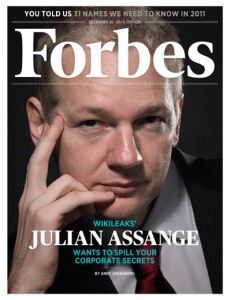
Fascinating article, including leaks in the pipeline (banks), whistleblowers, censorship, his story, trying to stop leaks, spying, untrustful competitors, secrecy, war, field of intelligence, etc. … “our primary defense isn’t law, but technology…courage is contagious” (p.8) — JAS
Following is an excerpt from page 5 regarding moving in the direction of ethical business — JAS
Forbes Cover Story
What do you think WikiLeaks mean for business? How do businesses need to adjust to a world where WikiLeaks exists?
WikiLeaks means it’s easier to run a good business and harder to run a bad business, and all CEOs should be encouraged by this. I think about the case in China where milk powder companies started cutting the protein in milk powder with plastics. That happened at a number of separate manufacturers.
Let’s say you want to run a good company. It’s nice to have an ethical workplace. Your employees are much less likely to screw you over if they’re not screwing other people over.
Then one company starts cutting their milk powder with melamine, and becomes more profitable. You can follow suit, or slowly go bankrupt and the one that’s cutting its milk powder will take you over. That’s the worst of all possible outcomes.
The other possibility is that the first one to cut its milk powder is exposed. Then you don’t have to cut your milk powder. There’s a threat of regulation that produces self-regulation.
It just means that it’s easier for honest CEOs to run an honest business, if the dishonest businesses are more effected negatively by leaks than honest businesses. That’s the whole idea. In the struggle between open and honest companies and dishonest and closed companies, we’re creating a tremendous reputational tax on the unethical companies.
No one wants to have their own things leaked. It pains us when we have internal leaks. But across any given industry, it is both good for the whole industry to have those leaks and it’s especially good for the good players.
But aside from the market as a whole, how should companies change their behavior understanding that leaks will increase?
Do things to encourage leaks from dishonest competitors. Be as open and honest as possible. Treat your employees well.
I think it’s extremely positive. You end up with a situation where honest companies producing quality products are more competitive than dishonest companies producing bad products. And companies that treat their employees well do better than those that treat them badly.
Would you call yourself a free market proponent?
Absolutely. I have mixed attitudes towards capitalism, but I love markets. Having lived and worked in many countries, I can see the tremendous vibrancy in, say, the Malaysian telecom sector compared to U.S. sector. In the U.S. everything is vertically integrated and sewn up, so you don’t have a free market. In Malaysia, you have a broad spectrum of players, and you can see the benefits for all as a result.
How do your leaks fit into that?
To put it simply, in order for there to be a market, there has to be information. A perfect market requires perfect information.
There’s the famous lemon example in the used car market. It’s hard for buyers to tell lemons from good cars, and sellers can’t get a good price, even when they have a good car.
By making it easier to see where the problems are inside of companies, we identify the lemons. That means there’s a better market for good companies. For a market to be free, people have to know who they’re dealing with.
You’ve developed a reputation as anti-establishment and anti-institution.
Not at all. Creating a well-run establishment is a difficult thing to do, and I’ve been in countries where institutions are in a state of collapse, so I understand the difficulty of running a company. Institutions don’t come from nowhere.
It’s not correct to put me in any one philosophical or economic camp, because I’ve learned from many. But one is American libertarianism, market libertarianism. So as far as markets are concerned I’m a libertarian, but I have enough expertise in politics and history to understand that a free market ends up as monopoly unless you force them to be free.
WikiLeaks is designed to make capitalism more free and ethical.
But in the meantime, there could be a lot of pain from these scandals, obviously.
Pain for the guilty.
Do you derive pleasure from these scandals that you expose and the companies you shame?
It’s tremendously satisfying work to see reforms being engaged in and stimulating those reforms. To see opportunists and abusers brought to account.
By John Robb at Global Guerrillas (Networked tribes, systems disruption, and the emerging bazaar of violence. Resilient Communities, decentralized platforms, and self-organizing futures)
Wikileaks and Al Qaeda's Open Source Jihad are both open source insurgencies. While there are obvious differences between the two, what's more interesting is how they are similar. Namely: as open source insurgencies both groups use systems disruption (the ability…
Phi Beta Iota: The deeper interpretation of the similarity of Al Qaeda and WikiLeaks is that they are both finding huge audiences for what they are offering, and they are both playing off of a massive public distaste for Open Veins of Latin America, Killing Hope, Rule by Secrecy, Sorrows of Empire, Web of Deceit, The Fifty Year Wound, etc. The USA has created its enemies because of its hubris and the corruption inherent in how it has supported dictators and predatory immoral capitalism, imposing virtual colonialism and unilateral militarism, all without regard to either the rights of the indigenous parties treated as “collateral damage” or the interests of the American citizen-voter-taxpayer whose blood, treasure, and spirit have been consumed by an elite class that comprises an “Other Atrocity” on a global scale. It troubles us that there is no one in the Administration with the intellectual breadth of mind and the intestinal fortitude to point out to President Barack Obama that he has a game-changing choice in front of him. We (the 800 contributors, 80 active, 8 frequent) of Phi Beta Iota have always been open, honest, and loyal–these insurgencies are occurring because the US Government failed to heed the early warnings that began in the 1970's and reached a crecsendo in the 1990's. There is still time for Barack Obama to Change the Game!
MajGen Eduardo ALDUNATE Herman, Chilean Army (Ret), served as the Deputy Force Commander of the United Nations Force in Haiti (MINUSTAH) in the earliest rounds, and was instrumental in both sponsoring the Joint Military Intelligence Analysis Center (JMAC) concept in its first modern field implementation, but also in evaluating most critically both the lack of useful intelligence from allies relying on secret sources and methods that did not “penetrate” to achieve gangs and neighborhoods; and the astonishing “one size fits all” propensity of the allies to treat every “threat” as one that could be addressed by force.
His contributions are helpful in understanding the more recent failure of allied relief operations in Haiti that again assumed that the use of armed bodies would address the problem, without making provision for real-world ground truth intelligence (CAB 21 Peace Jumpers Plus) or intelligence-driven harmonization of non-governmental assistance (Reverse TIPFID).
British-based men of Afghan origin are spending months at a time in Afghanistan fighting Nato forces before returning to the UK, the Guardian has learned. They also send money to the Taliban.
A Taliban fighter in Dhani-Ghorri in northern Afghanistan last month told the Guardian he lived most of the time in east London, but came to Afghanistan for three months of the year for combat.
“I work as a minicab driver,” said the man, who has the rank of a mid-level Taliban commander. “I make good money there [in the UK], you know. But these people are my friends and my family and it's my duty to come to fight the jihad with them.”
“There are many people like me in London,” he added. “We collect money for the jihad all year and come and fight if we can.”
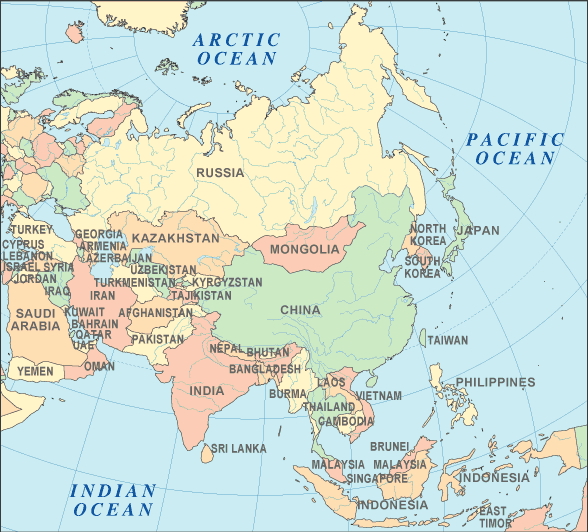
China-Burma: Construction of a high-speed rail link between China's southwestern province of Yunnan and Myanmar will begin in two months. The line will link Kunming, Yunnan's capital to Yangon (Rangoon), on the Indian Ocean, according to Wang Mengshu, an academic from the Chinese Academy of Engineering.
Wang said a China-to-Cambodia high-speed rail connection is under discussion as well as a link between Yunnan and Vientiane, the capital of Laos. He said that all three rail connections are likely to be completed with 10 years. Wang said the project aims to boost cooperation between China and its Southeast Asian neighbors and foster the economic development of China's western regions.
China-Bangladesh: China is interested in increasing cooperation with Bangladesh in different sectors including agriculture technology, trade, commerce and communication, according to a report about the 21 November meeting between Lu Hao, leader of a visiting Chinese delegation and a member of the Communist Party of China and Bangladesh President Zillur Rahman, The Daily Star reported. Rahman called for more Chinese cooperation on socioeconomic development, adding that China is a great friend to Bangladesh. Lu said he hopes the new cooperation will strengthen bilateral relations.
NIGHTWATCH Comment: China is creating a sphere of influence that stretches from North Korea to Pakistan, and surrounds India. This is a threat to US interests as well as to the political independence of the states accepting Chinese aid. A rail line to the Burmese port of Rangoon would give China access to two Indian Ocean ports with direct rail links to China. The other will be Gwadar in western Pakistan which was built with Chinese investments and aid.
Rail links from China through the Karakoram Range to Pakistan Rail and then a spur to Gwadar are undergoing feasibility studies. The link to Rangoon is much more advanced.
Phi Beta Iota: We must disagree with our learned colleague whose analytic skills we greatly admire. China's building of infrastructure to the seas is not a threat to American the Beautiful as envisioned by our Founding Fathers–it is only a threat to a predatory imperialist out of control government stupid enough to spend $750 million dollars EACH on three fortresses in Baghdad, Kabul, and Islamabad, at the same time that US infrastructure and US economic competitiveness has been DESTROYED by a two-party tyranny that has sold the American public out–in a word, treason against the public interest. ENOUGH. It is time to shut down the Empire before the Empire shuts down America the Beautiful. Tomorrow we will post a review of Buckminster Fuller's Ideas and Integrities written in 1928. He nailed it. The US Government at the political level is NOT in “friendly” hands….certainly not friendly to the 90% that actually pay their taxes unmindful of how those taxes are funding fraud, waste, and abuse on a global scale. America desperately needs an honest President willing to sponsor Electoral Reform in February in time for the 4th of July recall of anyone who votes against it, and a Director of National Intelligence (DNI) who actually wants to create a Smart Nation and stop going along with $90 billion a year in fraud, waste, and abuse….[less the 4% that General Tony Zinni says is useful].
Hint: if you are in lower 90% of income earners, just look in the rear view mirror — because S-B is about to sell you the same ideological snake oil that got America into its current economic mess.
My good friend Jeff Madrick, a old fashioned liberal in the best sense of the term, dissects the Simpson-Bowles cape-job in the article attached below.
In my opinion, the litmus test for measuring the seriousness of the Simpson – Bowles recommendations will be what if anything the commission recommends for containing the Pentagon's out-of-control budget. At a minimum, the defense budget should be frozen (for reasons cited here) in current dollar terms until the Pentagon can pass the audits legally required by the Chief Financial Officer Act of 1990, not to mention the the letter and original intent of the Accountability and Appropriations Clauses of the Constitution — a document that every officer in the US government has taken an unconditional oath to protect and uphold.
My personal view is that the Pentagon's budget can and should be placed on a downward path glide path of 2-3% reduction per year in current dollars. One way for doing this, while forging a more sensible and responsive national military strategy, is described here. But, of course, that kind of hard decision making is simply not going to happen in the Hall of Mirrors that is Versailles on the Potomac. Indeed, even the generous constraint of a current dollar freeze to a defense budget, which is now at the highest level since the end of WWII, is likely to be a pipe dream, because as Jeff points out, the evidence to date suggests that Simpson – Bowles is likely to give the Pentagon a free ride … again. Maybe we will be surprised, but don't bet your diminished net worth on it.