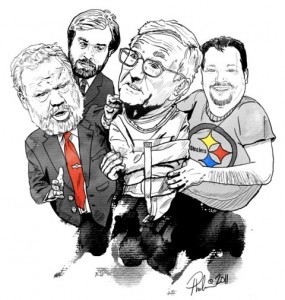
RED FLAG: State Revenue Estimates Hosed

03 Economy, 11 Society, Budgets & Funding, Government
Who, Me?

ERRORS IN STATE REVENUE ESTIMATES GROWING IN SIZE AND FREQUENCY

WASHINGTON — States have been making more serious errors in estimating their revenues during tough economic times, according to a new report by the Pew Center on the States and The Nelson A. Rockefeller Institute of Government. This has significant implications for policy makers who need to know how much money they will have to spend on programs and services as they grapple with severe budget shortfalls.

The report, States’ Revenue Estimating: Cracks in the Crystal Ball, found that in fiscal year 2009—the first of the ongoing budget crisis—half the states overestimated revenues by at least 10.2 percent. That equated to an unexpected shortfall of nearly $50 billion in personal income, corporate income and sales tax revenues. In a year when state policy makers faced $63 billion in mid-year shortfalls—coming atop $47 billion they already had closed when crafting their budgets—this was a significant challenge. States had to close the gaps by cutting spending, increasing taxes and fees, tapping reserves and borrowing.

The study found that the primary culprit driving more serious and frequent errors is not the states’ processes, methods and techniques, but rather, the increasing volatility of the revenue streams themselves. This appears to result from states’ growing reliance on income taxes and the ways in which highly fluctuating capital gains affect income tax revenue.


Read more….

Understanding America’s Decline: When…

09 Justice, 10 Security, 11 Society, Advanced Cyber/IO, Communities of Practice, Corruption, Officers Call
Chuck Spinney Recommends....

… we reward incompetence and/or lying as described below in the essay by Robert Parry?

Chuck Spinney

The Blaster

Gates Agrees, Bush's Wars Were Nuts

By Robert Parry, consortiumnews.com, February 27, 2011

When Defense Secretary Robert Gates told West Point cadets that you’d have to be crazy to commit U.S. troops to wars like those in Iraq and Afghanistan, media commentators quickly detected a slap at his predecessor, Donald Rumsfeld, who oversaw those conflicts.

But what about everyone else in the U.S. power structure who went along with those insane and bloody wars? Shouldn’t such people – whether they acted out of ideology or opportunism – be kept away from levers of authority that might get others killed?

For instance, what about the top editors at the Washington Post, the New York Times and a host of other establishment publications and TV outlets who hopped on the pro-war bandwagon and mocked anyone who suggested that negotiations or some less violent means might be preferable?    Read more….

Phi Beta Iota: Like most others, Dr. Gates finds his integrity late in life.  It was not just those who lied to the public who betrayed the public trust, but also  those like Dr. Gates who kept silent.  A handful of us tried to buy full page advertisements against  the wars, only to have them rejected by The Washington Post, Los Angeles Times, etcetera.  This is what happens when the “elite” value their membership in the elite club more than they value their integrity.  Integrity matters most when you can still make a difference, not after the fact when you have reaped all you could from “going along.”  At this juncture in time, the simple best thing for America–apart from Electoral Reform–would be the resurrection of integrity among our senior officials.

No Such Thing As a Good War….

09 Justice, 10 Security, 11 Society, Advanced Cyber/IO, Communities of Practice, Corruption, Counter-Oppression/Counter-Dictatorship Practices, Key Players, Misinformation & Propaganda, Money, Banks & Concentrated Wealth, Peace Intelligence, Power Behind-the-Scenes/Special Interests, Secrecy & Politics of Secrecy, True Cost
Chuck Spinney Recommends....

Advocates of humanitarian intervention like to use Kosovo as an example of a “good” war to distinguish it from Bush's bad war in Iraq and the Bush/Obama bungles in Afghanistan.  But Kosovo was a template for bungling and blowback in the wars of empire that emerged after the collapse of the Soviet Union.  The below article is outlines some of the reasons why this is so.

Chuck Spinney
The Blaster

Wrong choice in Kosovo

By GREGORY CLARK,  Japan Times, 1 March 2011

A recent Council of Europe report says that during and after the 1998-99 Kosovo conflict, militia leaders of the Kosovo Liberation Army (KLA) tortured and killed hundreds of Serbs and political rivals in secret Albanian hideouts, removed their organs for sale and dumped their bodies in local rivers.

The report added that these people were also heavily involved in drug, sex and illegal immigrant trafficking across Europe. Yet while all this was going on, the NATO powers had decreed that Serbia should be bombed into accepting the KLA as Kosovo's legitimate rulers — rather than the more popular Democratic League of Kosovo headed by the nationalist intellectual Ibrahim Rugova advocating nonviolent independence.

Recent years have not been kind to Western policymakers. They have shown an almost unerring ability to choose the wrong people for the wrong policies. Think back to the procession of incompetents chosen to rescue Indochina from the communist enemy. Does anyone even remember their names today? Yet at the time they were supposed to be nation-savers.  Read more….

Phi Beta Iota: It is now known that the World Wars were enabled by bankers intent on empowering the evil side with loans so as to force the good side to borrow heavily.  Bankers–and corporate mercenary interests with zero respect for “the public interest,” have created a world of grostesque inquality instead of a prosperous world at peace.  Revolution 2.0 is connecting the public–that is phase one–to be followed by phase two, an informed public that will not brook corruption.

TAKE INITIATIVE–Design the World, Don’t Edit It…

11 Society, About the Idea, Advanced Cyber/IO, Collective Intelligence, Cultural Intelligence, Earth Intelligence

Seth Godin Home

Who will say go?

Here's a little-spoken truth learned via crowdsourcing:

Most people don't believe they are capable of initiative.

Initiating a project, a blog, a wikipedia article, a family journey. Initiating something even when you're not putatitively in charge.

At the same time, almost all people believe they are capable of editing, giving feedback or merely criticizing.

So finding people to fix your typos is easy.

A few people are vandals, happy to anonymously attack or add graffiti or useless noise.

If your project depends on individuals to step up and say, “This is what I believe, here is my plan, here is my original thought, here is my tribe,” then you need to expect that most people will see that offer and decline to take it.

Most of the edits on Wikipedia are tiny. Most of the tweets among the billions that go by are reactions or possibly responses, not initiatives. Q&A sites flourish because everyone knows how to ask a question, and many feel empowered to answer it, if it's specific enough. Little tiny steps, not intellectual leaps or risks.

I have a controversial belief about this: I don't think the problem has much to do with the innate ability to initiate. I think it has to do with believing that it's possible and acceptable for you to do it. We've only had these doors open wide for a decade or so, and most people have been brainwashed into believing that their job is to copyedit the world, not to design it. [Emphasis Added.]

There's a huge shortage… a shortage of people who will say go.

Continue reading “TAKE INITIATIVE–Design the World, Don't Edit It…”

Foreign Policy Slanders Sy Hersh–Loses Its Integrity

07 Other Atrocities, 09 Justice, Analysis, Corruption, Cultural Intelligence, IO Sense-Making, Journalism/Free-Press/Censorship, Media, Misinformation & Propaganda
(from left to right) Tom Ricks of Foreign Policy magazine and The Washington Post, along with fellow FP editors Joshua Keating and Blake Hounshell all rushed to discredit Hersh and the contents of his January 17th, 2011 speech.

Pulitzer Prize Winner Seymour Hersh And The Men Who Want Him Committed

By Matthew Phelan on February 23, 2011

WhoWhatWhy: Forensic Journalism

It seems unusual for a staid, respected publication (one that has received three National Magazine Awards in just this past decade) to start treating a celebrated journalist (who himself has won two National Magazine Awards in just this past decade) as if he were nothing more than a paranoid crank.

It seems unusual, but it’s exactly what the staff of Foreign Policy has done to Seymour Hersh, following a lecture the venerated reporter gave at Georgetown University’s campus in Doha, Qatar. You may know Hersh as the dogged investigator who exposed the My Lai Massacre during Vietnam. You may know him as the staff writer for The New Yorker who published some of the earliest pieces on Abu Ghraib in May 2004. You might even know him as the man derided and then vindicated for claiming that Dick Cheney was running a secret assassination squad right out of the Vice President’s office. (In truth, the squad was and is a bipartisan affair, initiated under Clinton and still operative under Obama.)  Read more….

Phi Beta Iota: Sy Hersh is as honest as it gets.  Foreign Policy used to be a reputable, imaginative endeavor.  This is now the second time it has been disreputable and ignorant.  Inquiry has established that Moises Naim, the extraordinary editor who took Foreign Policy from nothing to being twice as good as Foreign Affairs, has moved to other duties within the Carnegie Endowment, and it is clear to us that with his departure, Foreign Policy has lost its integrity as well as its intelligence.

Secrecy News: CIA Culture In Detail

07 Other Atrocities, 10 Security, Analysis, Corruption, Cultural Intelligence, Government, Intelligence (government), Officers Call, Secrecy & Politics of Secrecy

Amazon Page

LONG STRANGE JOURNEY: A WHISTLEBLOWER'S TALE

In the vast literature of intelligence-related memoirs, the new book Long Strange Journey by Patrick G. Eddington stands out in several ways.

Eddington entered the intelligence arena as an imagery analyst for the CIA's National Photographic Intelligence Center.  Imagery analysis is a predominately technical activity and is not normally considered a hotbed of intrigue or controversy.  Nor has it been widely featured in the intelligence “literature of discontent.”  Eddington provides an introduction to the world of light tables, mensuration and the now-defunct world of the NPIC analyst.

Then Eddington himself defies easy stereotyping.  As an Army veteran, a political conservative, and a person of faith, he might have been voted least likely to rock the boat and to become a whistleblower.  But that's what he did.
Continue reading “Secrecy News: CIA Culture In Detail”

noble gold