Patrick Meier: Building Resilient Societies

11 Society, Blog Wisdom
Patrick Meier

On Building Resilient Societies to Mitigate the Impact of Disasters

I recently caught up with a colleague at the World Bank and learned that “resilience” is set to be the new “buzz word” in the international development community. I think this is very good news. Yes, discourse does matter. A single word can alter the way we frame problems. They can lead to new conceptual frameworks that inform the design and implementation of development projects and disaster risk reduction strategies.

The term resilience is important because it focuses not on us, the development and disaster community, but rather on local at-risk communities. The terms “vulnerability” and “fragility” were used in past discourse but they focus on the negative and seem to invoke the need for external protection, overlooking the possibility that local coping mechanisms do exist. From the perspective of this top-down approach, international organizations are the rescuers and aid does not arrive until they arrive.

Resilience, in contrast, implies radical self-sufficiency, and self-sufficien-cy suggests a degree of autonomy; self-dependence rather than dependence on an external entity that may or may not arrive, that may or may not be effective, and that may or may not stay the course. In the field of ecology, the term resilience is defined as “the capacity of an ecosystem to respond to a perturbation or disturbance by resisting damage and recovering quickly.” There are thus at least two ways for “social ecosystems” to be resilient:

  1. Resist damage by absorbing and dampening the perturbation.
  2. Recover quickly by bouncing back.

So how does a society resist damage from a disaster? As noted in an earlier blog post, “Disaster Theory for Techies“, there is no such thing as a “natural disaster”. There are natural hazards and there are social systems. If social systems are sufficiently resilient to absorb the impact of a natural hazard such as an earthquake, then disaster unfolds. In other words, hazards are exogenous while disasters are the result of endogenous political, economic, social and cultural processes. Indeed, “it is generally accepted among environmental geographers that there is no such thing as a natural disaster. In every phase and aspect of a disaster—causes, vulnerability, preparedness, results and response, and reconstruction—the contours of disaster and the difference between who lives and dies is to a greater or lesser extent a social calculus.”

Read more….

John Robb: Second Global Depression (D2) 2008-2018+

03 Economy, 11 Society, Blog Wisdom
John Robb

Friday, 05 August 2011

JOURNAL: D2, The Second Global Economic Depression

D2 is shorthand for the second global economic depression.  It started formally in 2008, and despite a short respite over the last two years, it never left.  It was only delayed by massive amounts of government intervention.  It is now back in force.

D2, given the forces driving it, is going to last a decade or more.  Simple prepping might help a little but it's far from what is going to be required given its duration.

This depression will fundamentally reorder the economic, political and social landscape.  When it ends, most of the global institutions and markets we see today will mere husks of what they are today.

What will replace them?  That's up to you.

Patrick Meier: Crisis Crowd Sourcing the Diaspora

Advanced Cyber/IO, Blog Wisdom, Civil Society, Collective Intelligence, Cultural Intelligence, Earth Intelligence, IO Deeds of Peace, IO Technologies, Policies
Patrick Meier

Crisis Mapping Somalia with the Diaspora

The state of Minnesota is home to the largest population of Somalis in North America. Like any Diaspora, the estimated 25,000 Somalis who live there ar closely linked to family members back home. They make thousands of phone calls every week to numerous different locations across Somalia. So why not make the Somali Diaspora a key partner in the humanitarian response taking place half-way across the world?

In Haiti, Mission 4636 was launched to crowdsource micro needs assessments from the disaster affected population via SMS. The project could not have happened without hundreds of volunteers from the Haitian Diaspora who translated and geo-referenced the incoming text messages. There’s no doubt that Diasporas can play a pivotal role in humanitarian response but they are typically ignored by large humanitarian organizations. This is why I’m excited to be part of an initiative that plans to partner with key members of the Diaspora to create a live crisis map of Somalia.

Read more….

See Also:

Ushahidi & The Unprecedented Role of SMS in Disaster Response

Marcus Aurelius: Defense Downsizing, Retirement

Defense Science Board
Marcus Aurelius

Two core references for DoD going forward, both from the Defense Science Board (DSB).

Corporate Downsizing Applications for DoD

Military Retirement Final Presentation

Phi Beta Iota:  Defense can drop to $300 billion a year without any major issues.  All it takes is integrity across the board.  Military retirement–as with CIA and FBI and Secret Service retirement–is long over-due for severe change.  In the military only 4% of the force suffers 80% of the casualties, and that is the only part of the force that merits early retirement while also correcting the criminal neglect of ill and disabled veterans that continues today.  It merits observation that in the absence of a population strategy and policy, no retirement program can be said to have a strong foundation.

John Robb: Solar-Power Water Treatment Plus…

Blog Wisdom
John Robb

Some items of interest:

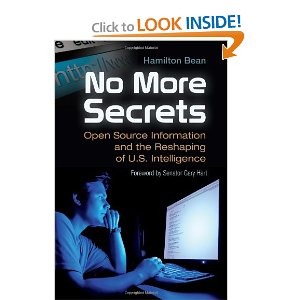
Reference: No More Secrets – Open Source Intelligence/Intelligence Reform Fight Round II

Advanced Cyber/IO, Blog Wisdom, Collaboration Zones, Communities of Practice, Ethics, Key Players, Officers Call, Policies, Serious Games, Threats
Amazon Page

Updated 4 Aug 2011 to add M4IS2

Multinational, Multiagency, Multidisciplinary, Multidomain Information-Sharing and Sense-Making (M4IS2)

2012 Manifesto for Truth: Expanding the Open Source Revolution (Evolver Editions, July 2012)

2010: Human Intelligence (HUMINT) Trilogy Updated

2010 INTELLIGENCE FOR EARTH: Clarity, Diversity, Integrity, & Sustainability

2006 Briefing to the Coalition Coordination Center (CCC) Leadership at the U.S. Central Command (USCENTCOM)–Multinational Intelligence: Can CENTCOM Lead the Way? Reflections on OSINT & the Coalition

– – – – – – –

Short Review by Retired Reader

Long Review by Robert Steele

Reference: Open Source Agency (OSA) III

Reference: Open Source Agency (OSA) II

Reference: Open Source Agency (OSA) I

See Also:

Continue reading “Reference: No More Secrets – Open Source Intelligence/Intelligence Reform Fight Round II”

noble gold