Jon Lebkowski: Beyond Push-Pull to Interactive Engagement

Blog Wisdom
Jon Lebkowsky

Phi Beta Iota:  For a half century the US Intelligence Community has “pushed” hard target “intelligence” downstream while refusing to do Global Coverage.  In the late 1980's it started to hear customer complaints about wanting to “pull” relevant information.  Today the US Intelligence Community is completely isolated from 90% or so of the direct end-users, and has nothing to offer them even if they could “interact.”  Below is a nuanced discussion that bears on the matter.  The future of intelligence is not federal, not secret, and not expensive.  The diamond paradigm, not the linear paradigm, is the inevitable future organization of a mature intelligence community.  The conclusion is especially trenchant, focusing on shared tools and context as the core environment–the US Intelligence Community cannot provide tools for its own analysts, much less its customers, and is so divorced from reality (ten threats, twelve policies, eight demographics) as to be virtually irrelevant to the future.   Emphasis below added to highlight three gold nuggets any information-intelligence manager should be harvesting.

Thinking about the future of online marketing

Continue reading “Jon Lebkowski: Beyond Push-Pull to Interactive Engagement”

Seth Godin: When the Truth is Near — Do You Avoid It?

Advanced Cyber/IO, Blog Wisdom, Ethics
Seth Godin Home

When the truth is just around the corner

…what's your posture?

Sometimes, we get close to finding out who we really are, what's the status of our situation, what's holding us back. When one of those conversations is going on, do you lean in, eager for more, or do you back off, afraid of what it will mean?

Do you go out of your way to learn about your habits, relationships and strengths? Or what's driving traffic to your website? Or why you didn't get that job?

When your organization has a chance to see itself as its customers do, do your leaders crowd around, trying to glean every insight they can about the story and your future, or do they prefer the status quo?

There are more mirrors available than ever. Sometimes, though, what's missing is the willingness to take a look.

Richard Wright: Jail Time for Over-Classification?

07 Other Atrocities, 09 Justice, 10 Security, 11 Society, Articles & Chapters, Corruption, Cultural Intelligence, Director of National Intelligence et al (IC), DoD, Government
Richard Wright

Is it possible the good guys are going to win the issue of over-classifcation? Can a real Open Source Agency (OSA) become the new face of strateic intelligence?

Complaint Seeks Punishment for Classification of Documents

By

New York Times, August 1, 2011

EXTRACT

Under the executive order governing classification, the punishment could include dismissal, suspension without pay, reprimand or loss of a security clearance.

. . . . . .

“I’ve never seen a more deliberate and willful example of government officials improperly classifying a document,” he said.

Phi Beta Iota:  Since the early 1990's the general practice has been to classify everything, and agency heads and the limited number of classifying authorities have been severely derelict in their duty, allowing anyone down to the GS-1 night sweeper to classify documents “in their name.”  In this specific instance, the Drake case, it would be quite nice to see someone go to jail.  It won't happen, but both the Courts and the public are growing very intolerant of Executive malfeasance that would make Dick Cheney proud.  In the purest sense of the world, the US Intelligence Community agency heads are corrupt.  They lack integrity.

See Also:

Reference: No More Secrets – Open Source Intelligence/Intelligence Reform Fight Round II

Reference: 1996 Hill Testimony on Secrecy

Reference: 1996 Testimony to Moynihan Commisson

1993 TESTIMONY on National Security Information

Koko: Books on Complexity and Resilience

Book Lists
Koko

There is a convergence among literatures, with complexity and resilience now bringing forth Ecological Economics, concepts of agile social response, and our favorite, Engineering Resilience, a multi-disciplinary mind-set most engineers are simply not up to (nor politicians, bureaucrats, etcetera).

Adapting Institutions: Governance, Complexity and Social-Ecological Resilience (Emily Boyd, Carl Folke (eds), 2011)

Viability and Resilience of Complex Systems: Concepts, Methods and Case Studies from Ecology and Society (Guillaume Deffuant, Nigel Gilbert (eds), 2011)

Spatial Resilience in Social-Ecological Systems (Graeme Cumming, 2011)

What Kind of Information Society? Governance, Virtuality, Surveillance, Sustainability, Resilience (Jacques Berleur, Magda David Hercheul, Lorenz M. Hilty (eds), 2010)

Continue reading “Koko: Books on Complexity and Resilience”

Koko: Books on Early Warning & Prevention

Book Lists
Koko

Early Warning is nice.  Honest politicians willing to listen and learn is even nicer.  We conclude that early warning must be very public and very understandable to the public at large.  The challenge for Early Warning is to achieve coherence–no one cares about single issue early warning.  The acme of skill is to achieve M4IS2 Early Warning–all threats, all policies, all true costs, “in your face.”

Crashes, Crises, and Calamities: How We Can Use Science to Read the Early-Warning Signs (Len Fisher, 2011)

Coping with Global Environmental Change, Disasters and Security: Threats, Challenges, Vulnerabilities and Risks (Hans GunterBrauch et al (eds) 2011)

Famine Early Warning Systems and Remote Sensing Data (Molly Brown, 2010)

Earthquake Early Warning Systems (Paolo Gasparini, Gaetano Manfredi, Jochen Zschau (eds), 2010)

Anticipating African Conflicts: A Capability Assessment of the African Union and its Continental Early Warning System (Christian Nitschke Smith, 2009)

Heads Up!: Early Warning Systems for Climate-, Water- and Weather-Related Hazards (United Nations, 2009)

Conflict and Fragility Preventing Violence, War and State Collapse: The Future of Conflict Early Warning and Response (OECD, 2009)

reTHINK: A Twenty-First Century Approach to Preventing Societal Catastrophes (Donald B. Louria, KINDLE ONLY, 2009)

Continue reading “Koko: Books on Early Warning & Prevention”

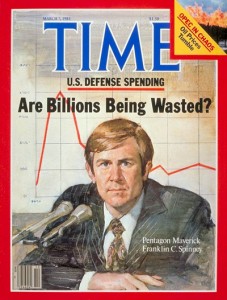
Winslow Wheeler: Defense Cuts, Defense Flim-Flam

07 Other Atrocities, 10 Security, 11 Society, Blog Wisdom, Budgets & Funding, Civil Society, Corruption, Cultural Intelligence, DoD, Government, IO Impotency, Military, Misinformation & Propaganda, Officers Call, Open Government, Peace Intelligence, Politics of Science & Science of Politics, Power Behind-the-Scenes/Special Interests, Secrecy & Politics of Secrecy, Strategy, Technologies
Winslow Wheeler

There are numerous misleading and misinformed assertions being made about the defense spending parts of the debt deal.

The White House's “fact sheet” asserts a $350 billion savings in the “base defense budget.” The $350 billion in defense savings that the White House declares apparently uses a different “baseline” (basis of comparison) and pretends that a two year cap the bill establishes on “security” spending will extend to ten years.  Most misleading of all, it assumes that all savings in the “security” category (which includes DOD, DOE/nuclear weapons, all State Department related spending, Veterans Affairs, and Homeland Security) will occur only in DOD spending.  In fact, the “security” category was designed to broaden the base for “defense” cuts and to lessen the impact on DOD.  The undocumented $350 billion in “security” savings will actually translate into lesser reductions in DOD spending, but the amount is unknown.  The actual amount will be decided by Congress in the future.

Chuck Spinney: Jeff Madrick on The Age of Greed and Failure of Government to Check Private Sector Greed

03 Economy, 07 Other Atrocities, 09 Justice, 10 Transnational Crime, 11 Society, Articles & Chapters, Commerce, Commercial Intelligence, Corruption, Cultural Intelligence, Government, IO Impotency, Money, Banks & Concentrated Wealth, Power Behind-the-Scenes/Special Interests
Chuck Spinney
Here is a review of my friend Jeff Madrick's important new book, Age of Greed: The Triumph of Finance and the Decline of America, 1970 to the Present

Book review: ‘Age of Greed’ by Jeff Madrick

By David Greenberg, Washington Post Outlook, 29 July 2011

David Greenberg is a professor of history and of journalism and media studies at Rutgers University. He is a fellow at the Woodrow Wilson International Center for Scholars for the 2010-11 academic year.

EXTRACTS

“Age of Greed” chronicles how Americans ended up with the highly unregulated financial system that produced the meltdown of 2008 and the fallout that lingers three years later. What’s most novel about the book, which relies heavily on other secondary accounts, is that unlike other recent treatments of the financial crisis, it traces the origins of the problem not to the Bush or Clinton or even Reagan years, but all the way to the late 1960s.

. . . . . .

The real scandal revealed by Madrick’s important book is not the well-known tales of dastards such as telecom analyst Jack Grubman or Internet stock promoter Frank Quattrone, but the more elusive — and more consequential — story of how the government came to abdicate this supreme responsibility.

Read full review….

noble gold