Journal: Femicide, Educating Women, Saving Earth

04 Education, 07 Other Atrocities, 11 Society, Civil Society, Collective Intelligence, Cultural Intelligence

CNN Story on TED Story

Tens of millions of ‘missing' girls

(CNN) — Discrimination against women and girls takes a staggering toll around the world, says author Sheryl WuDunn. It leads to as many as 100 million fewer females than males in the world.

Ending the oppression of women is the great moral challenge of the 21st Century, a cause she compares to fighting slavery in the 19th century and totalitarianism in the 20th Century.

The solutions, she says, are education and economic opportunity. Overpopulation is one of the larger contributors to poverty, WuDunn said. “When you educate a girl, she has significantly fewer kids.” Girls who go to school get married later in life and educate their children “in a more enlightened way.”

“So let us be clear about this up front: We hope to recruit you to join an incipient movement to emancipate women and fight global poverty by unlocking women's power as economic catalysts.

WATCH THE TED SHORT STORY

Phi Beta Iota: It merits comment that micro-lending was a success because its founder recognized that women, not men, would be the more reliable and productive catalyst.  It also merits comment that the best aid investment, dollar for dollar, is in the education of women.  What is missing is the “giant leap forward” that would come from distributing free telephones and creating multi-lingual call centers that educate women–and men–one cell call at a time, while serving as catalysts for harnessing the distributed intelligence of the Whole Earth, creating smart neighborhoods to smart nations to a smart planet.

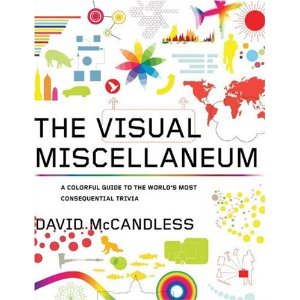
Reference: Data Is the New Dirt–Visualization

Analysis, Augmented Reality, Blog Wisdom, Briefings (Core), Collective Intelligence, info-graphics/data-visualization, InfoOps (IO), IO Sense-Making, Methods & Process, Peace Intelligence
Full Short Video Brief Online

About this talk

David McCandless turns complex data sets (like worldwide military spending, media buzz, Facebook status updates) into beautiful, simple diagrams that tease out unseen patterns and connections. Good design, he suggests, is the best way to navigate information glut — and it may just change the way we see the world.

About David McCandless

David McCandless draws beautiful conclusions from complex datasets — thus revealing unexpected insights into our world. Full bio and more links

Phi Beta Iota: “Mining” the soil does not go far.  Actually planting, tilling, watering, and growing is much more powerful.  This is one of the most compelling TED briefs we have seen.  “Language of the eye” combined with “language of the mind.”  All about “relative” numbers and relationships.  “Let the data set change your mindset.”  Art of knowledge compression.  Living data in a Google document.  If you visit his books at Amazon, take the time to check out the related books on data visualization that Amazon clusters for around these.

Tip of the Hat to Magnus Hultberg at LinkedIn.  Also see these resources.

David McCandless' two books:

Amazon Page
Amazon Page

Journal: Brains Beat Algorithms….Again

04 Education, Advanced Cyber/IO, Analysis, Citizen-Centered, Civil Society, Collective Intelligence, info-graphics/data-visualization, InfoOps (IO), IO Sense-Making, Methods & Process, Politics of Science & Science of Politics, Tools
Full Story Online

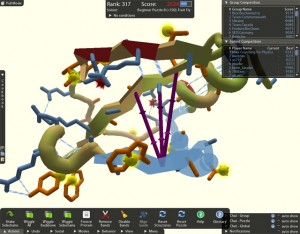
Today's issue of Nature contains a paper with a rather unusual author list. Read past the standard collection of academics, and the final author credited is… an online gaming community.

Scientists have turned to games for a variety of reasons, having studied virtual epidemics and tracked online communities and behavior, or simply used games to drum up excitement for the science. But this may be the first time that the gamers played an active role in producing the results, having solved problems in protein structure through the Foldit game. (Also related, TED talk on how gaming can make a better world).

See Also:

Graphic: Jim Bamford on the Human Brain

2010: Human Intelligence (HUMINT) Trilogy Updated

Reference: Citation Analytics 201

About the Idea, Advanced Cyber/IO, Analysis, Analysis, Articles & Chapters, Augmented Reality, Balance, Budgets & Funding, Collaboration Zones, Collective Intelligence, Communities of Practice, History, ICT-IT, info-graphics/data-visualization, InfoOps (IO), Maps, Methods & Process, Multinational Plus, Policies, Policies-Harmonization, Policy, Political, Politics of Science & Science of Politics, Power Behind-the-Scenes/Special Interests, Processing, Real Time, Research resources, Secrecy & Politics of Secrecy, Strategy-Holistic Coherence, Threats, Tools, Tribes

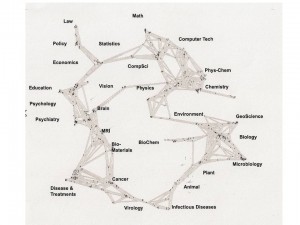
Phi Beta Iota: Most serious analysts now understand Citation Analytics 101.  It's time to move to Citation Analytics 202, and there is no better way to introduce the art of the possible than by pointing to Kevin W. Boyack, Katy Borner, and Richard Klavans (2007), “Mapping the Structure and Evolution of Chemistry Research (11th International Conference of Scientometrics and Infometrics, pp. 112-123.

Full Article with Color Graphics
Graphic as Printable Single Page PPT

There are several take-aways from this article, which is more or less the “coming out” of the Klavens-inspired infometrics field now that he has won his law-suit and has unchallenged access to all Institute of Scientific Information (ISI) access [this was one of the sources we used to win the Burundi Exercise before the Aspin-Brown Commission in 1995].

Continue reading “Reference: Citation Analytics 201”

Worth a Look: SystemWiki.org & Co-Mapping

Analysis, Augmented Reality, Budgets & Funding, Collective Intelligence, InfoOps (IO), Methods & Process, Tools, Worth A Look

Graphic by Georg Schilling

UPDATE of 22 Aug 2010 to add Viral Video (John Pourdehnad)  that started the dialog.

Ackoff Virtual Inqiry Center (AVIC)

There is a discussion underway at Systems Community of Inquiry focused on developing the concepts for a network of Ackoff Virtual Inqiry Centers (AVIC) located around the world. Early on, the original vision for AVIC, offered by Dr. John Pourdehnad, was that AVIC serve as a nervous system for the Systems and Design Community in Dr. Russell Ackoff’s name. With this belief, Dr. Pourdehnad also made clear the need for AVIC to be designed Ideally and created by the stakeholders themselves. The concept is being extended by Gene Bellinger and Kent Myers.  The work of Clay Shirky is most helpful:
See Also:
Ackoff Centers for Design Thinking Version of April 12, 2010
Co-Mapping
Co-Mapping for Educators
Design Thinking
Idealized Design
Knowledge Management in Inquiring Organizations
Sustainable Development Simulation (SDSIM)
Virtual Systemic Inquiry (VSI)

Worth a Look: SciVal from Elsevier

Analysis, Collective Intelligence, Maps, Politics of Science & Science of Politics, Research resources, Tools, Worth A Look

SciVal Home

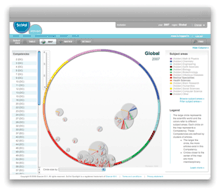
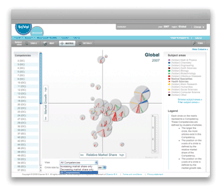
We have in the past highlighted the work of Dick Klavans, who along with Brad Ashton is one of our foremost Scientific & Technical Intelligence (S&TI) colleagues.  Apart from his book with Brad, Keeping Abreast of Science and Technology: Technical Intelligence for Business and his new web site, Maps of Science, see also on this site: 2002 Klavans (US) Technology Mapping: A Workshop on (Open) Sources & Methods for Identifying Commercial Opportunities in Technology and 2002 Klavans (US) Tomorrow’s Hotspots: Identifying Commercial Opportunities from Science.

SciVal Home

Elsevier is now commercializing what Dick has been doing for the last twenty years in one-of productions, and we believe this capability will be extraordinary, not only in performance measurement and performance enhancement for specific disciplinary units, but in demanding that inter-disciplinary and integrative problem-finding and solving come back into being.

Code for America

Civil Society, Collective Intelligence, Government, Open Government, Technologies

Code for America was founded to help the brightest minds of the Web 2.0 generation transform city governments. Cities are under greater pressure than ever, struggling with budget cuts and outdated technology. What if, instead of cutting services or raising taxes, cities could leverage the power of the web to become more efficient, transparent, and participatory?

Friends of Code for America

The Case Foundation | CityCamp | GOOD | GovFresh | GovLoop | Omidyar Network | Open311 | OpenMuni | OpenPlans | O'Reilly Media | Stamen Design | The Sunlight Foundation