The Government Cost Calculator is a unique service from The Independent Institute that enables any American to clearly understand three aspects of federal government spending. First, the Calculator helps you determine how much you will pay for various federal programs now and over the course of a lifetime. Second, it compares those tax payments to the forgone earnings that would have been possible if such funds were kept and invested in private market accounts. Finally, the Calculator enables you to see the difference between government expenditures and your tax payments, clearly illustrating the growing debt obligations you face in the future. Unlike total or “per capita” government debt calculators currently available, the Calculator personalizes government spending, enabling you to see how much federal programs are costing you now and how much they will cost you in the future.
I have read the released Odom interview MFR. Odom is not kind (perhaps not fair) to CIA or Gen Mike Hayden. Interview, like all others in extensive series, was done circa 2003-2004. Some prominent military SO names, such as Schoomaker and Boykin are among the interviewees. Extent of redaction ranges from fairly light to very heavy. Pre-sanitization/release original classification of interview MFRs ranges from U to TS//SCI (multiple caveats). As documented, little/no evidence that 9/11 Commission interviewers operated in hostile/coercive manner. Even through sanitization, knowledgeable readers can glean some interesting opinions.
The CIA is “out of control” and often refuses to cooperate with other parts of the national security community, even undermining their efforts, said former National Security Agency head William Odom, according to a recently released record of a 9/11 Commission interview.
“The CIA currently doesn't work for anyone. It thinks it works for the president, but it doesn't and it's out of control,” says a report summarizing remarks made by Odom, a retired three-star general who served as director of the NSA from 1985 to 1988.
Odom, who also served on the National Security Council staff during the Carter administration, was known as an outspoken advocate for intelligence reform. He died in 2008.
. . . . . . .
While deeply critical of the CIA, Odom also had harsh words for other NSA directors, including Adm. Bobby Inman, whom he accused of “playing games” in Washington. He also said that Gen. Michael Hayden, then the director of the NSA, was “destroying” the agency and didn't know his “intellectual limits.”
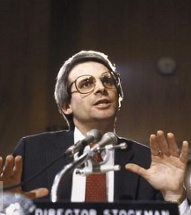
The Obama administration's $78 billion cut to US defense spending is a mere “pin-prick” to a behemoth military-industrial complex that must drastically shrink for the good of the republic, a former Reagan administration budget director recently told Raw Story.
. . . . . . .
The ‘Ponzi scheme' of ‘artificial prosperity'
Stockman, who described himself as a libertarian during a recent interview with Reason.tv, told Raw Story that the economy got into this mess because of the public and private sectors' addiction to “guns and butter Keynesianism,” an economic policy that amounts to a Ponzi scheme that has ballooned since 1990.
“If we see what's going on carefully, we've reached the final unmasking of the Keynesian illusion, that Keynesianism is really nothing but borrowing, stealing from the future to induce consumption today,” he said. “There are no multipliers. Every one of these programs we've had from ‘cash for clunkers' to housing purchase credits have disappeared as soon as they expired and simple shifted activities in time by a few months.”
Stockman explained that before 1980, it took about $1.50 of new borrowing — public or private — to generate $1 of GDP growth. By the mid-1990s, it was $2.50 or $3 of borrowing for a $1 of GDP growth. By 2007, before the big collapse and meltdown finally came, $7 of public and private debt was added to the national balance sheet in order to get $1 of GDP growth.
“When you get to the point of $7 of borrowing to get $1 of income, you're obviously on an unsustainable path and pretty close to hitting the wall, which more or less we have,” he said.
Phi Beta Iota: Drawing down the military-industrial complex will immediately produce two highly undesireable masses of unrest: pissed off unemployed veterans who own a gun and know how to use it; and pissed off pasty-faced short fat bald white guys with no marketable skills who either own a gun or know where to buy one. We agree that the military budget needs to be cut by $200 billion or more–however, it must be done strategically, with clear-cut plan for both assuring every veteran of a job, with priority to amputees, and for redirecting our energies into homeland development before we spent another dollar on foreign development. We've blown it for nearly three-quarters of a century. This is now about strategic design–do it, or lose what's left of the Republic.
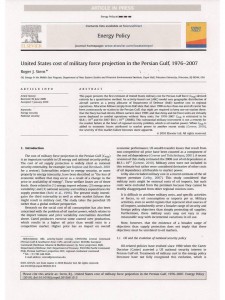
This reference strives to demonstrate that the “true cost of oil” to the USA between 1976 and 2007 should include the cost of the aircraft carriers and related forces to the Middle East. The author has two major flaws in his argument, stating that each forward-deployed carrier requires eight others (vice two more, one down, one training up), and that Army and Air Force units are virtually never deployed without supporting carriers. We draw three take-aways from this:
1. The US Government is going to have to start doing strategic holistic “true cost” analysis or it will be bombarded with this kind of analysis in the future that is both flawed and constructive–we do need to know the “true cost” of everything and the military costs borne by the taxpayer are a part of that.
2. Academics such as this author are well-intentioned but deprived of robust access to military analysts and budget specialists. The war colleges could play a very constructive role in bringing various parties together, both to improve government development of “true cost” models, and to improve academic understanding of how military power projection is structured.
3. The time has come for the Office of Management and Budget (OMB) to get back into the Management side, and particularly to begin evaluating Return on Investment (RoI) across the board. This should lead to a substantial increase in the budget for diplomacy & development, while requiring some meaningful realignments within both the military and the secret intelligence worlds.
M-Paisa: Ending Afghan Corruption, one Text at a Time
Monty Munford Oct 17, 2010
Afghanistan supplies 92% of the world’s opiates. According to the latest available figures, the country produced 8,200 tons of heroin in 2008, more than double the the amount three years earlier.
But even being the heroin capital of the world, bringing in more money than most Afghans can dream of, the on-going war and rampant corruption means the money goes to the wrong people and the country has no infrastructure. There are no decent roads, no railways… But they do have mobile phones.
Four months ago, the Afghan National Police began to pay salaries through mobiles (using a text and Interactive Voice Response system), rather than in cash. The platform used was based on the M-Pesa service that has become highly successful in Kenya. Branded M-Paisa in Afghanistan, it was introduced by the operator Roshan in partnership with the Ministry of the Interior (MOI) and had an immediate effect.