Quietly but steadily Central Asia’s basic human and physical
infrastructure – the roads, power plants, hospitals and schools and the
last generation of Soviet-trained specialists who have kept this all
running – is disappearing. The equipment is wearing out, the personnel
retiring or dying. Post-independence regimes made little effort to
maintain or replace either, and funds allocated for this purpose have
largely been eaten up by corruption. This collapse has already sparked
protests and contributed to the overthrow of a government.
1. He quotes Madison, as we have, on the importance of public knowledge as the basis for the Republic keeping the government accountable and in check.
2. He points out that the defense budget has never been audited, cannot be audited, and is both totally “out of control” and irresponsibly chaotic and grotesquely excessive.
3. He proposes regular persistent cuts in the defense budget until such time as it can actually pass an audit.
Re-Imagining Journalism is a small, invitation-only summit of young journalists from a diverse cross-section of the industry. The one-day gathering seeks to explore not simply the production and delivery of news, but to delve deeply into the craft of journalism.
A Norwegian lawmaker has nominated WikiLeaks for the 2011 Nobel Peace Prize, saying Wednesday that its disclosures of classified documents promote world peace by holding governments accountable for their actions.
Historic events in the Arab world gripped the world's attention in January. In Tunisia weeks of escalating riots and demonstrations over dire economic conditions, corruption and government repression culminated in the ouster of President Zine al-Abidine Ben Ali on 14 January. He was replaced by an interim government which announced the country's first free elections since independence.
The direction of Tunisia's transition, and its significance for the region, are not yet clear. But, assuming a successful transition, this could mark the first genuine popular revolt leading to a democratic government in the Arab world.
Inspired by the Tunisian uprising yet fuelled by their own long-standing grievances, hundreds of thousands took to the streets across Egypt towards the end of the month, protesting against authoritarian rule and poor living standards, and calling for President Hosni Mubarak to step down. Over 135 people were killed and more than 2,000 injured during the initial police response. The army was deployed at the end of the month to curb increasing chaos and looting, but vowed not to use force against the protesters.
Seemingly somewhat similar approach to “monkeywrenching” ecotage (sabotage) of Earth Liberation Front originating in American Southwest…..not sure The Atlantic has done its homework–apart from the naivete of thinking that this would remain “controlled” it reads like a CIA-version of a faux activist plan.
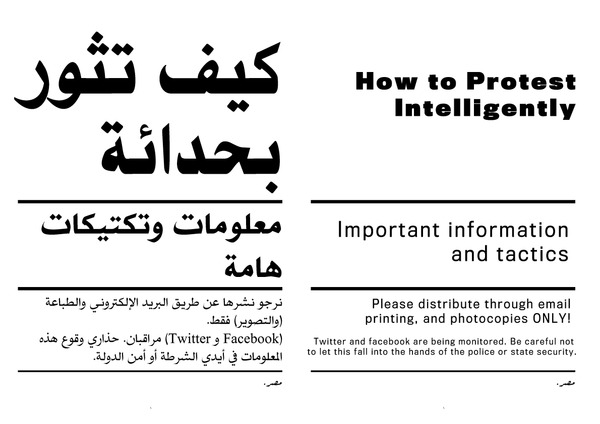
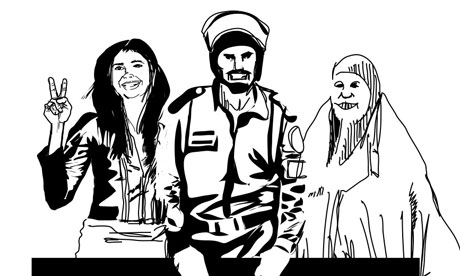
Anonymous flyers provide practical and tactical advice for confronting riot police, and besieging government offices
Phi Beta Iota: Agree with Marcus Aurelius. A simpler plan is “be on the street, be respectful and non-violent at all times, be patient.” This is a word of mouth revolution, 26 pages is suspect and we have to wait to see the entire product as well as verification that this has gone anywhere other than The Atlantic. This is the kind of thing CIA would do (violate the law, feed this to The Atlantic) to try to get on the boards “virtually.” Fairly stupid to want to occupy buildings, the key is public presence, non-violent, nothing more. V-sign? Is this a 1960's annuitant on modern drugs? We wait with bated breath to learn who is actually behind what the UK Guardian calls “the slickly produced 26-page document.”



 Re-Imagining Journalism