
The author is a Lebanese journalist who is very well informed and knows many jihadists on a personal basis. He presents a view on AQ in the period just before 9/11 and its early aftermath.


The truth at any cost lowers all other costs — curated by former US spy Robert David Steele.
The author is a Lebanese journalist who is very well informed and knows many jihadists on a personal basis. He presents a view on AQ in the period just before 9/11 and its early aftermath.
This search is a VERY important one, and does not yield the correct answer, which is in itself an indictment of information technology.
The correct answer is NEGATIVE, and Paul Strassmann, former Director of Defense Information, is the person who established this fact for the top corporations, although he likes to soft-shoe it and say neutral or negative. NOT positive. There is no Return on Investment (RoI) for information technology in and of itself. He first disclosed this in his keynote luncheon presentation at OSS '96, and then published a book. Both links are below. Paul Strassmann is one of our heroes–he has NOT been listened to carefully enough, and is in our little black book as a “must have” advisor for any future Information Operations (IO) “break-out” but only if he signs a non-compete and forgoes any association with any of the vendors selling vapor-ware (which is to say, all of them).
1996 Strassmann (US) U.S. Knowledge Assets: Choice Traget for Information Crime
Review: Information Productivity–Assessing Information Management Costs of U. S. Corporations
In Case of DoD Specifically:
2006 General Accountability Office (GAO) Defense Acquisitions DoD Management Approach and Processes Not Well-Suited to Support Development of Global Information Grid
2002 The New Craft of Intelligence–What Should the T Be Doing to the I in IT?
Graphic: Tony Zinni on 4% “At Best”
Graphic: Jim Bamford on the Human Brain
Journal: Return on Investment Missing from IT World
Journal: Systems Design & “Reverse Innovation”
Journal: Bees’ tiny brains beat computers
Continue reading “Search: return of investment for information sys”
Dear Friends of the American Monetary Institute,
IMPORTANT MONETARY NEWS ALERT: MAJOR, HISTORIC PROGRESS BEING MADE
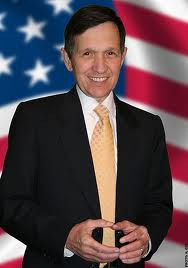
On Friday December 17th Congressman Dennis Kucinich (D,Ohio, 10th District) took a crucial and heroic step to resolve our growing financial crisis and achieve a just and sustainable money system for our nation by introducing the National Emergency Employment Defense Act of 2010, abbreviated NEED. The bill number is HR6550.
While the bill focuses on our unemployment crisis, the remedy proposed contains all the essential monetary measures being proposed by the American Monetary Institute in the American Monetary Act. These are what decades of research and centuries of experience have shown to be necessary to end the economic crisis in a just and sustainable way, and place the U.S. money system under our constitutional checks and balances. Yes it can be done!
We expect this bill will also be re-introduced next year in the 112th Congress. By putting it in now Congressman Kucinich accomplishes these important things:
* First, the seriousness of intent is underscored;
* Second, it gives our nation the opportunity to view, discuss and understand the necessary provisions, giving the chance to make improvements for re-introduction;
* Third it serves as a beacon to our beleaguered people, cutting through the error, vested interest and disinformation that has blocked monetary reform understanding and action in the past.
The American Monetary Institute has activated its blog to discuss and review any questions about this act. Just click on the blog link at our homepage.
To participate in this process, please sign up at the bottom of our home page at . Then, after reading the proposed legislation feel free to make comments or put questions on the blog, including thoughtful suggestions on how it might be improved.
You can read a copy of the legislation here.
Warm regards to all,
Stephen Zarlenga
AMI
See Also:
Dennis Kucinich on the Proposed Monetary Reform
Dennis Kucinich, Vice President for the Commonwealth–and Some Details

General Clapper is extremely qualified to be Director of National Intelligence (DNI) in terms of intelligence experience and management skills. Far too many senior management staff at CIA have proven incompetent time servers and selection of the DNI from the upper ranks of CIA would have to be done with extreme care.
The fact is however that no matter who is DNI, it is an untenable job. Although General Clapper supposedly received authority over 80 per cent of the intelligence budget my guess is that DOD and its friends in congress will make sure that he will be unable to exercise any real control over spending. Further no DNI appears to have had the full confidence of either President Bush or President Obama. With Leon Panetta as Director of CIA, that agency will continue to operate pretty much independent of the DNI. Finally the simple fact is that President Obama has apparently placed his full confidence in John Brennan and Brennan apparently thinks nothing of undercutting any intelligence official who might undermine his role as the Intelligence Authority for the President. If General Clapper would have asked me I would have told him to forget the DNI position and get himself a cushy job in private industry.
Journal: Brennan Sandbags Clapper? The London 12
Harnessing Collective Intelligence to Save Democracy
Journal: Can’t Get No Satisfaction from US Intelligence Community…
DDoS Attacks Continue to Plague Human Rights Sites
By: Chloe Albanesius
PC Magazine, 12.22.2010
WikiLeaks and Operation Payback have put distributed denial of service (DDoS) attacks in the news recently, but independent media and human rights Web sites have been battling these attacks on a consistent basis with no easy solution in sight, according to a Wednesday study.
While major sites can fend off a DDoS or recover quickly, smaller sites can be crippled by these attacks, which often hit in conjunction with other attacks like filtering, intrusions, and defacements, according to the Berkman Center for Internet & Society.
“DDoS is an increasingly common Internet phenomenon capable of silencing Internet speech, usually for a brief interval but occasionally for longer,” the report said. “Our report offers advice to independent media and human rights sites likely to be targeted by DDoS but comes to the uncomfortable conclusion that there is no easy solution to these attacks for many of these sites, particularly for attacks that exhaust network bandwidth.”
The report's authors suggest that DDoS attacks will become more common amidst news about similar WikiLeaks and Operation Payback attacks. Even before that, however, DDoS attacks on independent media and human rights sites were quite common during the last year, happening even outside of major events like elections, protests, and military operations.
These sites are being hit with two types of DDoS: application and network. Application attacks exhaust local server resources and can usually be rectified with the help of a skilled system admin. Network attacks, however, exhaust network bandwidth and can usually only be fixed with the (costly) help of a hosting provider.

Phi Beta Iota: There is no other person we hold in higher esteem than Tom Atlee. For America the Beautiful, at least, he is this generation's Wise Man. Below in his own words. We urge one and all to contribute to his sustenance.
. . . . . . . . . . . . . . . . . . . . . . . . . .
Dear friends,
I have been talking a lot lately with strategists in the Coffee Party movement (CPM). If you don't know much about the Coffee Party, I urge you to check out their website and Wikipedia's well-referenced short article on them.
While the Coffee Party has definite progressive roots, it also features bright transpartisan energies. Most Coffee Party members — and co-founder Annabel Park — promote civil dialogue about public issues. They also promote democracy-building policies, especially ones to address the democracy-degrading influence of money in politics.
I much prefer the Coffee Party's brand of transpartisanship to the more recent No Labels movement whose goal is “to encourage politicians to come together to develop pragmatic and workable solutions.” Politicians? What about We, the People? What about citizen deliberations and stakeholder dialogues? I can't help but wonder what informed citizen deliberative councils would have to say about the issues the No Labels site addresses…
Although I'm still open to evidence to the contrary, it seems to me that No Labels is trying to co-opt the very real frustration most Americans feel for the political polarization and legislative logjam they see every day. I fear No Labels is cleverly reframing the meme of transpartisanship to rally growing populist energies around a hidden special interest agenda — perhaps building a movement to support a Bloomberg presidential bid in 2012.
Check out “No Labels: What’s Behind “Forward?” Pro-Corporate Economic Policy.” While I don't agree with everything Jim Cook writes or implies there, I think it is significant that all three No Labels co-founders are professionally involved in promoting corporate interests, and that they advocate tapping Social Security to reduce the debt — when SS is not actually a part of the federal budget, per se, but is a collective retirement account into which workers have paid for decades which has lately been ripped off for budgetary expenditures. Their budget concerns do not highlight the gigantic portion of the actual budget that goes to military expenditures — to say nothing of the non-budgeted expenditures for the wars in Iraq and Iran which constitute a gigantic part of the federal debt — military expenditures that are greater than all other military budgets in the world combined. Nor do they feature the many forms of corporate welfare and the option of raising taxes on the hyper-wealthy to the 1950s levels. Notably, they depend heavily on the Peter G. Peterson Foundation, a very partisan source, as their favorite budgetary reference.
The whole thing doesn't smell right to me. But I do see it as another indicator of how powerful the emerging transpartisan populist trend is, that so much elite attention is being dedicated to co-opting it.

Three items here on major DNI flub on national TV new. I saw interview in question — no tricks or BS on part of reporter Diane Sawyer. Lt Gen Clapper was just unprepared and came off looking like a cretin. ODNI staff didn't prep the boss or the boss was stupid. Of course, my personal view is that zone of consideration for the DNI position should start and stop within CIA, with officers who have been either D/CIA or D/NCS.
National Security Leaders Discuss Terror Threat (ABC News)
White House Admits Intel Chief Was Not Briefed on Britain Terror Arrests (FOX News)
Phi Beta Iota: We do not concur with the assessment above. We were the only ones to publicly defend Jim Clapper with a national press release and other measures when Donald Rumsfeld had the gall to fire him for being honest, and we will again defend him. This is all on John Brennan, hardly an Ollie North but trying never-the-less. As for who should be DNI, we will point to the two memoranda that went to Condi Rice on national intelligence reform unsolicited, the second invited on homeland defense intelligence, to Chapter 13 from Book One and Chapter 15 from Book Two, and to the Technical Preface by Robert Garigue (RIP) in Book Three. We have a proliferation of “czars” because the Office of Management and Budget (OMB) has not been able to manage anything since the mid-1980's if not earlier. If the President (or the DNI) ever wants to get it right, he can start right here. We should have a Deputy Vice President for Education, Intelligence, and Research, not a DNI. Everyone, without exception, means well, but they just do not have the mind-sets to actually do the right stuff. The next two years will be largely wasted, in our view.
See Also:
