Enhancing Access to Modern Technology
Clean Technology and Smart Energy: Deploying the Green Economy
Democracy and Voice: Technology For Citizen Empowerment and Human Rights
Mobile Revolution: Transforming Access, Markets, and Development

The truth at any cost lowers all other costs — curated by former US spy Robert David Steele.
Enhancing Access to Modern Technology
Clean Technology and Smart Energy: Deploying the Green Economy
Democracy and Voice: Technology For Citizen Empowerment and Human Rights
Mobile Revolution: Transforming Access, Markets, and Development
There are differences between “learning” and “education,” but hopefully more people can be inspired to blur the two further than we currently see happening.
Open Courseware, Audio and Video:
Open Courseware Consortium
M.I.T. Open Courseware
M.I.T. open courseware YouTube channel
List of courses by subject (May 2007)
The University of Chicago on iTunes U,
University of South Carolina at iTunes U,
Stanford at iTunes U, Depaul at iTunes U,
Univ of South Florida at iTunes U,
Harvard “Extension” at iTunes U
Udemy.com
Khan Academy (videos)
Audible.com
“World In Time”
+ Gutenberg Project (for text)
+ Scrape Torrent (books, videos, etc)
+ Clips and Documentaries at YouTube (and the YouTube Time Machine), Google video, Journeyman Films, TED, live online courses.
Video talks
Sir Ken Robinson: school kills creativity
Sir Ken Robinson makes the case for a radical shift from standardized schools to personalized learning — creating conditions where kids’ natural talents can flourish.
Sir Ken Robinson: Bring on the learning revolution
Entertaining and profoundly moving case for creating an education system that nurtures (rather than undermines) creativity.
Jesse Schell: Visions of the Gamepocalypse (entertaining and fascinating)
Jesse Schell explores the social, cognitive, and technological trends in computer game design and use.
+ Affordable mobile devices, tablets
+ Example of a digital textbook
September 21, 2010, NEW YORK CITY — Omidyar Network today announced it will dedicate $55 million to fund technology investments that provide people around the world with information, tools and services that improve their quality of life. The philanthropic investment firm pledged $30 million to progress government transparency and $25 million in support of mobile innovation benefitting people in emerging markets. The announcement was made at the Clinton Global Initiative (CGI) annual meeting in New York City.
“We are at the cusp of understanding technology’s potential for creating positive change in the world,” said Matt Bannick, managing partner, Omidyar Network. “Through these commitments, Omidyar Network will support technologies that provide citizens with information and insight about their government, and fund mobile platforms that reach new markets with life-changing services.”
Each of Omidyar Network’s CGI commitments will be fulfilled over the next three years, and include both for-profit investments and nonprofit grants.
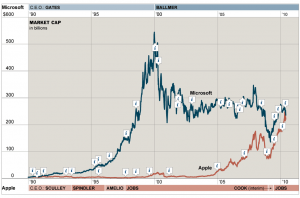
Phi Beta Iota: Industry colleagues point out that Ballmer took over at the top while Jobs came back in at the bottom. Our own view is that a convergence is occurring that will be settled between the personal device and the cloud–who comes up with the most secure reliable personal device (e.g. an eye-screen with earpiece/mike and voice or virtual keyboard or pointer) and the most global affordable mix of call centers, intelligence centers, and M4IS2 softwares, services, and sense-making within the cloud. Google and Oracle and IBM (and their Brazilian, Chinese, and Russian counterparts) are on the same court, but none of them are truly focused on the end game: a World Brain with a Global Game in which we connect all humans to all information in all languages….an open self-organizing world in which profit comes from cost avoidance, truth, reconciliation, and non-zero outcomes.

Engineering for Change is an online environment bringing together engineers and other problem solvers with NGOs and local communities to address basic quality of life issues such as access to clean water, electricity and proper sanitation. Also see their Twitter feed
Related:
+ Engineers Without Borders
+ Architecture4Humanity
+ Open Architecture Network
+ Entrepreneurial Design for Extreme Affordability
+ D-Lab @ MIT
+ Wisdom from Paul Polak on How to Design for the Market
The Technological Disobedience of Ernesto Oroza: In Isolated Cuba, Inventing to Survive
In 1991, Cuba’s economy began to implode. “The Special Period in the Time of Peace” was the government’s euphemism for what was a culmination of 30 years worth of isolation. It began in the 60s, with engineers leaving Cuba for the Unites States, and continues in part today, under the longest trade embargo in modern history.
When Ernesto Oroza, a Cuban-American designer and artist, began studying the technological innovations that have been made during this period, he uncovered a trove of homespun, Frankenstein-like machines that ordinary citizens made for their survival, out of day to day objects. In this episode of Motherboard, we visit Ernesto in Miami to talk about his work and the amazing creations of Cuba’s enterprising DIY inventors.
In the 1970s, a group of scientists and mechanics inspired by Che Guevara formed the National Association of Innovators and Rationalizers (ANIR) as a way of organizing and strengthening this homebrew culture, uniting the ethos of the hacker with the needs of an isolated economy and the call of a socialist revolution. Oroza showed us his meticulous collection of these machines, which he has contextualized as art pieces in a movement he calls “Technological Disobedience.”

By ALAN FEUER
The New York Times, Published: September 17, 2010
EXTRACT:
Mr. Rascoff said the working relationship between the civilian and sworn counterterrorism officials in New York was better than the parallel relationships in the Federal Bureau of Investigation because federal agents, unlike the local detectives, were often as highly educated as the analysts they work with.
“F.B.I. agents sometimes look at their analysts and say, ‘So, basically, we do the same job, but I carry a gun and kick down doors while you sit at your desk all day,’ ” said Mr. Rascoff, who has been working in intelligence since 2003, when he was a consultant to L. Paul Bremer, the special envoy to Iraq.
In the C.I.A., Mr. Rascoff added, the relationship between operatives and analysts is often the chilly one between “an author of cables and a reader of cables.”
In the Police Department, he said, there is an “educational, experiential but not intellectual” gulf that can, paradoxically, bring the sides together.
“While it’s sometimes hard to harness those conflicting energies,” Mr. Rascoff said, “when it succeeds, it succeeds wildly.”
Tip of the Hat to Niels Groeneveld at LinkedIn.
