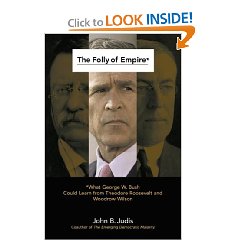
Review: The Folly of Empire–What George W. Bush Could Learn from Theodore Roosevelt and Woodrow Wilson

5 Star, Empire, Sorrows, Hubris, Blowback

Amazon Page
Amazon Page

5.0 out of 5 stars Balanced Review of Lessons from Roosevet and Wilson,

November 12, 2004
John B. Judis
This is a balanced book, well-grounded in history, with an objective air and a very pleasing integration of specific quotes from both the past and the present. It strips away the false airs of the neo-cons, and with trenchant scholarship shows how deeply ignorant America's neo-conservatives and their leading light are of the lessons of history.

The early portion of the book provides an excellent overview, concise, documented, easy to absorb, of the origins of American imperialism in the early century of Christian millennialism followed by civil millennialism. The chart on page 17 is useful, covering the seven period of various styles of American imperialism or avoidance thereof.

The book documents the explicit rejection by the Founding Fathers of empires based on conquest and distance rule, and of foreign political entanglements.

I especially liked a 1780 quote from Reverend Samuel Cooper that captures my own personal belief in how America should relate to the world: “Conquest is not indeed the aim of these rising states; sound policy must ever forbid it. We have before us an object more truly great and honorable. We seem called by heaven to make a large portion of this globe a seat of knowledge and liberty, of agriculture, commerce, and arts, and what is more important than all, of Christian piety and virtue.”

I find it relevant that Mark Twain, among many others in our history, was a staunch opponent of American imperialism.

The middle portion of the book provides a non-judgmental review of how America was lured into imperialism for largely economic reasons, including a fear of losing access to China as well as coaling stations for a global navy.

At the same time, there is a recurring theme throughout the book of the arrogance and ignorance of white Protestants, who believed-as the Spanish did when they began the genocide in the Americas-that the heathen are savages that must be either absorbed or exterminated.

Especially interesting to me is the concept discussed in the book regarding the early American view that all land not under direct human cultivation was “waste land” whose occupants merited removal as a precondition to “civilized” stewardship [exploitation] of the land.

Theodore Roosevelt is discussed in both negative and positive terms-I have the note in the margin here of Roosevelt as the originator of what can easily be called “macho shit racism”-yet Roosevelt also matured, and ultimately set the stage for a discussion of the League of Nations concept.

Woodrow Wilson is the other historical figure in the center of the book, and his ideal of a collective multinational “conscience of the world” receives a good review. Critical within this section is Wilson early understanding that the “balance of power” model for nations was an inherent unstable model. To this I would add a pointer to my review of Philip Allot, The Health of Nations: Society and Law beyond the State where he documents the absurdity of allowing any crime against humanity to occur within any political boundary as part of the acceptance of sovereign borders.

Other specifics include a discussion of morality as an international force, of the importance of trust in mediators who avoid entanglements, of the CIA's early days sponsoring socialist alternatives to communism that now dominate Europe, and of the US failure to respect the North Vietnamese when they first declared independence and publicly stated their respect for the early American model of governance.

The final portion of the book is a review of modern history. Clinton comes across as disengaged, out-sourcing foreign policy to a very ineffective team, while Bush comes across as provincial and ignorant. In both cases the author notes that underlying conditions have changed, with various bits suggesting to me that there are three major things than have changed: capitalism has become immoral rather than innovative; democracy has become apathetic rather than engaged, and dictators have become the norm as US partners, rather than loathed.

The author links Ahmed Chalibi the thief and Iranian double-agent, with Bernard Lewis the historian fool, in a very compelling manner-both contributed to the debacle of Iraq by deceiving first the neo-conservatives, and then the American people.

The book concludes with some thoughtful assertions on the perils of empire, the legitimate historical and current grievances of the Muslims at large, and the urgency of returning to an American foreign policy that relies on collective security, a collective conscience, and a restoration of America's commitment to the rights of individuals to self-determination.

See also, with reviews:
The Fifty-Year Wound: How America's Cold War Victory Has Shaped Our World
The Unconquerable World: Power, Nonviolence, and the Will of the People
The Sorrows of Empire: Militarism, Secrecy, and the End of the Republic (The American Empire Project)
Failed States: The Abuse of Power and the Assault on Democracy
The Paradox of American Power: Why the World's Only Superpower Can't Go It Alone
A Foreign Policy of Freedom: Peace, Commerce, and Honest Friendship


Vote on Review
Vote on Review

Review: HOW ISRAEL LOST

4 Star, Atrocities & Genocide, Consciousness & Social IQ, Crime (Government), Diplomacy, Empire, Sorrows, Hubris, Blowback, Misinformation & Propaganda, Peace, Poverty, & Middle Class, Public Administration, Religion & Politics of Religion

Amazon Page
Amazon Page

4.0 out of 5 stars Pulitzer American Jew Speaks Truth to Power,

November 11, 2004
RICHARD BEN CRAMER
This book wanders a bit but renders a valuable service in speaking truth to power and considering, from a prize-winning investigative journalism perspective, “the story” of how Israel moved so far from its roots as a home for Jews, to a fanatical almost fascist and certainly zealot state concerned with its own survival. I recommend that the review by Mohamed F. El-Hewie, the New Jersey man with the Islam point of view be read in conjunction with this review.

The author opens with an examination of how the “story of Israel” has gone from core reality (a place so barren it makes the Congo look good, Palestinians kicked off their land after Israeli terrorists expelled the British occupying power) to a “land of milk and honey” with deserts made prosperous by Israeli industry–he neglects to mention that Israeli agriculture contributes 3% of the GDP while using 50% of the water, and that most of the water is being stolen by Israeli from underneath land outside Israeli territory.

From an “information operations” perspective, this is a really fascinating and well-told story of how Israel created several myths that sold not only in the USA but all over the world. I write in the margin, “Israel is the ultimate Potemkin village.” The author is also good at exploring the early signs that these myths are being exploded, the world is catching on, and US support for Israel may be on the verge (within five to seven years) of being withdrawn.

As he is both an American Jew and a Pulitzer-prize winning journalist, I give this author special marks for combining a loyalty to his faith with a loyalty to the truth. The Islamic-oriented review from New Jersey adds a frame of reference I am not qualified to comment on, but I recognize it as valuable. Among the most important observations the author makes early on are these: 1) when Israel became an occupying power and got into the business of assassination as a routine method, censorship of Jews by Jews became commonplace–this was the “new aspect” of the Israeli regime. 2) At the same time, in America, self-censorship and popular protest of Jewish readers against Jewish writers critical of Israel, became more marked. The Jews of America–at least the vocal ones cited by the author–simply do not want to hear the truth–they are blindly bonded to the myths.

Sharon is slammed in this book many times over. The author credits Sharon with being the original Israeli army sponsor for assignations, and the several pages on Israeli assassination history and policy are alone worth the price of the book (pages 39-51). Sharon is recalled in the book by General Pundak as “a disgraceful officer–a liar, cheater, a swindler and suck-up, a killer and a coward.” I believe this–sounds like Chalabi and Arafat–the three were made for each other and disgrace us all.

The author explores a second crime against humanity characteristic of the Israeli bureaucracy: collective punishment. He builds a bridge from this–a policy that is explicitly forbidden by the Geneva Convention–to Israel's collective loss of shame and loss of emotional commitment to the “all for one and one for all” attitude that marked the early years. Now it is everyone for themselves, never mind what the authorities do “in our name.”

The chapter on why Palestinians do not have a state is full of interesting observations, including the author's view that the US audience simply does not know the Palestinian side of the story; that the occupation is costing 18% of Israel's GDP (just 1% over the 17% of the Israeli government budget that we provide them out of the US taxpayer's pocket–two different stacks of money, but the comparison needs to be made); and that the isolation of Gaza, and the honeycomb nature of the walls and barriers, are so grotesque as to be both Kafkaesque and Warsaw ghettoish–the victim has indeed become the perpetrator, and Israel cannot be seen, in its treatment of the Palestinians, as anything other than fascist and abusive.

Having torn apart the Israeli side, the author then moves to the Palestinian side, and two major ideas stay with me: first, the concept of honor so deeply rooted in Arab culture, an honor that the Israeli's are attacking with every humility they can impose; and second, the utter contemptible corruption of Arafat and the Palestinian security authorities.

The book moves to a conclusion with a retrospective look at the bargain with the devil made by the Israeli security authorities very early on, when they accepted a dictatorship of the government from the zealot orthodox rabbis. He also explores the various “tribes” now within Israel, concluding that two thirds of the “new Jews” are not Jews at all, but simply Russian and other opportunists who have succumbed to the global covert and overt action operations of the Jewish state seeking to bring in more bodies as part of a demographic campaign plan.

The author can be shocking. He makes a case that is the Jews of Israel who bear the bulk of the responsibility for starting “the hate” and that it is the Israeli government that originally funded Hamas as an alternative to Arafat–an unfortunate reminder of US government funding for Islamic fighters in Afghanistan who have now turned on us.

The author's note and acknowledgements at the end of the book are worth reading carefully, and includes a list of other books on this topic.

I expect a lot of negative votes on this review–that is the price we pay for offering honest opinions in a forum where a deliberate Jewish bloc attacks those like the author–and this reviewer–for seeking to move a balanced dialog forward. Amazon has new algorithms for detecting “hate votes” and “organized negative votes,” we shall see if those work here.

Vote on Review
Vote on Review

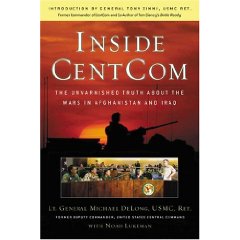
Review: Inside CentCom–The Unvarnished Truth About the Wars in Afghanistan and Iraq

3 Star, Biography & Memoirs, Congress (Failure, Reform), Empire, Sorrows, Hubris, Blowback, Executive (Partisan Failure, Reform), Iraq, Leadership, Military & Pentagon Power, War & Face of Battle

Amazon Page
Amazon Page

3.0 out of 5 stars Puff Piece, Bland, Avoids Conflicting Facts & Big Picture,

November 11, 2004
Mike DeLong
On balance I found this book very disappointing. It reads more like “how I spent my summer vacation” (and like all school essays, avoids the negatives), and it also reads as if the author is either oblivious to or unaccepting of the investigative journalism reporting. I use Tora Bora as a litmus test. For this author to fail to mention that Secretary Rumsfeld authorized a Pakistani airlift that ultimately took 3,000 Al Qaeda and Taliban fighters out of the Tora Bora trap, tells me all I need to know about the over-all balance in this account. It is a glossy rose-colored view more suited for Fox viewers than for any military or intelligence professional who is actually well-read across global issues literature. A great deal of important detail is left out of this 140-page double-spaced book (the additional 80 pages are largely useless appendices used to bulk up the book).

In no way does this diminish the personal accomplishments of the author. He was clearly a great general and a loyal hard-working individual within the military chain of command. The book does however trouble me in that it has a very tight narrow focus on military operations “as ordered,” and does not reflect the kind of geo-political awareness and nuanced appreciation of non-military factors–diplomatic, cultural, economic, demographic–that I want to see at the flag level. His treatment of Sudan in passing is representative: astonished delight that they are “helping” in the war on terrorism, and no sense at all of the massive genocide of the Sudanese government against its own people.

On the intelligence aspect, this book smells a bit. The general has not been close enough to CIA to know that agents commit treason, case officers handle them–calling a CIA officer an “agent” is a sure sign of ignorance about what CIA does and how it does it. He also claims, contrary to many open source reports as well as government investigations, that Guantanamo produced “reams of intelligence.” In my own experience, tactical combatants have very little to offer in the way of strategic third-country intelligence leads, and on balance, I believe that while the general may have been led to believe that Guantanamo was a gold mine, in fact it was a tar pit and a blemish on the US Armed Forces. The author continues to be a believer in the now long-discredited Chalabi-DIA-CIA views on the presence of weapons of mass destruction, to the point of still being in the past on the issue of the aluminum tubes.

There are exactly two gems in this book. The first deals with the problems we had in supporting our Special Forces in Afghanistan above the 12,000 foot level (actually, anything above 6,000 feet challenges our aviation). I ask myself in the margin, “why on earth don't we have at least one squadron of helicopters optimized for high-altitude combat operations?” The Special Air Force may claim they do, but I don't believe it. We need a high-altitude unit capable of sustained long-haul operations at the 12,000 foot level, not just a few modified Chinooks and brave Chief Warrant Officers that “made do.”

The second gem in the book is a recounted discussion on the concept of Arab honor and how US troops in Iraq should have a special liaison unit that approached the families of each person killed “inadvertently” to offer a profound and sincere apology and an “accidental killing fee.” This resonates with me, and I was disappointed to see no further discussion–evidently the general heard and remembered this good idea, but did nothing to implement it.

I have ordered a copy of the Koran and will read it, because I respect this officer's account of how much good it did him in understanding his mission and the context for the mission (aided by a regular discussion of the contents with an Islamic practitioner).

Bottom line: great officer within his scope, moderate author within his mandate, the book is at about 60% of where I would expect to be given this officer's extraordinary access.

Vote on Review
Vote on Review

Review: War, Evil, and the End of History

4 Star, Atrocities & Genocide, Consciousness & Social IQ, Empire, Sorrows, Hubris, Blowback, History, Philosophy, Values, Ethics, Sustainable Evolution, War & Face of Battle

Amazon Page
Amazon Page

4.0 out of 5 stars Connects 9/11 to Long Era of Imperial Deceit & Predatory Looting,

September 18, 2004
Bernard Henri Levy
Edit of 20 Dec 07 to connect to more recent books.

There are some gems in this book, but it is *not* anywhere near the kind of blindingly brilliant, deeply philosophical work that the publicists would have you believe. He is a talented and very wealthy (inherited wealth) Frenchman of the Jewish faith who could be called the Bill Gates of French philosophy, fwith irst-rate marketing.

The author is clearly a courageous and inquisitive individual, and I would rank him third, after Robert Young Pelton and Robert Kaplan, in the “journalist-philosopher-adventurer” category. He has been to all of these places, he has seen with his own eyes, and he writes thoughtfully, if often tediously, about what he has seen.

The real gem in the book is the connection he makes between 9-11 and our deliberate ignorance of the many wars, genocides, crimes against women and children, torture, corruption, etcetera that we in the West have manifested. He writes with conviction and insight about the “meaningless war” across Africa, South Asia, around the globe, where entire regions have descended into a chaotic hell of kill and be killed, work and die, slavery or death, rape then death. His point, which I like very much, is that history does not end, it recycles, and in 9-11 and the global war on terrorism what we have is a “homecoming” of all these wars to America and its Western allies.

This is not, however, completely original, in the sense that the “Map of World Conflict & Human Rights” that I have been handing out to my adult students (thanks to Berto Jongman in The Netherlands for creating it, and to the European Centre for Conflict Prevention and Goals for Americans Foundation, among others, for funding its creation) ably documents all of this is a single compelling document, and many books in the 490+ that I have reviewed cover all aspects of these “ungovernable regions” in great detail.

The author is half absurd and half correct when he condemns the United Nations for its zealous pursuit of Israel as a racist and terrorist state, while the United Nations largely ignores the many genocides taking place from Russia and China to Indonesia and Brazil and Central America and onwards. He is absurd on the first count, correct on the second.

The book is fully worth four stars, definitely worth purchasing, for its articulation of a European view on “the heart of darkness” as it exists today. I was especially taken with his discussion of Buddhist versus Hindu terrorism and extremism and the use of child soldiers in Sri Lanka, since it makes the point that other religions, not just Islam and Christianity, spawn cycles of terrorism and ethnic violence.

The book concludes on a note worthy of the greatest philosophers, a reflection on the death of memory within Western civilization, the death of *moral* memory. Having just returned from Denver, where I was privileged to observe a two-week Office of Personnel Management course on National Security, a first-class endeavor, I was struck by the recurring theme, across virtually all of the world-class lecturers: “morality matters.” Morality has a tangible value in helping nations, organizations, and individuals “get it right.” The last two pages of the book are the best, and conjure up clear and frightening pictures of billions of dispossessed swarming over the European and US cities, bringing the despair we have ignored to our doorstep. Ignore history, ignore evil, and it will eventually, inevitably, come to your doorstep. We–or perhaps even more sadly, our children and grandchildren–will pay for our moral cowardice and our historical blindness. In these final reflections, the author does demonstrate a brilliance that requires us to attend to his future reflections.

More recent books supportive of this author's insights:
Legacy of Ashes: The History of the CIA
Web of Deceit: The History of Western Complicity in Iraq, from Churchill to Kennedy to George W. Bush
The Looming Tower: Al Qaeda and the Road to 9/11 (Vintage)
9/11 Synthetic Terror: Made in USA, Fourth Edition
The Sorrows of Empire: Militarism, Secrecy, and the End of the Republic (The American Empire Project)
The Fifty-Year Wound: How America's Cold War Victory Has Shaped Our World
War Is a Racket: The Anti-War Classic by America's Most Decorated General, Two Other Anti=Interventionist Tracts, and Photographs from the Horror of It
Blood Money: Wasted Billions, Lost Lives, and Corporate Greed in Iraq
Rumsfeld: His Rise, Fall, and Catastrophic Legacy

Vote on Review
Vote on Review

Review: Blood and Oil–The Dangers and Consequences of America’s Growing Dependency on Imported Petroleum

5 Star, Empire, Sorrows, Hubris, Blowback, True Cost & Toxicity, Water, Energy, Oil, Scarcity

Amazon Page
Amazon Page

5.0 out of 5 stars Absolutely Extraordinary: Cheap Oil Equals Lots of Bloodshed,

September 4, 2004
Michael T. Klare
Edit of 20 Dec 07 to add links.

I have heard this author speak to groups of international intelligence professionals, and they take him very seriously, as do I. In many ways, his books complements the one by Thomas Barnett, The Pentagon's New Map: War and Peace in the Twenty-first Century except that whereas Barnett says that the military must go to war to make unstable areas safe for America, Klare points out that a) we don't have enough guns or blood to stabilize a world that we antagonize every time we deploy into an “occupation” mode, and b) cheap oil is going to be very very expensive in terms of American blood on the floor.

Although I have reviewed many books about both the problems within America and its policies, as well as books optimistic about the future of America and the world, I give credit to Klare and this book for finally forcing me to realize that our federal budget and federal policies, in relation to protecting America, are “inside out and upside down.” There is, and Klare documents this beautifully in relation to petroleum, a very pathological cycle that could be easily stopped. We insist on cheap oil, this leads to bloodshed and high oil prices; this comes back to lower quality of life for the workers, etc.

As Klare points out, the pipelines (and I would add the pipe to ship portals) cannot be protected. American policy makers are deceiving the public when they suggest they can stabilize the Middle East and protect cheap oil. Not only can the pipelines not be protected, but on America's current consumption path, according to Klare, the Gulf States would have to DOUBLE production to keep up with American demand.

Klare is also intellectually powerful in painting a future picture when China, Russia, and Europe are in armed competition with the USA for energy from Central Asia, Latin America, under the Spratley Islands, etcetera. As I read Klare's book, I was just shaking my head. Our policies on energy are delusional and destructive, and Klare is among the few that is providing an objective report to the public on this reality.

Klare is actually kind to the current Administration (Bush-Cheney), pointing out that they are no more or less corrupt than previous administrations going back to World War II. Cheap oil has become a mantra, and military power has become the unquestioned means of achieving that–along with supporting 44 dictators, genocide, state-sponsored terrorism (as long as we like them and we get the Jewish vote to boot).

I especially liked Klare's observation that cheap oil for the US is a major contributor to unemployment and destabilization within Arabia. Buying oil from Saudi Arabia subsidizes terrorism. Buying cheap oil from Saudi Arabia increases the number of unemployed who might be inspired to become terrorism. Hmmmm… At what real cost shall we continue to demand cheap oil?

Klare is also very effective in objectively criticizing the manner in which the US Administrations have integrated anti-terrorism initiatives with energy-protection initiatives. Bin Laden is still at large, but by golly, we have 200,000 Americans sitting on top of the Iraqi oil fields.

Klare joins Jim Bamford Body of Secrets: Anatomy of the Ultra-Secret National Security Agency, Chalmers Johnson The Sorrows of Empire: Militarism, Secrecy, and the End of the Republic (The American Empire Project), Derek Leebaert The Fifty-Year Wound: How America's Cold War Victory Has Shaped Our World and a score of other authors who have in one way or another alluded to the fact that we are now doing to China what we did to Russia after the Cold War: needlessly confronting them, scaring them, and pushing them to arm themselves. Klare focuses on our “occupation” of Central Asia, an area of direct concern and interest to China, but I would add our sending seven carriers to the Formosa Straits recently and part of the problem–reminding me of how we sent squadrons of nuclear bombers deep into the Soviet Union from the north, immediately following World War II, just to see how far we could get. WE started the arms race!

The book ends as intelligently as it begins, with emphasis on getting to a post-petroleum economy. Listing all the ways we could get there would be another book in itself, but we could start with neighborhood level solar power, more wind power, deep conservation (which must also apply to water), a gradual elimination of chlorine-based and petroleum-based industries, a turn toward self-sustainment across the board, and what Klare cites as his big three steps:

1) divorce energy purchases from security commitments—stop tolerating dictators and arming terrorist nations for the sake of cheap oil

2) reduce our reliance on imported oil, dramatically

3) prepare the way for a transition to a post-petroleum economy that includes conservation, hybrid vehicles, public transportation, the two-way energy grid that WIRED featured on its cover the same week Cheney met secretly with Enron…and so on.

Fool's gold at high moral cost. Klare makes it clear that if we do not heal ourselves from inside out, that no amount of guns, blood, or destruction will save us from the inevitable implosion of the unstable places where oil is to be found.

Special books read since then that carry the argument forward:
Web of Deceit: The History of Western Complicity in Iraq, from Churchill to Kennedy to George W. Bush
Sleeping with the Devil: How Washington Sold Our Soul for Saudi Crude
Crossing the Rubicon: The Decline of the American Empire at the End of the Age of Oil
Twilight in the Desert: The Coming Saudi Oil Shock and the World Economy
The Long Emergency: Surviving the End of Oil, Climate Change, and Other Converging Catastrophes of the Twenty-First Century
9/11 Synthetic Terror: Made in USA, Fourth Edition

Vote on Review
Vote on Review

Imperial Hubris: Why the West is Losing the War on Terror

5 Star, Empire, Sorrows, Hubris, Blowback, Executive (Partisan Failure, Reform), Iraq

Amazon Page
Amazon Page

5.0 out of 5 stars Finds Legitimacy in Bin Laden's Strategic Goals, Ignorance & Ideology in Ours,

August 13, 2004
Michael Scheuer
Edited 18 Sep 07 to respond to comment and add links to other books.

The author, who has the advantage of being a senior CIA analyst with access to what secrets we do have, has produced what may well be the single most important book in terms of getting this country back on track in relation to the rest of the world. This is the second of three “must read” books I am reviewing today. The first, which sets the stage for this book by providing a truly inspired, informed, extraordinary, and nuanced review of the “just causes” for Muslim radicalization against the USA, is by Mahmood Mamdani, Good Muslim, Bad Muslim: America, the Cold War, and the Roots of Terror The third, best read last, is Paul L. Williams' Osama's Revenge: THE NEXT 9/11 : What the Media and the Government Haven't Told You The latter books paints a compelling portrait, using only open sources of information, on how likely it is that Bin Laden not only has a number–perhaps 20 or more–nuclear devices of one sort or another–but is also receiving technical assistance from Pakistan, Iran, North Korea, and certain Russians in refreshing and maintaining those devices for use within the US homeland to create a “nuclear hellstorm” (Al Qaeda's words).

This book, the second of two by the same person, but easily the most relevant to the salvation of the American dream and homeland, is a tour d'force. It is an incredibly thoughtful, well-ordered accounting of both our mistakes and both the rationality and inevitability of Bin Laden's victory over the US. The endnotes are world-class.

As Congress prepares to confirm a new Director of Central Intelligence, the author's frequent and articulate damning of the U.S. Intelligence Community leadership for its moral cowardice (specifically slamming George Tenet and also Richard Clarke, who is labeled “blusterer in chief”) must, in my view, require that the nominee for the position of DCI promise to clean house as a condition of his confirmation. Above the rank of GS-15, every Senior Intelligence Service officer should be put on probation by the incoming DCI, and half of them should be retired within 2-3 years. The author of this book knows what he is talking about.

The author very usefully slams (on page 175) Michael O'Hanlon from the Brookings Institute, William Hawkins from the Army War College, and Anthony Davis of Jane's Intelligence Review for their absolute misreading of the situation in Afghanistan. it is helpful to emphasize that these and other so-called experts that Congress tends to rely on, are absolutely superb when they do their homework (O'Hanlon is top notch on the non-revolution in military affairs, for example), and very dangerous when trying to milk the issue of the day without doing their homework (on intelligence reform, for example).

I do not want to conclude without highlighting the author's praise for the Foreign Broadcast Information Service (FBIS). They appear, in this one instance, to have excelled at finding and translating every word uttered by Bin Laden and his key aides, in public and in Arabic, and the author–whom I respect completely–is profuse in his detailed thanks to FBIS. Although I and my leading military colleagues consider the FBIS model to be rotten at the core (marginal remote collection, not doing tribal languages or in-country gray literature, broadcasting generic reports largely useless in operational decision making) I do affirm that FBIS can and should be saved, if it can be re-oriented to do for all of its clients what it did for the Bin Laden task force.

In conclusion, I want to focus on what I believe is a misreading by many of the author's recommendation of a “scorched earth” campaign against Al Qaeda as a global insurgency (rather than a law enforcement challenge). Although the author is correct to suggest that such an approach is necessary if we wish to continue doing the six things that Bin Laden wants us to stop, I believe that most readers of this book go into instant denial and fail to see the author's logic, especially when he points out (page 17) that Bin Laden has explicitly stated that he does not desire to expand Islamic dominance beyond existing Muslim countries, and that he will follow us in DE-escalation just as quickly as he is following us in escalation.

What we need to do, according to Bin Laden:

1) End US aid to Israel and support a Palestinian state
2) Withdraw US/Western military forces (not business) from the Arabian Peninsula and all Muslim countries worldwide
3) End US engagement in Afghanistan and Iraq
4) End US support for oppression of Muslims by Chinese, Russian, Indian, and other governments (e.g. Philippines)
5) End US manipulation of oil prices through corrupt dictators
6) End US support for corrRogue Nation: American Unilateralism and the Failure of Good Intentionsupt Muslim regimes

I think this all makes sense, especially when you add the insights from the other 479+ books that I have reviewed, books such as Clyde Prestowitz's , Jonathan Schell's The Unconquerable World: Power, Nonviolence, and the Will of the People Derek Leebaert's “The Fifty Year Wound” and on and on and on. If our policy makers were willing to read and think for themselves, and not spend endless hours trying to leverage their perks and manipulate their more honest constituencies, it seems to me that we could a) get ourselves out of this mess; b) redirect half the national security budget toward global stabilization instead of selective occupation; and c) restore morality to both our global business practices and our global foreign policy.

Probably will not happen until two nuclear devices go off in America–one will be in a shipping container, the other in a Central Park. Just how stupid can America get? We'll have to wait and see–I don't see us getting any smarter.

The Looming Tower: Al Qaeda and the Road to 9/11 (Vintage)
The Road to 9/11: Wealth, Empire, and the Future of America
The Sorrows of Empire: Militarism, Secrecy, and the End of the Republic (The American Empire Project)
Failed States: The Abuse of Power and the Assault on Democracy
Confessions of an Economic Hit Man
Sleeping with the Devil: How Washington Sold Our Soul for Saudi Crude

Vote on Review
Vote on Review

Review: Good Muslim, Bad Muslim–America, the Cold War, and the Roots of Terror

5 Star, America (Anti-America), Culture, Research, Diplomacy, Empire, Sorrows, Hubris, Blowback, Religion & Politics of Religion

Amazon Page
Amazon Page

5.0 out of 5 stars Inspired, Disciplined, Nuanced, Nobel-Level Thinking,

August 13, 2004
Mahmood Mamdani
This is an inspired, disciplined, nuanced, Nobel-level book, and if it ends up saving America from itself, then it would surely qualify the author for the Nobel Peace Prize.

This is the first of three “must read” books that I am reviewing today, and it is first because the other two are best appreciated after absorbing this one. The other two books are “IMPERIAL HUBRIS” and “OSAMA'S REVENGE.”

The main weakness of this book is the author's lack of strong criticism of Pakistan, Egypt, and Saudi Arabia, and of other states that are corrupt, repressive, and therefore a huge part of the problem. Having said that, here are some of the key points:

– “West” pioneered genocide, expulsions, and religious wars, with Spanish genocide of Indians in Americas, and Spanish expulsion of first the Jews and then the Muslims as critical starting points in understanding Muslim rage today
– America adopted terrorism as a preferred means of fighting proxy wars in both Central America and Africa, when Reagan began “rollback” with the same neo-conservative advisors that guide Bush II today.
– West has four dogmas as summed up by Edward Said (who is admired by the author): 1) that Orient is aberrant, undeveloped and inferior; 2) that Orient is inflexibly tied to old religions texts, unable to adapt; 3) that Orient is inflexibly uniform and unable to do nuances; and 4) Orient is either to be feared (Green or Yellow or Brown Peril) or controlled.
– Fundamentalism actually started in the US among the Christians seeking to insert religion into the state's business and ultimately demanding faith and loyalty as the litmus tests for acceptance.
– Earlier generations of Islamic reformists disavowed violence, but ended up adopting violence after being in state prisons (e.g. Egypt).
– Earlier incarnations of a Muslim revival were in the open literature in the 1920's and then in the 1960's, and lastly in the 1980's to date–our national “intelligence” agencies appear to have missed the importance of all three
– Viet-Nam, Africa, and Central America all fostered extremely unhealthy connections between CIA covert operations and the drug trade, with CIA routinely condoning and often actively enabling massive drug operations and related money laundering, as the “price” of moving forward on covert operations.
– The obsession with winning the Cold War at all costs essentially destroyed U.S. foreign policy and set U.S. up as the enemy of the Third World [see Derek Leebaert's “The Fifty-Year Wound”].
– Morality in the US has been perverted, as the extreme right, joining with extreme Zionists, has “captured” the U.S. government in both Congressional and Executive terms. Orwellian “spin” together with the labeling of all dissent, made possible by media corporations “going along”, has destroyed any possibility of informed, objective, or actually moral dialog.
– The Central American campaign pioneered the privatization of terrorism and proxy war by the US, with secrecy and deception of the US public being the principal role of the US government.
– The US Government is explicitly accountable for introducing bio-chemical weapons into the Iraqi arsenal, and thus accountable for the genocide and war crimes attendant to their use.
– US (AID) sponsored textbooks, such as those created by the University of Nebraska, routinely used terrorism against Russians as examples in the mathematic and other textbooks being distributed in Afghanistan.
– CIA's main contribution to the destabilization of the world has been in its Afghan-related privatization of information about how to produce and spread violence, and its training of tens of thousands of jihad warriors from all over the world who have now returned home and are teaching and leading others.
– Under US leadership, Afghanistan has gone from providing 5% of the global opium production in 1980, to 71% in 1990, and even more today–much of which comes to the US.
– America not only accepts massive drug activities as part of the “cost of doing business”, but also ignores human rights in its rush to cozy up to corrupt dictators.
– From an Iraqi point of view, the 1.5 million or so children that died in Iraq due to the sanctions, must be seen as a major war crime and a form of terrorism, together with the air war with its indiscriminate murder of thousands if not tens of thousands civilians including women and children. The US has killed more civilians in Iraq than it did in Japan with two atomic bombs. Napalm and depleted uranium are disabling US troops as well as Iraqi civilians long after their use in the field.
– Economic sanctions, when they have the impact they did in Iraq, must be considered weapons of mass destruction, their application terrorism, and their results war crimes.
– The US Government's general disdain for the rule of law, but the incumbent Administration's particular focus on ignoring treaties and refusing accountability (e.g. for war crimes) sets a new low standard for immoral behavior by nation-states.
– The UN Secretary-General was forced by the US to ignore the Rwandan genocide because of a US desire to keep everyone focused on Sarajevo, and continues to us its veto power to prevent UN from being effective against racist Zionism, which is routinely committing crimes against humanity with its Palestinian campaign.

The author concludes, without sounding inflammatory, that America was built on two monumental crimes: the genocide of the Native Americans, and the enslavement of African Americans. His point: the US is in denial over this reality, while the rest of the world is completely aware of it. He agrees with Jonathan Schell, concluding as Schell does in “Unconquerable World,” that the challenge of our times is in “how to subdue and hold accountable the awesome power that the United States built up during the Cold War.” The last sentence is quite powerful: “America cannot occupy the world. It has to learn to live in it.”

Vote on Review
Vote on Review