PDF (3 Pages): FORBES Blank Slate Intelligence Print Version
Full Text Below the Line

The truth at any cost lowers all other costs — curated by former US spy Robert David Steele.
PDF (3 Pages): FORBES Blank Slate Intelligence Print Version
Full Text Below the Line
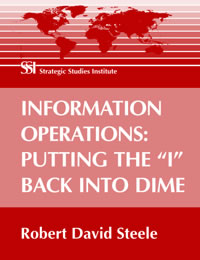
DIME is military for Diplomatic, Information, Military, Economic. It is an old acronym that leaves out Social, Cultural, Technical, Demographic, Natural, and Geographic as well as Political and Criminal, but we work with what we have.
The Strategic Studies Institute (SSI) at the Army War College in Carlisle, PA is one of America's gems, along with other service educational and strategic thinking centers. The professionalism and open-mindedness and rock-solid integrity are models to be emulated by all others.
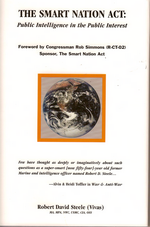
Congressman Rob Simmons (R-CT-02) lost by eighty-three votes in 2006. A retired U.S. Army Colonel who pioneered Open Source Intelligence (OSINT) and whose service on the House Committee for Homeland Security focused on the urgency of greating public intelligence useful to our state, county, municipality, and tribal leaders, his defeat came in part because two editorial boards in his district turned against him with the tide of the times, completely unaware of his very big ideas. This book, published in 2006, was distributed to every member of the House by his staff, and to every Senator by my staff, and we can now be quite certain that not a single Member every actually read this book (just as they do not actually read the legislation they vote on such as the Patriot Act). To read Congressman Simmon's Forword only, click on his photo below.
For a number of related references in the related areas of electoral, intelligence, governance, and national security reform, see Search: smart nation intelligence reform electoral reform national security reform


I have learned a great deal from colleagues at the U.S. Special Operations Command. Their most memorable lesson is captured in the following quotation from a person who in my mind represents the very best intellect and ethics that command has to offer:
“Secret intelligence is 10% of all-source intelligence, and all-source intelligence is 10% of Information Operaitons (IO).”
I have long known that acquisition and logistics are the red-headed step-children of the global defense community, and long realized that we create force structure without regard to the actual threat or the actual geospatial conditions in which we will be waging war and peace, but with this book I attempted to address the totality of our information needs in relation to strategic planning and programming for Whole of Government operations, not just military operations. I also believe that we have failed to develop decision support as well as IO capabilities relevant to cdost avoidance, burden sharing, and leveraging opportunities for creating a prosperous world at peace.



Online Education for EVERYONE Especially the Poor,
After a very engaging book-length discussion of the history of economic theory in modern times, the author gets to the bottom line: education for everyone, and especially the poor, is essential. The author goes beyond this to state very clearly that the existing educational book industries and education institutions (normal schools) are generally worthless in an era of fast changing knowledge. Online education, or at least online selections of up to date mix and match materials that are AFFORDABLE, is the key to bringing entire populations up.
I recommend this book along with Thomas Stewart's The Wealth of Knowledge: Intellectual Capital and the Twenty-first Century Organization Barry Carter's Infinite Wealth: A New World of Collaboration and Abundance in the Knowledge Era Howard Rheingold's Smart Mobs: The Next Social Revolution and most recently, Alvin and Heidi Toffler's Revolutionary Wealth: How it will be created and how it will change our lives as well as their earlier major work, Powershift: Knowledge, Wealth, and Power at the Edge of the 21st Century.
It bears mention that the conclusion of Jeffrey Frieden in “Global Capitalism” bears on this author's determination: government is essential, and it is failed government that leads to the marginalization of education.

Bottom Line: Unfettered Capitalism is Destructive, Need Government,
Although I was less interested in the history, which is very well documented and clearly explained, and more in the lessons for the future, I found two clear bottom lines in this book that are supported by its extensive research:
1) Open societies and open democracies generate more money and more opportunity and more innovation than closed or failed societies; and
2) Keynes was right, there is an urgent vital role for government to play in addressing the social networks, including education, transportation, rules of commerce, and so on, that allow capitalism to work.
The author distinguishes between individual, cooperative, and competitive capitalism, and I found validation in this book for my concept of communal capitalism, a capitalism that is guided by government in avoiding the exportation of jobs, the importation of poverty, and the impoverishment of the middle class.
Unlike David Walsh's book, this book has more of a focus on what is moral and pragmatic, and so I recommend William Greider's “The Soul of Capitalism” as well as John Perkins “Confessions of an Economic Hit Man.”
I have a very strong feeling from this book and others, that the era of “out of control” capitalism is drawing to an end. We may even see the end of the corporation as a separate legal personality in the next 12 years. The transparency of information that is available when people attach themselves leech-like to a corporation and hold it accountable (see my review of “No Logo”) is creating a powerful antidote against the Enrons and Exxons and Wal-Marts of the world who bribe elites and screw over the publics on both ends. I also see Wall Street losing its ability to “explode the client” (see my review of “Liar's Poker”). A great deal of good will be done in the next quarter century, and it will come from a combination of good government and educated engaged citizens working together across all boundaries.

Vastly More Than a Text–The Future of Mankind's Mind,
This author, who earned the Nobel in 2000, has bridged the gap between biology of the mind, and psychology of the mind, but he has done much much more than that. This extraordinary book–perhaps I am alone in seeing this, but I believe it deeply–has finally articulated the connection between the health of the individual brain, and the health of mankind as a whole.
Although much of the book is too technical for my limited political science mind, what I see quite clearly is that this book is the manual for saving mankind's brain by focusing on three connected realities: the food that feeds the mind; the experience that educates the mind; and the visual cueing that stimulates the mind.
I have reviewed virtually all of the books on “wealth of knowledge” and knowledge as a catalyst for innovation and prosperity. What this book did for me was inspire a deeper sense of Hans Morgenthau's earlier focus on the population as the primary source of national power. I am reminded of George Will's Statecraft as Soulcraft as I contemplate the responsibilities of government for the nurturing of its population.
Here is the bottom line from this book as it applies to the future of mankind: the early years are CRITICAL to the ability to learn and innovate and prosper. Poverty will beget poverty UNLESS we work that triangle of food/water, experience, and visual stimulation (Note to the White House: Head Start).
As I read through this book I was acutely conscious of its relevance to the increasing “insanity” of society (see my reviews of Rage of the Random Actor: Disarming Catastrophic Acts And Restoring Lives and also the Dying to Win: The Strategic Logic of Suicide Terrorism.
I do not review this book as a medical book, but rather as a social construction book. It helped crystalize in my mind the absolute ignorance of governments that fail to see that the minds of their individual citizens are the ultimate source of national power.
One final note: the author speaks of the impact of behavior on the brain. I translate that into the good behavior of America as an impact on the world, and especially on hostile Islam and the Middle Eastern countries whose oil we have been stealing for over a century.
I lament any inappropriate hyperbole here, but this book has really moved me. It shows so clearly how isolated our diverse academic and scientific specialities are from each other, how ignorant our governments are of the fundementals of mind and brain.
Wow. My highest praise: relevant to the future of mankind.
