Big data is a resource and a tool. It is meant to inform, rather than explain; it points toward understanding, but it can still lead to misunderstanding, depending on how well it is wielded. And however dazzling the power of big data appears, its seductive glimmer must never blind us to its inherent imperfections. Rather, we must adopt this technology with an appreciation not just of its power but also of its limitations.
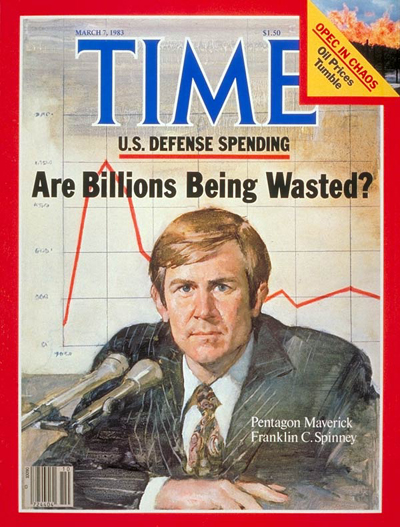
Almost 23 years ago, I wrote a short pamphlet, Defense Power Games. My aim then (as it is now) was to explain why the end of the Cold War would not produce a peace dividend in the form of reduced defense budgets that were substantially lower that those averaged during America's Cold War with the Soviet Union.
Take a quick scan of Defense Power Games … now watch this 25 minute video — America's War Games — (also on youtube here) just released by Aljazeera for its People and Power segment. The video explains why the end of the War on Terror will not, like the end of the Cold War did not, result in a peace dividend
Santayana wrote that those who ignore history are condemned to repeat it. After watching “America's War Games,” ask yourself two simple questions:
“What has changed since the Defense Power Games pamphlet was published in 1990?”
“Will the end of the War on Terror produce a dividend?”
I submit the answers are self-evident: (1) “Nothing” and (2) “No”
But one thing that has changed: Our economy is in far greater trouble today than it was in 1990, although the seeds for the current disaster were being merrily planted during the late 1970s and throughout the 1980s, as well as in the 1990s, not to mention the first decade of the 21st Century. And this time around, it ought to be clear that continuing to assign grossly excessive amounts of scarce resources (capital and skilled labour) to defense spending will make America's current economic problems worse.
So, how can we reduce the defense budget to free up the funds needed by both the private and public sectors to reinvigorate our economy?
Fab Labs, which began at MIT, could bloom under bill in Congress
EXTRACT
The mobile facility, as well as a Fab Lab at the South End Technology Center, are part of a patchwork of some 40 labs around the United States and 80 worldwide. Their fortunes range from well-endowed to hand-to-mouth; the South End one, for example, was short of money and closed to the public for the better part of 2011.
But their financial standing — not to mention availability — could take a huge turn if a US representative from Illinois persuades Congress to create a nationally chartered network for the US labs, to improve their fund-raising abilities, particularly for government money. The measure, which Democrat Bill Foster introduced in March, also calls for placing a Fab Lab in every congressional district.
His goal is, in essence, is to bring the tools of innovation to Main Street.
“It’s very empowering for a young person to actually build something,” Foster said. “Kids no longer take apart automobile engines. You can’t realistically take apart an iPod, like you could a radio. This is giving kids the opportunity for innovation.”
“This is the move from the last industrial-age analog technology to a digital technology,” said Fred Maxik, the chief technology officer with the Lighting Science Group Corporation, one of many newer players in the field.
The efforts start with energy efficiency and cost savings but go far beyond replacing inefficient incandescent bulbs. Light’s potential to heal, soothe, invigorate or safeguard people is being exploited to introduce products like the blanket, versions of which are offered by General Electric and in development at Philips, the Dutch electronics giant.
Innovations on the horizon range from smart lampposts that can sense gas hazards to lights harnessed for office productivity or even to cure jet lag. Digital lighting based on light-emitting diodes — LEDs — offers the opportunity to flit beams delicately across stages like the San Francisco-Oakland Bay Bridge — creating a light sculpture more elegant than the garish marketers’ light shows on display in Times Square, Piccadilly Circus and the Shibuya district in Tokyo.
Finally, we may have some good news about the bees. It's not a done deal yet, but it looks possible. It appears that whereas the American Congress, captured as it is by corporate forces, cares nothing for facts concerning the crisis of the bees, the EU has begun to recognize officially what is happening with these small creatures upon whom our wellbeing depends. And they are seem to be willing to do something about it — ban the insecticides that a growing body ! of research say are at least a major cause of the problem.
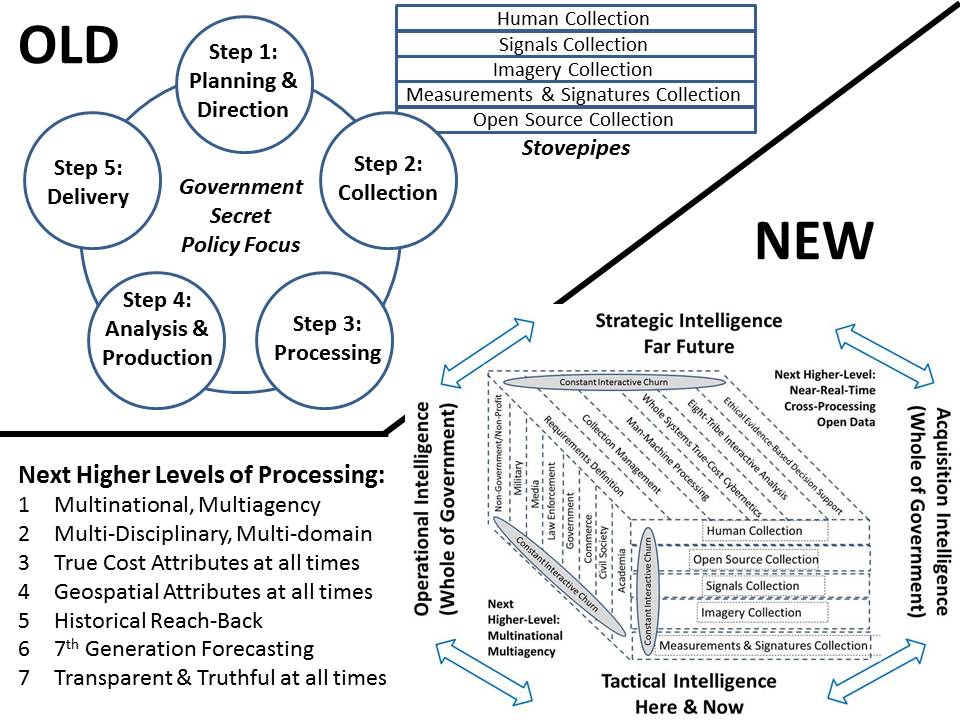
This is what NATO and Africa Command call their J-2 over-arching concept. It is a useful concept, although it needs to be taken several steps further and also needs to be properly funded. Right now it is a shadow puppet that lacks proper multi-lingual multinational sourcing, processing, and analysis, both human and machine. Our over-arching concept for is shown here to the left, along with the existing old concept.
INTELLIGENCE is decision-support. If it is not tailored to and timely enough to support a specific decision, it is not intelligence. If it lacks integrity in the over-all process of collection (e.g. excluding open sources and sources in languages neither CIA nor DoD can handle), in processing (e.g. not processing 95% of the relevant signals and failing to use drones for imagery integration), or analysis (e.g. failing to do outreach to the other seven tribes and the multinationals), it is not intelligence.
KNOWLEDGE DEVELOPMENT is the combination of increased INTER-DISCIPLINARY (all-source) subject matter expertise, and the increased INTER-DOMAIN (academic disciplines) in tandem, such that the individual is increasingly competent and even imaginative and original in applying what they know to leverage what can be known from others. It is the foundation for effective INTELLIGENCE.