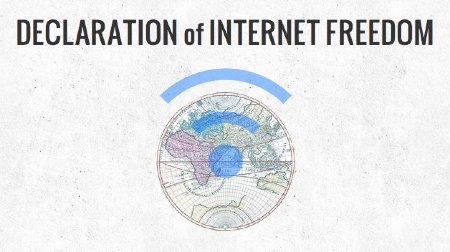
Last week, a group of activists and organizations came together to publish the Declaration of Internet Freedom, a set of principles that make up a vision for a free and open Internet. Groups behind the document include Free Press, Fight for the Future, Public Knowledge, and the Electronic Frontier Foundation, as well as others that fought against and helped defeat SOPA/PIPA earlier this year.
Since its launch, the Declaration has attracted a wide range of signees, including orgs like Amnesty International, the Harry Potter Alliance, and Mozilla; as well as individuals like artist/activist Ai Weiwei, musician Amanda Palmer, and Internet pioneer Vinton Cerf. And just yesterday, Rep. Darrell Issa became the first member of Congress to sign the document.
Read the handy infographic below and voice your support for an open Internet by joining thousands of others in signing the Declaration. Then use the EFF's action page to send a letter to your congressional representative asking her or him to join Issa in signing the Declaration. And if you've got ideas for additional principles or any general feedback about the document, you can contribute your thoughts and suggestions on Step2 and Reddit.
Along the way, I kept track of my process, to help me think about a talk I’ll be giving in October. I send students off to write research papers, and so I should be reflexive about my own work, in order to better teach them how to do research. And I was curious to see how new digital tools would change the way I work, and especially if they would change the questions I might ask and answer in my research. The answers I found: Yes, I could ask and answer different questions, especially about museum visitors. Yes, a research plan is still necessary; serendipitous Googling is not enough. No, digital is not enough; it’s still necessary to visit libraries. And a good reminder: research is only the first part of writing a scholarly paper. It’s also about knowing the big picture, puzzling out connections and making sense of relationships, and most of all, creating meaning. That part hasn’t changed.
Discovery is perhaps the stage of scholarship that’s seen the largest change. Scholars of 19th century American history have a remarkable amount of material available to them online. Newspapers, books, journals, all of them word-searchable. These sources would have been all but impossible to use earlier – I might have read on microfilm the newspapers closest to the Navy Yard, for those days where I knew something had happened. But now it’s easy to simply check out a few hundred newspapers, or a few million books, with a few clicks.
Phi Beta Iota: What is really remarkable is that despite wild spending by the secret world (now $80 billion a year) and huge spending by Google (generally $10 in stockholder income for every $1 in earnings–not a paying proposition in the long run), both machine processing and computer-aided tools for the analysis of all information in all languages all the time continue to STINK. No one has been held accountable for mandating geospatial attributes for every datum in every discipline and domain; no one has been held accountable for failing to break down the barriers to information-sharing and sense-making across the eight communities (academic, civil society, commerce, government, law enforcement, media, military, and non-governmental/non-profit) that each have a separate piece of the total picture on anything. We all knew the requirements in 1985-1989. Still today no government and no corporation and no international organization has gotten their act together. Proprietary does not scale, is not agile, does not work well with others, and is generally full of both security holes and end-user disrespect. At the same time, NSA and other US Government authorities have been severely remiss–if not in outright betrayal of the public trust–in failing to heed the many warnings and specific recommendations of many of us (four of us in the below 1994 letter) with respect to getting cyber-security and cyber-education right from the early days.
In the Philippines, turning plastic waste into fuel
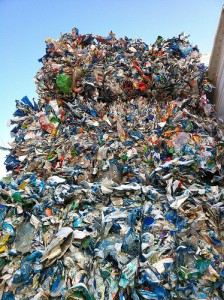
Plastic waste is a problem all over the world. And it is especially troubling in the Philippines where plastic waste piles up in Manila’s Payal landfill, unable to decompose. But one inventor thinks he might have found the answer to this chronic problem.
“Pyrolysis is a fairly simple process, it starts by drying plastics to be processed. They are then shredded into smaller pieces, and heated in a thermal chamber. The melted plastic is continually heated until it boils and produce vapors. The vapor is passed into cooling pipes and distilled into a liquid, which is chemically identical to regular fuel.”
And one of the great benefits of converting plastic to fuel is that the fuel burns cleaner because of a low sulfur content. Navarro estimates that the fuel will be 10-20 percent cheaper because of the low production costs since the raw material is available in such large quantities.
The method has already been approved for industrial use and it is being tested for use in vehicles.
Reuters reporter Elly Park says: “While plastic fuel technology isn’t anything new, Navarro believes that an industrial scale version of his technology can not only help drivers on the road, but help the country dig itself out of its trash problem.”
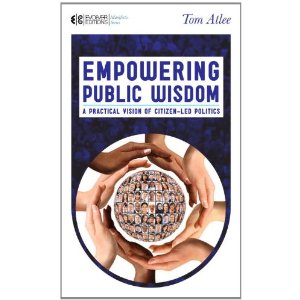
A year ago Doug Reil, the associate publisher of North Atlantic Books, explored with me the possibility of writing a manifesto to clarify my vision of a wise democracy. The culmination of that conversation is my new book EMPOWERING PUBLIC WISDOM: A PRACTICAL VISION OF CITIZEN-LED POLITICS to be released August 7 as part of NAB's Evolver Series.
My 2003 book THE TAO OF DEMOCRACY outlined the theory of holistic politics and listed numerous resources to realize it. EMPOWERING PUBLIC WISDOM takes the next step, painting a fairly detailed – but of course not final – vision of how we could make it happen. It highlights our need for real wisdom to successfully address our 21st century challenges and explores how we can co-create that wisdom in ways that will transform our sense of what democracy is all about.
I invite you to read a bit more about it and to order it in advance for only $14.95 from online or local bookstores. Your order will encourage more bookstores to stock it, and that will help more people see it and buy it, which in turn will help this vision of a wise democracy come to life in the rich compost of our currently wasting-away democracy. Along those lines, if you'd like to alert your social networks to this, please do.
Amazon Page
To give you a better sense of EMPOWERING PUBLIC WISDOM, I've enclosed a description of the book and its table of contents as well as several thoughtful endorsements. At the book's new website – http://empoweringpublicwisdom.us (still under development) – you can also read my brief “Manifesto: A call to establish a legitimate, wise, powerful, collective voice of the people” that declares the intent of the book right upfront. You can also buy the book there.
Finally, the transformational network Reality Sandwich is collaborating with NAB to serialize EMPOWERING PUBLIC WISDOM online – approximately one chapter every 3 weeks. Chapter 1 “Democracy is about power- and the people” is already posted at http://bit.ly/EPW-Ch-1 .
Please join me in spreading the word about this new resource for a co-intelligence society. The state of democracy everywhere suggests it is time for a change.