
What Presidents Don’t Know About Education Plus RECAP of 6 Star Plus Books Relevant to Creating a Smart Nation with a Strategic Narrative that WORKS

04 Education, Academia, Civil Society, Cultural Intelligence, IO Sense-Making
0Shares
DefDog Recommends...

How to Get a Real Education

Forget art history and calculus. Most students need to learn how to run a business, says Scott Adams (Creator of Dilbert)

Wall Street Journal, 9 April 2011

I understand why the top students in America study physics, chemistry, calculus and classic literature. The kids in this brainy group are the future professors, scientists, thinkers and engineers who will propel civilization forward. But why do we make B students sit through these same classes? That's like trying to train your cat to do your taxes—a waste of time and money. Wouldn't it make more sense to teach B students something useful, like entrepreneurship?
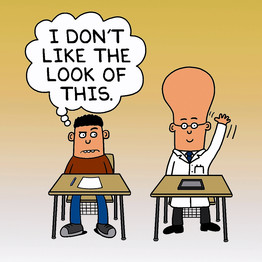
“Why do we make B students sit through the same classes as their brainy peers? That's like trying to train your cat to do your taxes—a waste of time and money. Wouldn't it make sense to teach them something useful instead?”

. . . . . .

By the time I graduated, I had mastered the strange art of transforming nothing into something. Every good thing that has happened to me as an adult can be traced back to that training. Several years later, I finished my MBA at Berkeley's Haas School of Business. That was the fine-tuning I needed to see the world through an entrepreneur's eyes.
If you're having a hard time imagining what an education in entrepreneurship should include, allow me to prime the pump with some lessons I've learned along the way.

Combine Skills  ..  Fail Forward  ..  Find the Action  ..  Attract Luck  ..  Conquer Fear  ..  Write Simply  ..  Learn Persuasion

. . . . . .

That's my starter list for the sort of classes that would serve B students well. The list is not meant to be complete. Obviously an entrepreneur would benefit from classes in finance, management and more.

Remember, children are our future, and the majority of them are B students. If that doesn't scare you, it probably should.


Read  expansion on the Seven Methods and complete article….

Continue reading “What Presidents Don't Know About Education Plus RECAP of 6 Star Plus Books Relevant to Creating a Smart Nation with a Strategic Narrative that WORKS”

40 Years of Doing Intelligence Analysis-Lessons

Analysis, Articles & Chapters, Intelligence (government), Methods & Process
0Shares

Martin Petersen  Studies in Intelligence Vol 55 No 1

An advantage of getting older is increased perspective. I have been doing, thinking and writing about intelligence and intelligence analysis for almost 40 years now. The business we are in has changed a great deal in that time, but more in its form than in its fundamentals.  I want to focus on three broad topics: understanding the customer, the importance of a service mentality, and the six things I learned in doing and studying intelligence analysis during my career in the DI. While these experiences are drawn from work in the CIA, I believe the principles apply across the Intelligence Community (IC).

Understanding the Consumer: Five Fundamental Truths

The Importance of a Service Mentality

The Six Things I Learned

Read the complete article….

Phi Beta Iota: This is a pleasure to read, and useful.

See Also:

Jack Davis on Analysis (All Phi Beta Iota Posts)

New Rules for the New Craft of Intelligence

Web’s Copernican Moment – Hand-Held Rules

Advanced Cyber/IO, Autonomous Internet, Civil Society, Collective Intelligence, Commercial Intelligence, Cultural Intelligence, Mobile
0Shares
Chris Pallaris Recommends

The Web's Copernican Moment

Dominic Basulto on April 4, 2011, 9:57 PM

bigthink

Whether consciously or not, most of us subscribe to a PC-centric view of the Internet, in which everything revolves around content that is created or accessed via a PC or Mac. However, that is about to change as mobile increasingly becomes the new paradigm for both creating and consuming content. Quite simply, the Web is about to experience a Copernican moment. Before Copernicus, it was widely believed that everything – including the Sun – revolved around the Earth, rather than the Earth revolving around the Sun. In the same way, it might be quaint one day to believe that everything once revolved around the PC rather than the mobile device.

The easiest way to understand this Copernican moment is to understand the extent to which mobile is becoming the new paradigm for the way we use the Internet. In terms of hours of usage, total content consumed and amount of data created, 2010 was the year of the mobile device. Keep in mind that the average teen now sends more than 3000 text messages each month! And that trend is only accelerating in 2011 as social networking rapidly migrates to the mobile device.

Read rest of article….

New Institutions as Bulwark Against the Corporate-Political State

Advanced Cyber/IO, Communities of Practice, Cultural Intelligence, Ethics, Methods & Process, Policies
0Shares
Michael Ostrolenk Recommends...

New Institutions as the Bulwark Against the Corporate-Political State from Kevin Rollins on Vimeo.

Michael Ostrolenk and Kevin Rollins discuss the role of new media, both social media like facebook and twitter, as well as niche magazines. Ostrolenk says that such forums help new ideas because they “remove barriers to entry and support [new idea] generation.

Five minute video

Search: “the truth at any cost reduces all other

About the Idea
0Shares

This is Robert Steele's core phrase, apart from the two Latin mottos (at end).

“The truth at any cost lowers all other costs.”

Citation (2 options):

Robert Steele, “About” at Phi Beta Iota the Public Intelligence Blog, 4 July 2010.

Robert Steele, “Cyber-Command or IO 21,” US Army Information Operations Conference, 6 April 2011.

It was inspired by Herman Daly and other champions of “true cost” and ecological economics.  Also influencial were these two quotes as found on the About page of Phi Beta Iota the Public Intelligence Blog.

Fedor Dostoevsky: A man who lies to himself, and believes his own lies, becomes unable to recognize truth, either in himself or in anyone else.

Bob Seelert, Chairman of Saatchi & Saatchi Worldwide (New York): When things are not going well, until you get the truth out on the table, no matter how ugly, you are not in a position to deal with it.

Latin mottos

E Veritate Potens.  From Truth We (the People) Are Made Powerful. Created for OSS.Net, Inc.

Connexum Sumus Unum.  Connected, We Are One. Created for Earth Intelligence Network, 501c3.

Still need a Latin scholar to certify the new one (Connexum…)

Complex Societies Collapse When Commodity Prices Go UP and Financial Speculation Returns Go DOWN

Analysis, Communities of Practice, Corruption, Cultural Intelligence, InfoOps (IO), Intelligence (government), IO Sense-Making, Key Players, Policies, Power Behind-the-Scenes/Special Interests, Threats
0Shares
John Robb

JOURNAL: Oil >$100 Crunch time ahead (again)?

The last time the price of oil topped $100 a barrel for an extended period, we ended up in a global financial meltdown.  Is this time any different?

Not much.

All of the excessively financial leverage and fraudelent derivative wealth we had during the last melt down is still in place.  Total debt to GDP levels in the US are about the same (370% of GDP or so).  No reforms were made on Wall Street.  Nobody at fault for the fraud that led to the last melt down went to jail, so behaviors haven't changed.

We're worse off than before.  Read rest of article…

This is classic Tainter (the excellent anthropoligist/historian).  He posited that complex societies only collapse when the costs of basic inputs increase at the same time the returns on investments in complex institutions/etc. turn negative. So, with oil going up again, we are seeing basic input costs rise.   It's also clear that our twin overheads Government and Global Finance are well past the point they delivered positive returns for additional complexity.  Worse, they are colluding, via cronyism, to prevent any meaningful changes.

See Also:

Review: The Collapse of Complex Societies