A federal judge on Tuesday awarded $20,400 each to two American lawyers
illegally wiretapped by the George W. Bush administration, and granted
their counsel $2.5 million for the costs litigating the case for more than
four years.
It was the first and likely only lawsuit in which there was a ruling
against the former administration’s secret National Security Agency
surveillance program adopted in the wake of the September 11, 2001 terror
attacks.
WikiLeaks and Operation Payback have put distributed denial of service (DDoS) attacks in the news recently, but independent media and human rights Web sites have been battling these attacks on a consistent basis with no easy solution in sight, according to a Wednesday study.
While major sites can fend off a DDoS or recover quickly, smaller sites can be crippled by these attacks, which often hit in conjunction with other attacks like filtering, intrusions, and defacements, according to the Berkman Center for Internet & Society.
“DDoS is an increasingly common Internet phenomenon capable of silencing Internet speech, usually for a brief interval but occasionally for longer,” the report said. “Our report offers advice to independent media and human rights sites likely to be targeted by DDoS but comes to the uncomfortable conclusion that there is no easy solution to these attacks for many of these sites, particularly for attacks that exhaust network bandwidth.”
The report's authors suggest that DDoS attacks will become more common amidst news about similar WikiLeaks and Operation Payback attacks. Even before that, however, DDoS attacks on independent media and human rights sites were quite common during the last year, happening even outside of major events like elections, protests, and military operations.
These sites are being hit with two types of DDoS: application and network. Application attacks exhaust local server resources and can usually be rectified with the help of a skilled system admin. Network attacks, however, exhaust network bandwidth and can usually only be fixed with the (costly) help of a hosting provider.
Phi Beta Iota: There is no other person we hold in higher esteem than Tom Atlee. For America the Beautiful, at least, he is this generation's Wise Man. Below in his own words. We urge one and all to contribute to his sustenance.
I have been talking a lot lately with strategists in the Coffee Party movement (CPM). If you don't know much about the Coffee Party, I urge you to check out their website and Wikipedia's well-referenced short article on them.
While the Coffee Party has definite progressive roots, it also features bright transpartisan energies. Most Coffee Party members — and co-founder Annabel Park — promote civil dialogue about public issues. They also promote democracy-building policies, especially ones to address the democracy-degrading influence of money in politics.
I much prefer the Coffee Party's brand of transpartisanship to the more recent No Labels movement whose goal is “to encourage politicians to come together to develop pragmatic and workable solutions.” Politicians? What about We, the People? What about citizen deliberations and stakeholder dialogues? I can't help but wonder what informed citizen deliberative councils would have to say about the issues the No Labels site addresses…
Although I'm still open to evidence to the contrary, it seems to me that No Labels is trying to co-opt the very real frustration most Americans feel for the political polarization and legislative logjam they see every day. I fear No Labels is cleverly reframing the meme of transpartisanship to rally growing populist energies around a hidden special interest agenda — perhaps building a movement to support a Bloomberg presidential bid in 2012.
Check out “No Labels: What’s Behind “Forward?” Pro-Corporate Economic Policy.” While I don't agree with everything Jim Cook writes or implies there, I think it is significant that all three No Labels co-founders are professionally involved in promoting corporate interests, and that they advocate tapping Social Security to reduce the debt — when SS is not actually a part of the federal budget, per se, but is a collective retirement account into which workers have paid for decades which has lately been ripped off for budgetary expenditures. Their budget concerns do not highlight the gigantic portion of the actual budget that goes to military expenditures — to say nothing of the non-budgeted expenditures for the wars in Iraq and Iran which constitute a gigantic part of the federal debt — military expenditures that are greater than all other military budgets in the world combined. Nor do they feature the many forms of corporate welfare and the option of raising taxes on the hyper-wealthy to the 1950s levels. Notably, they depend heavily on the Peter G. Peterson Foundation, a very partisan source, as their favorite budgetary reference.
The whole thing doesn't smell right to me. But I do see it as another indicator of how powerful the emerging transpartisan populist trend is, that so much elite attention is being dedicated to co-opting it.
Three items here on major DNI flub on national TV new. I saw interview in question — no tricks or BS on part of reporter Diane Sawyer. Lt Gen Clapper was just unprepared and came off looking like a cretin. ODNI staff didn't prep the boss or the boss was stupid. Of course, my personal view is that zone of consideration for the DNI position should start and stop within CIA, with officers who have been either D/CIA or D/NCS.
Phi Beta Iota: We do not concur with the assessment above. We were the only ones to publicly defend Jim Clapper with a national press release and other measures when Donald Rumsfeld had the gall to fire him for being honest, and we will again defend him. This is all on John Brennan, hardly an Ollie North but trying never-the-less. As for who should be DNI, we will point to the two memoranda that went to Condi Rice on national intelligence reform unsolicited, the second invited on homeland defense intelligence, to Chapter 13 from Book One and Chapter 15 from Book Two, and to the Technical Preface by Robert Garigue (RIP) in Book Three. We have a proliferation of “czars” because the Office of Management and Budget (OMB) has not been able to manage anything since the mid-1980's if not earlier. If the President (or the DNI) ever wants to get it right, he can start right here. We should have a Deputy Vice President for Education, Intelligence, and Research, not a DNI. Everyone, without exception, means well, but they just do not have the mind-sets to actually do the right stuff. The next two years will be largely wasted, in our view.
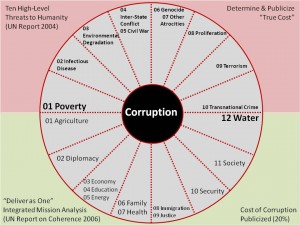
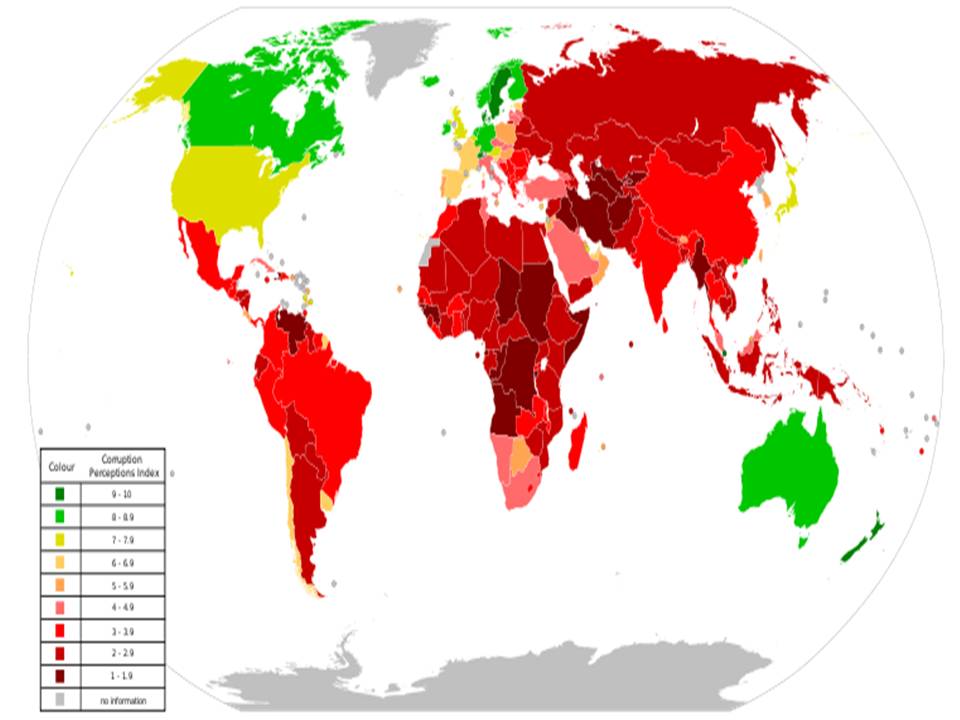
Phi Beta Iota:Buckminster Fuller and Russell Ackoff nailed it–everything has to be evaluated in relation to energy source and cost and time cost, and you have to focus on doing the right things, not doing the wrong things righter. Where Mr. Pickens went wrong was in sticking with the centralized ownership concept. Wind power and solar power are best for localized applications. The central grid–the Industrial Era top down control grid, is DEAD. Similarly, water and sewage should not be centralized grids demanding massive investments in collection and processing. The graphic to the right shows corruption in the center–when analytics and decision-making lose their holistic integrity, they inevitably fail to achieve the desired outcome while creating cascading costs everywhere else. Military spending in the USA is at the beginning of a nose dive–our military leaders would be wise to get a grip sooner than later, and “beat the dive” by making evidence-based decisions (Advanced IO) sooner than later. Now a really advanced thought: 21st Century national security is about eradicating corruption at home and abroad–this makes possible the creation of a prosperous world at peace. The breadth of that challenge is in the graphic below. That is an IO challenge, not a kinetic challenge. IO must be co-equal to kinetics beginning immediately. In our humble opinion.
By Greg Miller Wednesday, December 22, 2010; 12:24 AM
The CIA has launched a task force to assess the impact of the exposure of thousands of U.S. diplomatic cables and military files by WikiLeaks.
Officially, the panel is called the WikiLeaks Task Force. But at CIA headquarters, it's mainly known by its all-too-apt acronym: W.T.F.
The irreverence is perhaps understandable for an agency that has been relatively unscathed by WikiLeaks. Only a handful of CIA files have surfaced on the WikiLeaks Web site, and records from other agencies posted online reveal remarkably little about CIA employees or operations.
Phi Beta Iota: We understand that CIA used to handle Department of State Embassy traffic, and the ugly little fact associated with WikiLeaks, that the Department of Defense is now handling Department of State traffic, has been buried. The DoD “Grid” is hosed and is never going to be fixed absent a a clean sheet break from the legacy and the contractors. GAO is interested in doing an update to its first two damning indictments of DoD's Swiss Cheese Communications environment, it just needs one Member of Congress to ask for it….
Afterthought: CIA had a chance in 1986, under Bill Donnelly (DDA), Ken Weslick (C/DO/IMS), and Robert Steele (PM Project George (Smiley)), in combination with the superb work of Gordon Oehler, Dennis McCormick, and Diane Webb in in DI/OSWR, to get it right. They were specifically told at the highest levels that they needed to do two things: change the paradigm from “once in, everything visible” to “need to know tracking and accountablity,” and implement the “reverse hit” strategy that disclosed need to know hits to the owner of the clandestine or covert information rather than the seeker. With Bill Casey's death CIA lost whatever chance it had of entering the 21st Century moderately coherent. We have wasted close to a quarter century because DoD had a death drip on ADA and refused to contemplate object-oriented programming or open source software for decades beyond ADA's natural death, and OMB gave up the concept of inter-agency interoperability and secure information-sharing in the 1980's. At the same time, the National Information Infrastructure was all theater and no security. Marty Harris meant well, but he simply would not focus on fundamentals such as code-level security, education, and strict classification limitations.