Exhibition at Carnegie Mellon gives geography a new meaning
“Experimental Geography” is both the title of a mind-expanding exhibition and a term coined by contemporary artist/geographer/activist Trevor Paglen, who will speak tomorrow at Carnegie Mellon University.
If a geographer informs us about the land that we move within, or study from afar, an experimental geographer considers that land from the creative vantage point of an artist.
“In a manner that deploys aesthetics, ambiguity, poetry and a dash of empiricism,” the exhibition text explains.
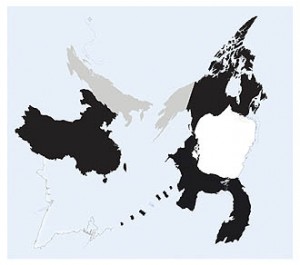
“Mappa Mundi,” a digital print by New York artist Lize Mogel, is part of a series exploring public space and cultural geography.
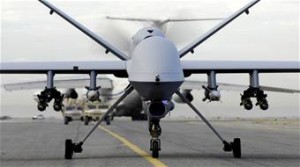
As a medium-altitude, long-endurance remotely piloted aircraft, the Reaper locates and destroys time-critical and highly mobile targets and provides real-time intelligence, surveillance and reconnaissance to military commanders.
To the best of our knowledge, both Translators without Borders and Telelanguage.com are reputable organizations and have nothing to do with fraud or scams. We happen to think very highly of Telelanguage.com, which among many other innovations made its software “open source” for potential future expansion. Both of these organizations are positioned to replace–bury–the antiquated US and NATO translation systems that rely on “trusted” citizens with clearances. No such thing–indeed, trusted citizens with clearances usually screw up the translations and create more dangerous problems in so doing.
The “scam” that gullible Americans are rocketing around the Internet is more of an urban myth and also a very well known scam going back through the ages, of the “overpayment” in advance and then the request. Few people seems to realize that cashing a check provides little protection against the check being rescinded. In any event, there is no connection between these two reputable companies and the gossip-fraud report that is circulating, as far as we know.
Many problems in alleviating humanitarian crises caused by natural catastrophes, like that in Haiti, have less to do with raising money and aid and more to do with how the flows of money and the aid are processed through the maw of bureaucratic institutions like the military, Red Cross, and the ever growing welter of NGOs. Adding to the complexity of multiple bureaucratic agendas is a sensationalist media that descends on the catastrophe like a cloud of locusts; it is naturally biased to exaggerate and generalize from any extreme incident like looting or killing or “feel-good” altruistic hype. Many times the picture on the ground is very different than that perceived through lenses conditioned by the needs of bureaucracy and sensationalism — but, like a self-fulfilling prophecy, reality is often made worse by how that conditioning feeds back on and distorts the OODA loops of the various bureaucratic agencies and the public.
My friend Robert Steele, a former Marine intelligence officer and a longtime promoter of the using “open source intelligence,” to open, sharpen, and quicken decision cycles (OODA Loops), just debriefed Sgt William McNulty (USMCR) about his recent trip to Haiti. Readers may recall that I forwarded McNulty's initial spot SITREP a few days ago. The attached interview organizes and adds information to that spot report.
Sgt McNulty's findings are very important and should be carefully considered. In my opinion, he exemplifies the kind attributes we seek in our military personnel — intelligence, drive, initiative, and forthrightness. In this interview he identifies crucial bottlenecks blocking the flow of aid to the Haitians. According to McNulty, many of these bottlenecks are self-inflicted and emanate from the US obsessions with top-down organization, bureaucratic control, and security. What is different and makes McNulty's report valuable is that he examines these bottlenecks from the viewpoint of those on the receiving end of the aid pipe, AND he identifies some ground-level examples of the kinds of self-organizing bottom-up initiatives, based on individual initiative and empowerment of those at the working level, could work more quickly to get aid to where it is needed the most.
Phi Beta Iota: Chuck's comment arrives as the media is starting to report that the U.S. military is declaring victory and winding down. From where we sit, there is still a need for all that the military did not do in the first 10 days. Haiti is an information and logistics challenge of the first order that none of the NGOs and most nations including Brazil simply cannot handle. If the USA does not step up to its Responsibility to Protect, then we anticipate both another 100,000 deaths, and a million or more incurring dehydration and starvation related illnesses. This is no way to run a railroad!
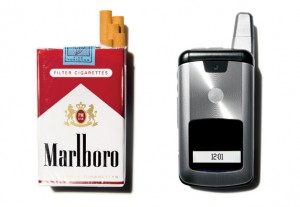
Warning: Your Cell Phone May Be Hazardous to Your Health (GQ)
Christopher Ketcham
Ever worry that that gadget you spend hours holding next to your head might be damaging your brain? Well, the evidence is starting to pour in, and it's not pretty. So why isn't anyone in America doing anything about it?
Phi Beta Iota: This is “old” news that is still news because neither the government nor the public actually pay attention. We've known since the 1980's that Soviet emission controls were ten times tougher than ours, and now in Afghanistan as we find UAVs and all other devices conflicting with each other across old “dumb” (assigned) spectrum, we are learning, AGAIN, why spectrum consciousness matters. Open Spectrum and smart devices are the way to go, along with public truth-telling about electromagnetic emissions as part of the “true cost” of all devices.