Excellent Presentation of Core Ideas with Lots of Examples,
April 27, 2007
Chip Heath
This book is getting a great deal more attention than Allison Fine's “MOMENTUM: igniting social change in the connected age,” so up front I want to say I consider them BOTH to be extremely complementary to one another, and MUST READS for any social activist or political reformer, as well as for those crafting educational or corporate messages.
I cannot improve on Brian Bex Huf's review, which I voted for, but for the sake of coherence for those who are alerted when I do a review, here is the meat from Brian's review:
* Simplicity: the idea must be stripped to its core, and the most important concepts should jump out.
* Unexpectedness: the idea must destroy preconceived notions about something. This forces people to stop, think, and remember.
* Concreteness: avoid statistics, use real-world analogies to help people understand complex ideas.
* Credibility: if people don't trust you, they'll ignore you. In some cases, they will be openly hostile, which means they'll actively try to dispute your message!
* Emotional: information makes people think, but emotion makes them act. Appeal to emotional needs, sometimes even way up on Maslow's hierarchy.
* Stores: telling a story [gets] people into paying closer attention, and feeling more connected. Remember the Jared Subway commercials?
The book ends with a five page reference guide that persuaded me of the author's value as consultants. They have given us a low-cost book we can use our5selves, but I am also persuaded they are valuable as brain-stormers for those trying to craft transpartisan and electoral reform messages, so I am recommending them both to the leadership of Reuniting America.
LOTS of details and examples. Easily a five-star book with great social and political value.
Nails It–Secretary of Education Needs to Read This Book,
April 27, 2007
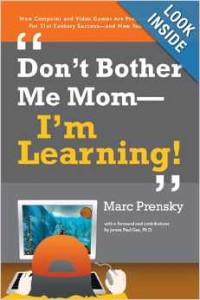
Marc Prensky
I was introduced to the author's work on Digital Natives by a very smart and unusually open-minded colleague at the National Geospatial Agency, and I am hooked as well as relieved.
The greatest complement I can give this book is that my 15-year old, a master of Warlock, saw this book come in the door and immediately took it away from me and read it overnight. He gives it high marks.
This is also the book that inspired me to take Serious Games and Games for Change *very* seriously. Most gamers do not understand the need to work toward an EarthGame that includes actual budgets and actual science, but Medard Gabel of BigPictureSmallWorld gets it, and that's enough for me.
The list of games provided at the end by the author, to create a serious game home learning environment, is priceless. Some may be overtaken by events but the bottom line is that digital learning is vastly superior to rote learning in schools.
I am a participant in three Hacker communities–Hackers on Planet Earth (HOPE) based in New York, Hac-Tic based in Amsterdam, and Hackers/THINK based in California. I have met thousands of hackers over the years, and I am certain that the best and the brightest are not those with straight A's in the current school system, but those that tune out the high school regime by their junior year, and start learning what they want to learn on their own. My oldest son just won first prize in the Fairfax County digital music content, representing his school, but he will not graduate because he refuses to spend time on Algebra 2. He has very high SAT scores, will pass the GED with an almost perfect score, and will take digital music and digital art courses at three colleges in the DC area as a non-degree candidate. I go on at length here because this is both very personal for me, and also a national disaster–our entire curriculum is so out of date, and taught by so many drones, the few master teachers not withstanding, that I completely understand why our national ranking in math and science is out the window, why we have fallen to 7th on the national innovation scale, behind three Nordic countries and three Asian countries.
I admire this author. In a most positive manner, he is telling us the Secretary of Education is quite naked, and what we can do about it. This is a foundation book for any parent of “digital natives.”
Renaissance of We the People, Unifying the Young and Old,
April 27, 2007
Jim Rough
This is one of the most brilliant and compellingly comprehensive books I have read in recent time, and certainly one of less than 100, probably less than 25, and perhaps even one of the ten most important books available in English.
Everyone, including corporations, is starting to realize that Green is Good (see my list on Natural Capitalism), and that the Earth is at a tipping point. The ten high-level threats are Poverty, Infectious Disease, Environmental Degradation, Inter-State Conflict, Civil War, Genocide, Other Atrocities (e.g. kidnapping for body parts or child soldiers), Proliferation, Terrorism, and Transnational Crime.
What this author has done is pioneered the concept of Wisdom Councils at every level of society, a leap ahead of citizen involvement initiatives like Citizen's Councils formed in Denmark to study issues of national importance for legislative action. This book suggests a strategy for bringing “all” together as “We the People” where We assume our rightful role as intelligent top authority.
The author is acutely aware that we are fragmented, ignorant, inattentive, and ineffective as a collective at any level. He suggests that we got that way because we adopted a mechanistic system to govern us, where self-interest is the prevailing value, rather than dignity, sharing, open-mindedness, and so on.
He articulates a vision of a We-ocracy, a circle instead of a box, with a spirit similar to our Native American councils, where people seek what's best for all. And, he suggests a surprisingly simple social invention, not fully tested, that can make the vision real.
It was my great good fortune to meet the author personally at the Nexus for Change conference organized by Peggy Holman and others, and I found him to be one of the most sensible, down-to-earth, and focused individuals I have ever met. He told me there that collective problems require collective solutions, and I agree with him completely. It's about all of us, as well as each of us. Along with this book I recommend Tom Atlee's “Tao of Democracy” and the other books linked to below.
The author's conception of the Wisdom Council, which is now enjoying significant success and public appreciation in the Eco-topia of the Pacific Northwest, is one of a continuous Constitutional Convention with all of us as permanent delegates. It is a way “We the People” can come into existence and collectively choose topics, explore them and evolve consensus … possibly some sensible sustainable decision or policy that goes out 200 years (what the Native Americans called 7th Generation thinking).
It's a simple approach that bridges all eight of what I call the tribes of intelligence–government, military, law enforcement, business, academia, non-governmental organizations, media networks, and most importantly, all citizens in all civil societies including social advocacy groups, labor unions, and religions.
The book describes an innocuous-seeming Constitutional Amendment to the United States Constitution. But the author inscribes the book to me, ending with “we don't need an amendment, we are out doing it.” Now, there are experiments in cities and organizations in different countries, begun by ordinary citizens, proving that this strategy can work. (see www.WiseDemocracy.org) This is good news for those of us who care about society as a whole.
I recommend this book, and the three books below, to every citizen and especially to the 48% that do not vote. We get morons and thieves in power because we all do not vote and hence these charlatans are elected by a minority of dogmatic fanatics aided by less than honorable tactics such as Karl Rove has pioneered (see “Bush's Brain”).
But beyond the bits of power our system currently provides to “the people,” all-of-us-together can assert power over the system. This book, the books below, and the many books I connect in my varied lists, show us how. They are ammunition in our combat with the Republican and Democratic Party mafiosos. Unity08 is in my view a scam–a last ditch defense of the totally corrupt two-party “winner take all” and share the spoils system. Only the Center for Wise Democracy, Reuniting America, the Transpartisan Policy Institute, and a couple of other massive social networks now in formation, can transform political hypocrisy, corruption, and illegitimacy. Our government today, all three branches, is illegitimate. We can fix that.
We are long overdue for a popular uprising. This author, like Gandhi (see the DVD), provides for an informed non-violent revolution that is both inevitable, and unbeatable. We the People … what a great concept. Time to honor it again, with the Wisdom Councils and the strategy of full engagement that the author outlines for us.
Sir David Ramsbotham is General (Ret.), British Army, and has served as a consultant to the UN on peacekeeping issues in Cambodia, Cyprus, Israel, Lebanon, Somalia, and Yugoslavia. Apart from his Army experience, rising to Adjutant General (number two on the Army Board, responsible for personnel and training) he has spent three years in the private sector dealing with UN and World Bank post-conflict resolution and de-mining challenges, and was HM Chief Inspector of Prisons from 1995-2000. Today he is a Fellow at Corpus Christi College within Cambridge University and continues to take an interest in peacekeeping intelligence matters.
Major leap forward in understanding humanity and its future,
April 21, 2007
John Clippinger
As a long-time admirer of Kuhn's concepts on paradigms and how they shift (“The Structure of Scientific Revolution” I really appreciate any thought leader that puts us on the cusp of such a shift. John Henry Clippinger is there.
I will begin with his conclusion: we are in the process of a “Big Bang” in human identity that shifts us away from organizations and nationalities and races and religions, and toward the realization that we are all “one” in terms of fractional variations of the same DNA, and hence, the world is going to start to revolve around the human end-users, not the organizations that turned them into slaves, amoral components of the industrial system, or mindless fundamentalists party to intolerant religions. For a sense of how the industrial era introduced evil by killing the role of kinship in trust, see Lionel Tiger's “The Manufacture of Evil.”
In my view, this is one of three really great books on the coming revolution in human organization. The other two are Max Manwaring's “The Search for Security” and Philip Alott's “The Health of Nations.” As Alott says, we took a wrong turn at the Treaty of Westphalia, and the world is long over-due for a return to localized kinship and global responsibility.
Those who favor the transpartisan transformational model of earnest and honest elections and engaged citizenry must read this book. The author opens with a long discussion of why it is relationships that matter, not transactions. Indeed, I am reminded of Margaret Wheatley and Esther Dyson–make the connections, don't worry about critical mass.
I learn the term “social physics” for the first time, and read again about reciprocity (Tom Atlee taught me about reciprocal altruism). The author disputes the idea that violence is a given, and joins Jonathan Schell (“The Unconquerable World”) is stating that force is no longer a means by which to gain one's will.
The middle of the book discusses both the threat of technical progress when combined with more failed states, and the promise of digital modeling for accelerating our understanding and testing new paths forward. The author points out that we have no more than 20 years, having wasted the last six, with 2000-2025 being the tipping point period during which we can either go toward stable convergence or hyper-instability and cascading catastrophe.
Brilliant quotes on how the military must shift to soft preventive and remedial measures (General Al Gray, USMC and I called this “peaceful preventive measures in 1988), and how “Brute force is about to be rendered obsolete” at the state level (while flourishing at the gang level).
The author relates his thinking to terrorism in a very useful way, conceptualizing terrorism as a form of non-state parasite eating away at its host, and able to be more entrepreneurial than its bureaucratic adversaries, constantly changing the rules of engagement and winning the key terrain of the minds of the population, using perception in lieu of truth.
The heart of the book is on page 39: “But rather than being treated as peripheral to a primary military mission, well-articulated warfare doctrine and practices for the information, cognitive, and social domains could significantly reduce the need for more traditional methods of influence and control.” Robert Garigue, RIP addresses this in his technical preface to my third book, “Information Operations,” and I am writing my fifth book on how digital natives, serious games, and the way of the wiki are making our military obsolete and unaffordable.
The author attributes the US failure in Somalia (and one would add, Afghanistan and Iraq) to a complete lack of local knowledge and particularly knowledge about language, kinship, and the role of religion.
Key quote on page 44: “It would appear that the Americans and the Israelis are virtually alone in the world in not realizing that the rules and weapons of war have changed.”
The book draws to a conclusion with lengthy discussions of how the complexity of social networks both define the size of one's brain, and the potential success and prosperity of the collective. Language is described as “social grooming” (hence one must be concerned when fundamentalists and extremists hijack the language). The author cites Shakespeare in suggesting that the inability to comprehend complex social networks is at the root of many misunderstandings and attendant tragedies. My first book, “On Intelligence” points out how the US Intelligence Community, a $60 billion a year endeavor, is utterly incompetent at understanding ideas, minds, individual, groups, clans, gangs, and tribes. They are optimized for counting THINGS.
Notable observation that tracks with Michael O'Hanlon's research: when women are in charge, collaboration flourishes.
Long discussion of trust and reputation, listing and discussion of seven types of leadership: authoritarian, exemplary, visionary, gatekeeper, truth teller, fixer, connector, and energizer.
Fairness is the balance point of society.
Cites Michael Vlahos, one of my personal intellectual heroes, on how the radical Islamic movement is a study in the failure of group identity and the failure of the group's “story” to adapt and prosper.
Lists and discusses Cameron's seven laws for digital trusted identity (OSS automatically destroys all digitally signed messages that demand registration before one can respond–that stupid technology is NOT part of the answer).
Engagement, not isolation. The books ends quite properly with praise for STRONG ANGEL, pioneered by Eric Rasmussen and Dave Warner, and suggests that the end game is going to be when we can engage everyone, in their own language, in their own identity terms, in the greatest story YET to be told, that of creating heaven on earth.
I totally respect this book. It is a KEY building block for moving forward with an Open Source Agency and a global free online public education as public diplomacy endeavor. It validates my view that we need a reality based Earth Game with embedded reality-based budgets, immediately. See Medard Gabel, whom I hope will develop such a game.
Manfiesto for Transpartisan Democracy and Moral Capitalism,
April 20, 2007
Robert W Fuller
Over the many years, roughly 3,000 books of which 850+ have been reviewed here at Amazon, with a few exceptions all of the authors at the top of their game, I have never encountered a book quite so straight-forward or quite so vital to our future. At 54, I simply did not understand the fundamentals of “all men are created equal” until this author pointed me to the one word I was missing: “dignity.”
This book is nothing less than revolutionary, nothing less than the manifesto for the new politics of transpartisanship and being developed by Don Beck and Jim Turner and Reuniting America (80 million strong and growing).
At the very highest level, the author suggests that “rankism” or the abuse of rank, not to be confused with the proper use of rank and authority for the good of the group, is an umbrella term that encompasses racism, sexism, fascism, and even (I add) fundamentalism that excludes “the others” and offers an almost cult-like sense of belonging to the “initiated.” We are all in this together, and with one word, DIGNITY, the author has completely shredded all excuses for abusing others, and opened the door for a new politics of one for all and all for one. The Republican and Democratic parties are, in my personal view, toast. Not their individual candidates, mind you, but the two parties, both of which violated their Article 1 responsibilities for keeping the White House in check, both of which have treated “the other” party as the enemy, with arrests, venomous attacks, slander, and other monstrous behavior.
Norman Cousins and his book, “The Pathology of Power” is still the best all-around dissection of the corrupt nature of unchecked power, but this book is in my view the single best lifeline for those who would seek to embrace bottom-up power, the power of the We, the Us, the collective intelligence of everyone from janitor to Epoch B swarm leader.
As an intelligence professional, and as an estranged moderate Republican who did what he could to oppose the war on Iraq based on lies from Dick Cheney and Paul Wolfowitz, I found the author to be utterly compelling and relevant when he reviewed how rankism silences or ignores dissent, and consequently leads to disaster. His examples are brilliant, from the shuttle disasters to nuclear power plant short-cuts that have almost led to Chernobyl-level melt-downs in the USA.
Bottom line: the dignitarian approach dramatically increases the chances that we will get a particular policy or budget or process RIGHT.
The author teaches us that insulting behavior from above is a precursor to exclusion, abuse, and I would add, genocide–see the work of Dr. Greg Stanton on the web. Isolating any one group is the first step in making them “sub-human” and thus acceptable as targets for mass murder.
I worked hard in the 1980's to shift the US Government away from its focus on military hardware geared to the Soviets and Chinese, and toward what General Al Gray, then Commandant of the Marine Corps, called “peaceful preventive measures.” I am warmed and impressed as this author makes the point that “dignity for all” is the ONLY “pre-emptive” strategy that will work both at home and abroad. See my reviews of “Class War,” “Working Poor,” “Rogue Nation,” “Confessions of an Economic Hit Man” and “The Soul of Capitalism” for a broader understanding of how all that our American leaders are disgracing America and making us less safe.
The author tells us that DIGNITY respects every contribution at every level. From this I take dignity to be the foundation for TRANSPARTISANSHIP, which embraces all individuals while recognizing that “Unity08” like the takeaway of the debates from the League of Women Voters, is a thinly guised effort to keep the two-party spoils and pork system alive.
The author teaches us that dogma is neither dignified nor sacrosanct. It is the opposite of dignity.
The author devotes an entire chapter to the importance of creating new models of understanding, something that humans are uniquely qualified to both do, and communicate and discuss.
He teaches us that humility is essential to an open mind, and essential to successful leadership. I fear that I have been lacking in this area my entire life, but now I embrace this term and am moving forward.
The author equalizes the role of the experts (who we learn are wrong 45% of the time in “The Wisdom of the Crowd” and the end-users, the citizens.
The author brings together and simplifies an entire literature in four ideas: shared governance; 360 degree reviews and evaluations, collaborative problem solving, and–this is huge–CONSTITUTIONAL reviews every five to ten years. Henry Kissinger in “Does American Need a Foreign Policy” and General Tony Zinni in his most recent book both tell us that our current government is DYSFUNCTIONAL. In my view, the most dysfunctional aspect is the “winner take all” approach to both the Cabinet and to Congressional leadership positions. We need a COALITION government that restores both the balance of power and the balance of ideas.
The author tells us that when authority loses credibility, the ship of state is on the rocks. See Max Manwaring's “The Search for Security” and Will and Ariel Durant's “The Lessons of History” to understand why legitimacy and morality, respectively, are the non-negotiable foundation for our future.
The author provides 10 ways to combat rankism, and provides a 17 item conclusion as a guide for leaders. Finally, the author joins with the relatively recent declaration of the United Nations, to wit, that sovereign nations should NOT be allowed to violate human rights, a universal right. On this see Philip Alcott's extraordinary book, “The Health of Nations.”
The author errs in identifying only 1 billion in poverty. Not only is the number five billion. See C.K. Prahalad in “The Fortune at the Bottom of the Pyramid.”
This author and this book save our Republic and the world with one word: DIGNITY.
During 2001-2002, I was a Scholar-in-Residence at the Sherman Kent Center for Intelligence Analysis, the “think tank” attached to the CIA’s training center for analysts. The CIA has long used such scholars as expert analysts, but the Kent Center wanted to try something new: using an outside scholar to study the process of analysis itself. In particular, I was charged with looking at how the Directorate of Intelligence (DI) uses information technology (IT), and how it might use this technology more effectively.

 Excellent Presentation of Core Ideas with Lots of Examples,
 Click Here to Vote on Review at Amazon,