Review: One Market Under God–Extreme Capitalism, Market Populism, and the End of Economic Democracy (Paperback)

4 Star, Capitalism (Good & Bad)
0Shares

Amazon Page
Amazon Page

Solid thoughtful, nails our national policy failures in a big way,

August 2, 2006
Thomas Frank
This is a very serious book, one that any candidate for President would do well to read, especially so the centrist candidates willing to announce that both the Democratic and Republican parties have sold the public into slavery to corporate fascism.

In summary, the author documents in detail how the Reagan Revolution, and especially the firing of the air traffic controllers and the wrongful use of military air traffic controllers as “union busting” scabs, eliminated the counter-vailing force of labor unions, at the same time that government deregulated and abdicated its responsibility for a social safety net, the media converted into advertising with a “news hole,” and corporations lost all moral and social standards.

He deconstructs the “New Economy” in persuasive detail and caused me to re-evaluate some of my earlier readings, especially of Kevin Kelly and others in the WIRED generation who articulate with blind faith the democratic value of the network, but fail to see, as Robert Samuelson and this author would have us understand, that outsourcing is union busting, and the actual effect of the network has been to make it possible for corporations to outsource middle class jobs while importing poverty through illegal immigration. The net loser is the Nation, because one of its most important sources of national power, an educated engaged citizenry, is being sold short.

The author is brutally on target when he points out that corporations have achieved a slight of hand in disconnecting labor from the value of created wealth, claiming much more management value (to the point that CEOs make 400 to 1000 times what their workers make, up from 25 times long ago). He also points out that the democratization of the stock market is code for what Mark Lewis called, in “Liar's Poker,” “exploding the client. The smart money rides the early surge and then sells out to the middle class dreamers, who end up losing 80-90% of their value over time.

I have a note in the flyleaf that this book is “quite extraordinary, almost breathtaking in scope, with a compelling array of well-ordered facts.”

Overall, while many will not like the term “corporate fascism” and the author prefers to use “extreme capitalism” while others discuss immoral and predatory capitalism, or “class war” (see my review of Faux's “The Global Class War” and, somewhat less solid but still good, Pabast's “Armed Madhouse” (dispatches from the front lines of the global class war). The sorry reality is that Americans have been lulled to sleep like sheep for a slaughter, and do not seem to appreciate the fact that there has been a MASSIVE theft of public capital through what this author calls “the Wall Street tax” on America.

The greatest strength of the book is how the author documents the calculated and comprehensive manner in which Wall Street and the evangelical right came together to turn reality on its head, and persuade everyone including blue collar workers that it was okay to break the social contract with labor, and that what is good for Wall Street is good for America and its workers. In fact, as the author points out repeatedly, when workers get laid off, Wall Street stocks go up. His entire review reminds one of Noam Chomsky and Edward Herman's classic “Manufacturing Consent.” Public relations has been used in a classic manner by American corporations, to include penetration of teen-age sub-cultures and the manipulation of teen-age desires. In Europe they consider public relations to be, according to this author, advanced corporate lying.

The author draws an excellent connection between the “blind faith” that keeps the corporate illusion of free trade on the table, and the “blind faith” that led Dick Cheney to depose George Bush and invade Iraq without regard to the policy process, accountability, or reality. America is in the grip of a very destructive combination of corporate ideology, religious ideology, and political ideology.

The author is properly and comprehensively critical of the media for failing to do its job. Journalists, a few exceptions aside, have become “filler.” The author excels at picking Tom Friedman apart, and at mocking the Wall Street Journal for idiocy in print.

The book ends on a sobering note, where the author points out that reality has a way of unmasking ideological pretensions in a most painful manner. He specifically suggests that George Bush Junior (he does not mention Cheney) will go the way of Herbert Hoover in the history books. Reality–that's what one White House staffer is reported to have said had no relevance, because this White House “creates its own reality.” Yes it does–a reality of greed and theft and immorality at the top, poverty and disease at the bottom, and a loss of American honor around the world.

First class thinking and writing. A really strong book.

Vote on Review
Vote on Review

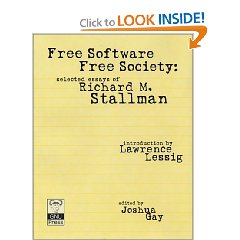
Review: Free Software, Free Society–Selected Essays of Richard M. Stallman (Hardcover)

6 Star Top 10%, Change & Innovation, Complexity & Resilience, Information Society, Information Technology, Intelligence (Collective & Quantum), Intelligence (Commercial), Intelligence (Government/Secret), Intelligence (Public)
0Shares

Amazon Page
Amazon Page

Essential Reading for any Intelligent Adult Favoring Social Progress,

July 22, 2006
Richard M. Stallman
I bought this book at Hackers on Planet Earth 6, and then after reading it in the morning, had the double benefit of hearing the author as keynote speaker in the afternoon. He is everything the book's contents suggest, and more. The author is one of the original MIT hackers (pick up a used copy of Shirley Turkle's “My Second Self, Computers and the Human Spirit” and/or Steven Levy's “Hacker's” which the author himself recommends.

The author's brilliant bottom line is quite clear throughout the book: software copyright prevents people from improving or sharing the foundation for progress in the digital era.

The author's social-technical innovation, which appears now to be acquiring tsunami force around the world, and is manifested in the Free/Open Source Software (F/OSS) movement that is being nurtured by governments worldwide from Brazil to China to Israel to the United Kingdom to Norway, is to modify copyright to a term he credits to another, copyleft, meaning that copyright in the new definition grants ALL permissions EXCEPT the permission to RESTRICT the enhancement and sharing of the software.

The author is also very careful to define the term free as meaning freedom of movement and growth, not free of price. GNU, his invention, removes computational obstacles to competition, and levels the playing field for more important innovations. In his view, the core issue is not about price, but about eliminating restrictions to freedom of sharing and enhancement.

On page 37 he sums up his life's purpose: “Proprietary and secret software is the moral equivalent of runners having a fist fight (during the race)” — they all lose.

The author carefully distinguishes between the free and open source software, citing the first as a movement with values, the second as a process.

His candidacy for a Nobel Prize is captured in the sentence on page 61, “Free software contributes to human knowledge, non-free software does not.”

Across the book, a collection of essays put into a very well ordered (not necessarily chronological) form, this book is a history of GNU (not UNIX) by its creator and co-founder of the Free Software Foundation. It is replete with concise useful discussions of terms, conditions, and cultures relevant to the future of mankind as a thinking forward looking species.

Section two, on copyright, copyleft, and patents is very helpful, and likely to become a standard in the field as the public fires elected representatives who sell out to Mickey Mouse copyright extenders, and demands a return to the original Constitutional limitation of copyright as an artifact of government, not a natural right, focused on nurturing knowledge. It means mention that Lawrence Lessig (see my reviews of his books) writes the introduction–the two authors together, along with Cass Sunstein, may be the most important trio of thinkers with respect to the future of man in the context of science, copyright, risk, and software as a human global contributor to sanity.

The author's keynote address at HOPE 6 is discussed toward the end of the book, where he lists the Four Freedoms:

Freedom 0: Run a program as you wish, for any purpose you wish, not limited to any narrowly defined application.

Freedom 1: Help yourself by improving the program (which requires access to source code).

Freedom 2: Help your neighbor by sharing a copy of the program with them.

Freedom 3: Help community by sharing the improved copy at large.

There is no question in my mind but that this manifesto of a single man's life's work is as important as Tom Paine's Common Sense treatises. There is a war now emergent between the classes (US elites bribing foreign elites, both screwing their publics over for private gain), and between corporations and the people, corporations long having abused the independent legal personality that was granted to promote business, and ended up being a legal barrier to holding corporate managers accountable for grand theft and social irresponsibility.

Toward the end the author offers thoughtful suggestions on how to “drop out” of the proprietary software world, and his thinking resonates with “No Logo” and its recommendations on selective purchasing.

This book is not a technical book although it offers up many understandable insights to technical matters underlying the social philosophy of the author. It is not a legal book either, but offers important informed commentary vital to getting the law focused again on human progress. Finally, in no way does the book dismiss the importance of capitalism–the author clearly states that it is entirely appropriate to charge a fee for one's contributions–this is about the “how” not the “how much.

Absolutely superb collection of essays, extremely important to where we go in the future. The author is not only an original hacker, he represents hacking as it should be understood by the authorities (see my review of Bruce Sterling, Hackers at the Edge of the Electronic Frontier), and as I see them–as people who have the “right stuff” and are testing the edge, pushing the frontier. In a world of drones, these are the libertarian spirits that may well keep us out of perpetual prison.

For reference: DARPA's STRONG ANGEL program, empowered now by DoD Directive 3000.cc. specifically seeks to create a suite of collaborative sharing and analytic tools that can be provided free to any non-governmental organization and any state and local government. Support costs have to be shared. It is now understood at the highest levels of the US military that we cannot make peace without sharing all information in all languages all the time (my third book), and this is progress.

Vote on Review
Vote on Review

2006 The Failure of 21st Century Intelligence (Followed by SPY IMPROV)

Briefings & Lectures
0Shares
Followed by SPY IMPROV

One of the magical things about the “wealth of networks” is the value-added that can come from voluntary social production.Ā  Governments and businesses are only now beginning to understand this, and most do not yet understand that the future is about hybrid open everything.Ā  Below, with a tip of the hat toEli Courtwright who says:

Robert Steele spent 30 years in the classified world and gave a four-hour lecture at the fifth HOPE (Hackers on Planet Earth) convention about reforming the intelligence community. His thesis is that most of what politicians and citizens need to know to make informed decisions is not secret. So while covert spying has its place, we should be paying much more attention to open sources of information. These sources include newspapers, websites, speeches, studies, etc, and this methodology is called Open Source Intelligence, or OSINT. For an example, listen to the Taking on the CIA clip, which is possibly the best single part of the lecture.

I highly recommend listening to the entire thing, which can be found here. After staying up all night to finish this four-hour lecture, I went to sleep and then woke up the next afternoon and immediately listened to it all again. However, for people who are too busy to spend that many hours on this, I've compiled twenty-two short clips of what I feel are the best parts.

Compressed Movie
Compressed Movie
22 Short Audio Clips

Review: The End of Iraq–How American Incompetence Created a War Without End (Hardcover)

Congress (Failure, Reform), Empire, Sorrows, Hubris, Blowback, Executive (Partisan Failure, Reform), Iraq, Military & Pentagon Power, Stabilization & Reconstruction, War & Face of Battle
0Shares

Amazon Page
Amazon Page

Lack of Balance,Good Detail, First-Rate Personal Perspective,

July 20, 2006
Peter W. Galbraith
I recommend the other reviews, including the negative ones, for they accurately depict a lack of balance that might normally cause me to give this book one less star. However, because it has first-rate personal perspective including extraordinary travel that most US officials and journalists cannot claim, it gets the full five stars. I especially liked the “cast of characters” at the end, with names and titles and dates. A fine review.

The book can be quickly summed up by a quote from page 7: “Insurgency, civil war, Iranian strategic triumph, the breakup of Iraq, an independent Kurdistan, military quagmire.”

As the Administration continues to deny that Iraq is in a civil war, the author is compelling in citing the Iraqis themselves saying that they are–and that America lost it when it turned from liberator to occupying power. Two people come out of this book looking colossally ignorant: George Bush, who never heard of the Sunni-Shiite split before the war, and Paul “Jerry” Bremer. The author's basic proposition is that the American Republic has been undone by extraordinary arrogance, ignorance, and political cowardice.

The author is a good writer with a gift for clear phrases. He concludes that the White House and the Pentagon's politically-appointed leaders consistently “ignored inconvenient facts.” He concludes that Iraq may actually be better off in the long run, but the US is clearly not–we have gored ourselves near fatally.

I agree with the critics that suggest the author is in love with Kurdistan and overlooking some of their less rosy realities. The book is a clearly partisan document that admires the Kurds and makes the case for a free Kurdish state within Iraq (three states, one nation, not a division of Iraq as some critics loosely interpret). He is considerate of Turkish concerns and how a Kurdistan inside of Iraq but independent within Iraq, can meet their needs for a secular buffer.

There are some gems in this book that I have not found elsewhere, including a detailed accounting of the atrocities committed by Hussein against the Kurds, the Kurds rebuilding including English-speaking universities and doctors certified by the British Medical Board.

I was shocked to learn that the White House employs a CANADIAN speech-writer (who may well be one of the new Canadian clandestine case officers they are starting to field), and that this CANADIAN inserted the “axis of evil” line (which the author points out is ignorant both geographically and historically).

Overall the author could help inspire the impeachment of the Vice President. His book complements that of Ron Susskind, “The One-Percent Doctrine” and is replete with lines like “logic and facts did not stop the Bush Administration…” (page 80), “wishful thinking substituted for knowledge” (page 88, describing Undersecretary Feith), “contrary views were not just rejected, they were banned” (page 89), and “the ignorant are always surprised” (page 101).

In terms of historical documentation, the author is strongest in his detailing the incompetence of the Bush Administration in failing to plan for the war, and he lays much of the blame on Cheney for falling prey to Ahmad Chalabi's lies. The author says on page 86 that Chalabi's role cannot be overstated.

He trumps that with detail on the idiocy and arrogance of Paul “Jerry” Bremer who decided to run Iraq as his own fiefdom, and in his first two decisions, banned all Baaths from leadership positions, and dismembered the army and all security services. If there is one man to blame for all the American dead and disabled since the war “ended,” it is this well-intentioned but contextually inept person, who acted against the specific advice of the senior Army generals then serving in the field.

From an intelligence perspective, the author is credible when he points out that in the aftermath of the war and before the break-down of all order in Iraq, neither the Pentagon nor the CIA seemed to be aware of, nor interested in, the treasure trove of intelligence materials scattered in various locations throughout Iraq. This tracks with my own intimate knowledge of civilian and military intelligence, both preferring to stay in the Green Zone and not miss their evening cocktails, Robert Bauer and a few others excepted.

On page 118 the author absolutely floors me by pointing out that the Department of State spent an entire year creating a blueprint for securing the peace in Iraq, but the Department of Defense, which insisted on controlling “diplomacy” in Iraq, did not tell Bremer the detailed plan existed until a year after he arrived on the job. On page 117, the author details how the US inter-agency bureaucracy was and is out of control, with rival US factions pursuing policies that are diametrically opposed. He is particularly caustic in slamming the grotesquely incompetent manner in which the Administration threw together the nation-building team, including six young people from the Heritage Foundation who ended up running a $13 billion a year budget.

The author condems Bremer's gratuitous humiliation as having broken Iraq apart and spawned the insurgency. In the author's view, Bremer blew it in that he was a naked Emperor hiding in the Green Zone, and neither the Shiites in the south nor the Kurds in the north ever gave up their militaries or their power over their own terrain.

The book ends by stating that the US needs a strategy based on reality, not wishful thinking or ideological fantasy, and he concludes that three states comprising one nation, is the fastest way out of Iraq. I agree.

This is a solid professional account. I disagree with those critics who consider the author to be self-serving, embellishing, or otherwise deceiving the public. While he emphasizes some things more than others, and would clearly like an independent Kurdistan, on balance I consider this to one of the better first-person stories, right up there with “Squandered Victory.”

Vote on Review
Vote on Review

Strategy Archives for Public Intelligence (1992-2006)

Strategy
0Shares
Archives 1992-2006
Archives 1992-2006

1997

US

Strategy Steele Cover, Appreciation, Foreword, Contents

1997

US

Strategy Steele Creating a Smart Nation: Strategy, Policy, Intelligence, Information

1997

US

Strategy Steele E3i: Ethics, Ecology, Evolution, and Intelligence

1997

US

Strategy Steele Intelligence & Counterintelligence for the 21st Century

1997

US

Strategy Steele Secrecy & Openness: Talking Points for Seminar on Intelligence Reform

1997

US

Strategy Steele Sources & Methods: A Primer for Congressional Inquiry

1997

US

Strategy Steele TESTIMONY to the Pres. Inter-Agency Task Force on National Security

1997

US

Strategy Steele VIRTUAL INTELLIGENCE & Information Peacekeeping

1996

US

Strategy Steele Clandestine Sources and Methods: Primer on Deception of Congress

1996

US

Strategy Steele Secrecy and Openness: Talking Points for a Seminar on the Hill

1993

US

Strategy Steele Comments on Executive Order 12356, National Security Information

1993

US

Strategy Steele Testimony to the President’s Inter-Agency Commission

1992

US

Strategy Steele E3i: Ethic, Ecology, & Evolution: An Alternative Paradigm

Reform Archives for Public Intelligence (1992-2006)

Reform
0Shares

2006

US

Reform Steele Open Source Intelligence Familiarization Documents (One Page of Links)

2004

US

Reform Atlee A Model of Intelligence Systems (Individual to Social)

2004

US

Reform Atlee Beyond Intelligence Reform Toward Co-Intelligence

2004

Austria

Reform Beer Need for a Theory of Intelligence

2004

US

Reform Harris Beautiful Minds: Maverick Minds Needed to Achieve Reform

2004

US

Reform Marrin Improving Training for New Analysts

2004

NL

Reform Wiebes Intelligence and the War in Bosnia

2003

CA

Reform Fyffe OSS ’03 Presentation on Information Sharing

2002

Israel

Reform Crevald van Twenty Four Theses on Intelligence

2002

US

Reform Herz Harnessing the Hive via Online Games for Networked Innovation

2002

US

Reform Pinkham Citizen Advocacy in the Information Age

2001

US

Reform Foster Getting to Tomorrow: A Plea for Strategic Reformation

2001

US

Reform Gessaman Summary of Comments on National Security Budget with Slides

2001

US

Reform Treverton Reshaping National Intelligence for an Age of Information