Review: Articles of Impeachment Against George W. Bush

5 Star, Impeachment & Treason
0Shares

Amazon Page
Amazon Page

Excellent but Incomplete–See Other Books Below,

August 11, 2006
Center for Constitutional Rights
This is a fine little effort, a very fast read, with four articles of impeachment:

1) Violation of privacy and law re the NSA eavesdropping

2) Initiation and continuation of the Iraq war on web of lies

3) Torture & rendition inclusive of US citizens and violation of habeas corpus, making law and interpreting law

4) Abrogation of power from Congress, exceeding the bounds of excutive authority as established by Constitution and laws in effect.

It is not, however, the whole story. At least two other books by constitutional lawyers must be read to appreciate the gravity and full range of impeachable offences that could be judged by Congress: the book “How Would a Patriot Act,” and the book, “The Case for Impeachment,” which is more substantive than this one. Here is the complete list from the latter book:

1. Stole Florida election in 2000.
2. Lied on Iraq to Congress, the Public, and the United Nations.
3. 9-11 Cover-Up and Obstruction of Justice.
4. Violated Rights of Citizens including Habeas Corpus.
5. NSA Program to Listen to Citizens without Warrant.
6. Violated International Treaties Including Geneva Convention.
7. Actively Encouraged, as a Policy, Use of Torture.
8. Gross Negligence on Hurricane Katrina.
9. Iraq Contract Corruption–Bremer “Lost” $8 billion in cash, sole source awards, and gross negligence in managing the peace.
10. Stole Ohio election in 2004.

Still, that is not the whole story. Congress, with the sole brilliant exception of the most extraordinary Senator Byrd (see my review of his book of speeches against the Bush violations, “Losing America: Confronting a Reckless and Arrogant Presidency”) failed all Americans. To understand the failure of Congress, see Senator/Congressman Tom Coburn's “Breach of Trust” and the book just out on “Broken Branch” in which the authors make clear that the extremist Republicans in Congress (not the moderate Republicans like Congressman Rob Simmons, an authentic patriot and man of honor) decided they were the President's “footsoldiers” rather than, as the Founding Fathers intended, the FIRST Branch of Government.

However, even that is not enough. To understand the full extent of the violations that have burned our seed corn, inflicted syphillis on our children, and cost us the moral regard of the rest of the planet, you need to read “The One Percent Doctrine” and “Speaking Freely” and can go on from there to “Downsizing Democracy: How American Sidelined Its Citizedns and Privatized Its Public.” And more. See my lists on evaluating Dick Cheney in relation to both impeachable offenses, and corporate corruption.

It was the Republicans with their grotesque law suite against President Clinton that demeaned Congress and surrended moral authority. This next election may throw out as many Democrats as it does Republicans (Democcrats are Republicans lite–just as corrupt, just less capable), but if we wish to avoid two more years of economic colonialism and unilateral militarism by chicken hawks like Cheney that never served under arms, then we may just have to bite the bullet.

The one thing missing from this book is the “Do It Yourself Impeachment” kit. It turns out that citizens can impeach the President and Vice President if Congress fails to do its dury. Now wouldn't that be something–restoration of the engaged Republic of the whole.

This is a fine book. My reviews of all of these books are the first investment I recommend, followed by any one of the above.

Vote on Review
Vote on Review

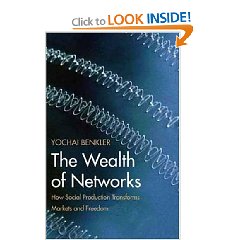
Review: The Wealth of Networks–How Social Production Transforms Markets and Freedom (Hardcover)

6 Star Top 10%, Best Practices in Management, Capitalism (Good & Bad), Change & Innovation, Culture, Research, Intelligence (Collective & Quantum), Intelligence (Public), Intelligence (Wealth of Networks), Values, Ethics, Sustainable Evolution
0Shares

Amazon Page
Amazon Page

Manifesto for the 21st Century of Informed Prosperous Democracy,

August 9, 2006
Yochai Benkler
Edit of 14 Apr 08 to add links (feature not available at the time).

Lawrence Lessig could not say enough good things about this book when he spoke at Wikimania 2006 in Boston last week, so I ordered it while listening to him. It arrived today and I dropped everything to go through it.

This book could well be the manifesto for 21st Century of Informed Prosperous Democracy. It is a meticulous erudite discussion of why information should not be treated as property, and why the “last mile” should be built by the neighborhood as a commons, “I'll carry your bits if you carry mine.”

The bottom line of this book, and I will cite some other books briefly, is that democracy and prosperity are both enhanced by shared rather than restricted information. The open commons model is the only one that allows us to harness the distributed intelligence of the Whole Earth, where each individual can made incremental improvements that cascade without restraint to the benefit of all others.

As I write this, both the publishing and software industries are in the midst of a “last ditch” defense of copyright and proprietary software. I believe they are destined to fail, and IBM stands out as an innovative company that sees the writing on the wall–see especially IBM's leadership in developing “Services Science.”

The author has written the authoritative analytic account of the new social and political and financial realities of a networked world with information embedded goods. There have been earlier accounts–for example, the cover story of Business Week on “The Power of Us” with its many accounts of how Lego, for example, received 1,600 free engineering development hours from its engaged customers of all ages. Thomas Stewart's “The Wealth of Knowledge,” Barry Carter's “Infinite Wealth,” Alvin and Heidi Toffler's most recent “Revolutionary Wealth,” all come to the same conclusion: you cannot manage 21st Century information-rich networks with 20th Century industrial control models.

Lawrence Lessig says it best when he speaks of the old world as “Read Only” and the new world as “Read-Write” or interactive. His fulsome praise for this author and this book suggest that the era of sharing and voluntary work has come of age.

On that note, I wish to observe that those who label the volunteers who craft Wikis including the Wikipedia as “suckers” are completely off-base. The volunteers are the smartest of the smart, the vanguard for a new economy in which bartering and sharing displace centralized financial and industrial control. Indeed, with the localization of energy, water, and agriculture, this book by this author could not be more important or timelier.

One final supportive anecdote, this one from the brilliant Michael Eisen, champion of open publishing. He captured the new paradigm perfectly at Wikimania when he likened the current publishing environment as one in which scientists give birth to babies, the publishers play a mid-wifery role, and then claim that as midwives, they have a perpetual right to the babies and will only lease them back to the parents. What a gloriously illuminating analogy this is.

I will end by tying this book and this author to C.K. Prahalad's “The Fortune at the Bottom of the Pyramid.” That other book focuses on the fact that the five billion poor are actually worth four trillion in disposable income, versus the one billion rich worth one trillion. C.K. Prahalad posits a world in which capitalism stops focusing on making disposable high-end high cost goods, and turns instead to making sustainable low-cost goods. I see the day coming when–the avowed goal of the Wiki Foundation–there is universal free access to all information in all languages all the time.

If Marx and his Communist Manifesto were the tipping point for communism, this book is the tipping point for communal moral capitalism. Yochai Benkler is–along with Stewart Brand, Howard Rheingold, Bruce Sterling, Kevin Kelly, Lawrence Lessig, Jimbo Wales, Ward Cunningham, Brewster Kahle, and Cass Sunstein, one of the bright shining lights in our constellation of change makers.

He ends his book on an optimistic note. Despite the craven collaboration of the U.S. Congress in extending copyright forever into the distant future, he posits a reversal of all these bad laws (it used to be legal to discriminate against women and people of color) by the combination of cultural, social, economic, and technical forces that have their own imperative. Would that it were so, sooner.

See also:
Infotopia: How Many Minds Produce Knowledge
Infinite Wealth: A New World of Collaboration and Abundance in the Knowledge Era
Revolutionary Wealth: How it will be created and how it will change our lives
The Wealth of Knowledge: Intellectual Capital and the Twenty-first Century Organization
Powershift: Knowledge, Wealth, and Power at the Edge of the 21st Century
The New Craft of Intelligence: Personal, Public, & Political–Citizen's Action Handbook for Fighting Terrorism, Genocide, Disease, Toxic Bombs, & Corruption
Information Operations: All Information, All Languages, All the Time
Peacekeeping Intelligence: Emerging Concepts for the Future
THE SMART NATION ACT: Public Intelligence in the Public Interest
Collective Intelligence: Creating a Prosperous World at Peace

I beg indulgence for listing five books I have published. I know you all know about Smart Mobs, Wisdom of the Crowds, Army of Davids, etc. See also the literature resilience, panarchy, and social entrepreneurship.

Peace (and prosperity) for all, in our time.

Vote on Review
Vote on Review

Review: The Broken Branch–How Congress Is Failing America and How to Get It Back on Track (Institutions of American Democracy)

5 Star, Congress (Failure, Reform), Corruption, Politics
0Shares

Amazon Page
Amazon Page

Helpful to Anyone Planning to Vote in November 2008,

August 9, 2006
Thomas E. Mann
I have long understood the original terrible sin of Congress, the obscene corruption. I did not understand party line corruption (forcing Members to vote the party line instead of for their constituents until I read Tom Coburns Breach of Trust: How Washington Turns Outsiders Into Insiders.

This book helped me understand that the third sin is that partisan politics have turned Members into (the author's term) “footsoldiers for the President” and thus a complete abdication of their role as the Article 1 (i.e. first) branch of government.

This book helped me understand that it is the long-serving Members who are often shaking down lobbyists and extorting funds from people, not the other way around, where bribes are offered by the lobbyists.

I read this book after reading David Broder's article in the 8 August 2006 issue of the Washington Post, an article entitled “Contempt for Congress” and summarizing the utter disdain that the Governors–both Republican and Democratic–have for most Members. The Congress is indeed broken and dysfunctional. There is a tide sweeping against all incumbents, regardless of party, in this year.

Hence, as Congress reconvenes on 5 September for one last session ending in early October, it could be quite fruitful for as many voters as possible to read this book and Tom Coburn's book, and demand of Congress two things in this next session: Electoral Reform, and a Public Intelligence Agency independent of both the President and Congress. We have a window for reform. This book is one of two pillars for those who wish to “raise the roof.”

See also, with a review, Running on Empty: How the Democratic and Republican Parties Are Bankrupting Our Future and What Americans Can Do About It.

It is vital that the 100 million voters who have “dropped out” of the broken partisan political scene come back in 2008.

Vote on Review
Vote on Review

Review: Fiasco–The American Military Adventure in Iraq (Hardcover)

5 Star, Congress (Failure, Reform), Corruption, Empire, Sorrows, Hubris, Blowback, Impeachment & Treason, Intelligence (Government/Secret), Iraq, Misinformation & Propaganda, Politics, Power (Pathologies & Utilization), Secrecy & Politics of Secrecy
0Shares

Amazon Page
Amazon Page

Extraordinarily Good Review, with Sadness of Deja Vu and Silence of the Lambs,

August 9, 2006
Thomas E. Ricks
There are other vital books to read, not least of which is James Risens State of War: The Secret History of the CIA and the Bush Administration and Jim Bamford's A Pretext for War: 9/11, Iraq, and the Abuse of America's Intelligence Agencies and Squandered Victory: The American Occupation and the Bungled Effort to Bring Democracy to Iraq as well as The End of Iraq: How American Incompetence Created a War Without End. There are lesser books as well, such as Cobra II: The Inside Story of the Invasion and Occupation of Iraq. On balance, of all the books I have read, this is the best and easiest to read chronicle and teaching device.

Everyone preparing to vote in November for the gutless Congress that betrayed America and failed to maintain either the power of the purse or the power to declare war, should read this book.

And when future politicians who were military commanders that failed to speak up (“the silence of the lambs” as the author notes) ask for your vote, laugh in their face.

There are leadership heros in this book–General Zinni of the Marine Corps, General Shinseki, who told the truth to Congress and was fired for his trouble (as was General Clapper, who said that the national agencies could be cut free from defense). Garner and the Army generals were on the right track, until Garner was fired for doing the right thing (trying to accelerate the turnover of authority to the Iraqis and the exit of Americans).

There are also villains. Chalabi gets his due share but in my view the author underestimates Chalabi's influence on Cheney, and Chalabi's treasonous representation of Iranian interests.

Rumsfeld is documented over and over as one massive ego completely uncaring of inter-agency effectiveness or accomodating to reality.

Edit of 10 Sep 06: the author appeared on a Sunday talk show today, and pointed out that it was Paul Bremer who gave the Iraqi insurgency everything they needed: 1) leadership, with his order to ban Bathists from responsible positions; 2) guns and volunteers with his order to disband the Iraqi military and police; and 3) finances, providing Iran with exactly the right opportunity to further its interests. It can be said that Bremer has done more damange to America than Bin Laden–what an obituary that makes!

This is a superb chronicle of who shot John, when, and how. The headings for each section of text are brilliant. When I first got the book I flipped through it and read only the headings, and they were as compelling and concise of summary of our botched endeavor in Iraq as one could want.

If you buy and read only one book from among all those I have mentioned, this is the book to buy.

Vote on Review
Vote on Review

Review: The End of Faith–Religion, Terror, and the Future of Reason (Paperback)

5 Star, Religion & Politics of Religion
0Shares

Amazon Page
Amazon Page

Very Important, Objective, Valuable, Relevant to Peace,

August 8, 2006
Sam Harris
Of the 3000 or so books I have read in the past decade, 750 or so them reviewed here at Amazon (almost all non-fiction) this is perhaps the single most important work that declares, and then documents, the “naked Emperor” of religion.

While I agree with the reviewer that sums it up as saying that religion in the form of blind faith does more harm than good, I would hasten to add that faith is an essential part of the American value system, and can do a great deal of good when channeled in partnership with a tolerant secular state. See my reviews of “The Left Hand of God,” “Faith-Based Diplomacy,” and “American Gospel.”

The alternative sub-title of this book could be “The Cost of Intolerance.” However–and I strongly recommend this book to the Information Operations and Public Diplomacy or Strategic Communication professionals–the author is brilliantly on point when he suggests that the third world war now happening is about beliefs–about good beliefs versus bad beliefs, about a need for a morality order of battle. As Robert Garigue sums up in his own original work offered as a technical preface to my book on Information Operations, war has moved to the semantic level, and we have to focus on identifying, containing, and then eradicating belief systems that are totally set against our once-balanced (not now) combination of secular state and diversity of belief.

It merits comment, as discussed in Howard Bloom's “Global Brain,” that belief systems, once embedded in a person older than 30, are not changeable. World War III is a war for the minds of those in elementary and secondary school. We have to contain or kill the adults who believe that martyrdom awaits those who kill “unbelievers.” On a positive note, the disciplines of psychology and neuroscience are now coming together (see my review of “Psychiatry, Psychoanalysis, and the New Biology of the Mind” by Eric Kandel). At the same time, the discipline of Open Source Intelligence (OSINT) is finally about to be funded properly, and we are within arms reach of being able to make sense of all information in all languages all the time.

Over-all the author agrees with those who say we are engaged in a clash of ideologies rather than civilizations. He notes that democracy can NOT be seen as a precursor to changing beliefs, for as we have found in Iraq, given a vote, most rabid Muslims would vote to give up their public liberties in favor of their blind and intolerant faith.

The author is compelling in also noting that poverty, among other high-level threats, is not the source of the conflicts that should frighten us with the prospect of being wiped out. It is about belief systems. He suggests that energy independence is actually a pre-requisite to gaining the economic leverage we need, while depriving the radical Muslim states of oil revenues they have consistently used to finance Al Qaeda and Hezbollah, among others.

Among the varied insights offered by the author I especially appreciated these:

1) Discussion of how evangelical Christians are penetrating the federal and state governments and subverting secular policy to fight “reasoned policy” and channel tax-payer funds to specific evangelical missions and churches.

2) A fascinating review of our skewed priorities, where we spend $4 billion annually to eradicate marijuana, which kills no one, while refusing to spend $2 billion one time to secure our ports, meanwhile ignoring the fact that alcohol kills hundreds of thousands.

3) Priceless quote, on page 165: “And yet, religious faith obscures uncertainty where uncertainty manifestly exists, allowing the unknown, the implausible, and the patently false to achieve primacy over facts.”

4) The author provides a very comprehensive review of both the Koran and the Bible, citing many specific passages, and concludes that even “moderate” Muslims are inherently trained to believe that “unbelievers” are to be converted or killed. This is, incidentally, the first stage of genocide, where the one to be killed is put into a class with vermin to set the stage for acceptable massacres.

The book concludes with a brilliant and provocative call for a science of good and evil, an ethics and science of the mind. The author states that truth is NOT just a matter of consensus or belief, and that some truths, in a human or reality sense, must be absolute. He calls for common sense and a sensibility of tolerance for others, while stating quite clearly that we must identify and kill those who threaten us “blindly.” He concludes that both torture and pacifism are wrong, and that principled moral engagement, one for all and all for one, is what is right. He supports non-violence where it works, but force is still needed for the greater evils that will respond to no other means.

The author documents the origin of the yellow star to “mark” Jews as having been in Baghdad, and only much later adopted by the Nazis.

The paperback version has a Question & Answer section that is not in the hardback original.

This is an extraordinary book, and should be–but of course is not–influencing those who would lead their Nation into a future of peace and prosperity. We have no strategy, no policy, only predatory capitalism fueled by militant unilateralism, and a Vice President who has usurped power from the President to pursue cheap oil at the expense of longer-term prosperity and peace. If ever there was a book to help us understand all that is wrong with America and the Muslims today, this is it.

Vote on Review
Vote on Review

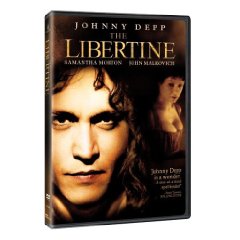
Review DVD: The Libertine (2006)

4 Star, Power (Pathologies & Utilization), Reviews (DVD Only)
0Shares

Amazon Page
Amazon Page

Deep Vulcan MindMeld for Intelligent Adults,

August 7, 2006
Johnny Depp
Wow! Johnny Depp, whom I first got to know when I took my kids to Pirates of the Caribbean, is a SHAKESPEARE level actor.

This is a supremely intelligent movie for very smart people that appreciate nuances. It is NOT an X-rated movie in disguise. A few (very few) exposed breasts, but some of the human choreography is reminiscent of Leonardi da Vinci, extremely tasteful and NOT pornography in any way.

This movie held my attention. It aroused a passionate empathetic appreciation of loyalty to life, liberty, wife, love, king, and country. Johnny Depp plays a very complex man, and the nuances of this movie have to be seen to be appreciated.

A keeper. I plan to buy it now that I have rented it.

Vote on Review
Vote on Review

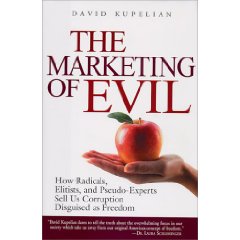
Review: The Marketing of Evil–How Radicals, Elitists, and Pseudo-Experts Sell Us Corruption Disguised As Freedom (Hardcover)

4 Star, Capitalism (Good & Bad)
0Shares

Amazon Page
Amazon Page

Ideologically biased with useful information, other books recommended,

August 2, 2006
David Kupelian
Edit of 26 Oct 06: for two excellent books that show there are two sides to any argument, see Mel White's Religion Gone Bad: The Hidden Dangers of the Christian Right and Reverend Barry Lynn's Piety & Politics: The Right-Wing Assault on Religious Freedom.

I have a taken a strong interest in immoral predatory capitalism and the cheating culture (see my reviews of Grieder The Soul of Capitalism: Opening Paths to a Moral Economy and Callahan, The Cheating Culture: Why More Americans Are Doing Wrong to Get Ahead among others) so when I saw this title, I was not only reminded of Lionel Tiger's path-finding work, Manufacture of Evil: Ethics, Evolution, and the Industrial System but also quite taken by the sub-title.

The book loses one star because it is an evangelical Christian tract that lacks depth (each of 10 chapters on 10 evils appears based on 1-2 key sources, with some “ibids” running over ten times in a row), and it is oblivious to a much larger serious literature such as Shattuck's Forbidden Knowledge: From Prometheus to Pornography which makes this book look like a high school rant, or John Paul Ralston's Voltaire's Bastards: The Dictatorship of Reason in the West.

There is a lot of good in the book, and it fully merits reading and reflection. Seen in its best light, the author has brilliantly compiled “conventional wisdom” within the hard-corps Christian right, and neatly packaged screeds against gay rights, church-state separation, violence, sex, multicultural madness (i.e. mixed marriages and the loss of the white majority), family meltdown, bad schools, media as myth, abortion, and of course white American Christianity as the last best hope for America.

In comparison with Thomas Frank's One Market Under God: Extreme Capitalism, Market Populism, and the End of Economic Democracy, this book is both lightweight and oblivious to larger strategic realities, but it is never-the-less quite a good means of understanding the filter through which white Christians on the hard right see the world.

The author loses credibility with well-read readers when he lambastes the gays and ignores biological evidence that we all start as women and evolve toward being men in the womb. Those that make it three quarters of the way are gay men; those that make it one quarter of the way are gay women. That is of course of grotesque simplification of a complex scientific and medical literature, but the point is that being gay is biological, and we can no more prosecute gays that we can prosecute people with diabetes or cancer.

The author is also overly dependent on the extreme right and evangelical Christian literature, and much too quick to accept “statistics” that are articulated as facts, for example, that 45% of America attends church regularly. Not in my world. In my world, they are sleeping late, out driving their Harleys (in Middle America nice normal people drive Harleys, not gangs), playing golf, or mowing the lawn.

The greatest weakness of the book, but not sufficient to take it down to three stars, is that while the author rails against radicals, elitists, and pseudo-experts, he fails to identify them by name. This is the politics of fear, the politics of creating a boogey-man to blame our problems on. To really understand this weakness, see the other book I review today, Frank's One Market Under God: Extreme Capitalism, Market Populism, and the End of Economic Democracy where I detail that author's more compelling and more authoritative discussion of how Wall Street and the evangelical right came together to destroy labor unions, baseline government, and informed media, all in the name of a “free market” that ostensibly promotes democracy in passing.

Of the two books, Frank's is the better value, and receives five stars.

Vote on Review
Vote on Review