Review: Beyond Baghdad–Postmodern War and Peace

4 Star, Asymmetric, Cyber, Hacking, Odd War, Complexity & Catastrophe, Force Structure (Military), Future, Stabilization & Reconstruction, Strategy, Threats (Emerging & Perennial), War & Face of Battle
0Shares

Amazon Page
Amazon Page

4.0 out of 5 stars Iraq a Mistake, Muslim Outlands More Important,

October 9, 2003
Ralph Peters
Edited 2003 review to add links and respond to comment.

I normally rave over Ralph Peter's books. He is America's Lawrence of Arabia and a brilliant intelligence analyst, especially on non-conventional threats. In this book (actually, a collection of clippings, most from the New York Post, which says something right off), he goes a bridge too far–on the one hand, he and his mentor, General McCaffrey) go several bridges too far in their praise for the “courageous” strategy of the Bush Administration (it's not a strategy, it's a mindless vendetta bought and paid for by Zionists), and on the other, he applies his superb mind to the realities of our global conflict with radicalized Islam.

The book is full of gems. I've said he is a soldier-poet before, and this book continues that tradition. The flashes of brilliance demand the purchase and reading of this book.

His most important point, one that merits its own book, is that America has misplaced its priorities in attacking radical Islam through Iraq (and passivity toward Saudi Arabia's sponsorship of terrorism, a neglect that will cost vastly more than the Iraq misadventure), and that it is the Muslim “outlands” from Central Asia to Indonesia, the Philippines, Malaysia, and India (with the second largest Muslim population in the world after Indonesia) where America would be elevating women, nurturing secular states, and spreading the gospel of peace and prosperity.

The author takes the long-view, at least a 50-year view, and this is in sharp contrast to the “quick win at any cost (to the future)” of the current Administration. Indeed, when the author describes bin Laden as “ultimately a blasphemer against his own religion, having appointed himself God's instrument upon earth, assuming the license to kill by the tens or tens of thousands those who do not share his vision, to purge, to punish, to sanctify,” the author is in fact describing George W. Bush, not just bin Laden.

The author overcomes the limitation of New York Post hyperbole in many of his pieces. Among the most interesting is one on the five socio-psychological pools from which terrorists draw their membership: underclass, “course of conflict” joiners, opportunists, hardcore believers, and mercenaries. Also helpful is his coverage of monotheist cultures, including a subtle reference to neo-conservatism aligned with Zionism as a rising monotheist culture potentially capable of undermining American democracy and religious tolerance.

Deep in the middle of the book we find his discussion of a world divided into three strategic zones, apart from North America: the monotheist zone centered in the eastern Mediterranean; the Sino-Verdic(Indian) zone; and the postcolonial zone of Africa and Latin America. His discussion cannot be summarized and contains many brilliant insights, including a conclusion that China is not a regional threat, and China's greatest variable is not its external ambition but rather its potential for internal implosion. He is provocative in envisioning a huge “Afro-Latino-American” triangle of power emerging, with Brazil, South Africa, and the USA as the potential engines for this renaissance of the Southern Hemisphere.

The author joins Robert Baer, whose book Sleeping with the Devil: How Washington Sold Our Soul for Saudi Crude in calling for a complete withdrawal of US support for the despotic and sleazy Saudi regime that blatantly continues to support global terrorism and the radicalization of Muslim youth.

Where Ralph Peters falls short, I believe, and I say this with the utmost respect for this warrior-scholar who has placed his life on the line more than once, is in allowing his ultra-patriotism to shut out the discordant and sometimes dissenting view of other patriots who are perhaps more willing than he to acknowledge that we ourselves are part of the problem. This book is a one-man opinion piece with no reference to other works, such as those by Jonathan Schell The Unconquerable World: Power, Nonviolence, and the Will of the People, Mark Hertsgaard The Eagle's Shadow: Why America Fascinates and Infuriates the World, or Michael Hirsh At War with Ourselves: Why America Is Squandering Its Chance to Build a Better World, among the many other national security books I have reviewed here at Amazon. It falls prey, therefore, to the over-powering tuba effect, and loses some of its gloss in being so strident and so unabashedly “grind the bastards down, we are the light”–but then, we acknowledge that he was writing originally for the New York Post.

The author gets some big things right: Bill Clinton, Madeline Albright, and Sandy Berger have much to answer for in their deliberate avoidance of the reality of terrorism and their failure to go to a war-footing as both Dick Clarke and George Tenet, among others, advised. He also gets some things wrong. He is wrong, for example, when he speaks on page 166 of Islam's failure to generate a single healthy state, to that we answer: Malaysia. He is half-right when he half-bakes the French, who welcome different dictators to their bosoms for different reasons, while opposing American unilateralism, and he is half-right when he dismisses all of the anti-war voices as ill-considered and cowardly. He is largely wrong in dismissing “Old Europe” as a voice of reason, and he is mostly wrong in assuming that all is right with U.S. intelligence and that everything U.S. intelligence produces is reliable. I realize he is writing hyperbole for the public and knows better, but the book must be judged on its substance.

To end on a most positive note, Ralph Peters is completely utterly correct when he points out that America has, in the past 20 years, surrendered the battlefield to our non-state enemies in advance, for lack of attention and insight and will. Ralph is one of perhaps ten people I listen to with rapt attention–his voice, when integrated with the voices of others with different perspectives, is a lifeline to reality, a voice we ignore at our peril.

See also:
Blind Into Baghdad: America's War in Iraq (Vintage)
A Pretext for War: 9/11, Iraq, and the Abuse of America's Intelligence Agencies
American Jihad: The Terrorists Living Among Us
While Europe Slept: How Radical Islam is Destroying the West from Within
How Israel Lost: The Four Questions
The Sorrows of Empire: Militarism, Secrecy, and the End of the Republic (The American Empire Project)


Vote on Review
Vote on Review

2003: Peacekeeping Intelligence Leadership Digest 1.0 (Full Text Online for Google Translate)

Articles & Chapters
0Shares

Peacekeeping Intelligence Leadership Digest 1.0[i]

Robert David Steele

Ben de Jong, Wies Platje, and Robert David Steele, PEACEKEEPING INTELLIGENCE: Emerging Concepts for the Future (OSS International Press, 2003), pp. 201-225.

Original As Published

Executive Summary

The Brahimi Report, in combination with documented field experience from numerous UN peacekeeping missions, and the memoirs and published statements of recent secretaries-general, make it clear that the time has come to establish strategic, operational, and tactical intelligence concepts, doctrine, and tables of organisation & equipment (TO&E) for intelligence support to UN decisions at every level. This Peacekeeping Intelligence (PKI) Leadership Digest 1.0 integrates key expert insights, and represents a first step in the long-overdue establishment of UN competency in the craft of intelligence.

Introduction
Possibilities for Failure
Purpose and Structure of the PKI Leadership Digest 1.0
Figure 1: Overview of the PKI Leadership Digest 1.0
Strategic Intelligence
Strategic Collection
Strategic Processing
Strategic Analysis
Strategic Security
Notional Strategic Organisation
Figure 2: Strategic Intelligence Secretariat, United Nations
Operational Intelligence
Operational Collection
Figure 3. Information-Gathering Spectrum from Permitted to Prohibited
Operational Processing
Operational Analysis
Operational Security
Tactical Intelligence
Tactical Collection
Tactical Processing
Tactical Analysis
Tactical Security
Concluding Observations
Endnotes

Full Text Online for Ease of Automated Translation

Continue reading “2003: Peacekeeping Intelligence Leadership Digest 1.0 (Full Text Online for Google Translate)”

2003 Information Peacekeeping & the Future of Intelligence – The United Nations, Smart Mobs, & the Seven Tribes (Full Text Online for Google Translate)

Articles & Chapters
0Shares

Information Peacekeeping & the Future of Intelligence ā€˜The United Nations, Smart Mobs, & the Seven Tribes’[1]

Robert David Steele

Ben de Jong, Wies Platje, and Robert David Steele, PEACEKEEPING INTELLIGENCE: Emerging Concepts for the Future (OSS International Press, 2003), pp. 201-225.

Original as Published

Full Text Online for Ease of Automated Translation

Continue reading “2003 Information Peacekeeping & the Future of Intelligence – The United Nations, Smart Mobs, & the Seven Tribes (Full Text Online for Google Translate)”

Review: Gold Warriors–America’s Secret Recovery of Yamashita’s Gold UPDATE to Add Links to CDs

5 Star, Corruption, Crime (Government), Empire, Sorrows, Hubris, Blowback, Impeachment & Treason, Military & Pentagon Power, Secrecy & Politics of Secrecy
52Shares
Amazon Page
Amazon Page

5.0 out of 5 stars Earth-Shattering, Faith-Shaking, Well-Documented Deceit,
September 25, 2003
Sterling Seagrave

This book is earth-shattering and faith-shaking, a well-documented tale of deceit at the highest levels of the US government. So controversial and potentially explosive are the findings of this book, to wit, that the White House recovered most of the Nazi and Japanese loot and created a secret slush fund for covert political operations world-wide, that the authors go the extra mile and offer, at a nominal price, two CD-ROMS containing 60,000 pages of supporting documentation including the Japanese treasure maps used by the US to recover the gold and other valuables.Major players include Presidents Truman, Eisenhower, and Nixon, both Allen and John Foster Dulles, Douglas MacArthur, John McCloy, and the famous unconventional warrior Edward Lansdale. What we learn from this book is that those writing about “blowback” (the consequences of unwise US actions) have barely scratched the surface. What we learn is that rather than truly seeking to help the Japanese, Chinese, and other looted nations recover in the aftermath of WWII, the most senior leaders of the US government, no doubt with the best of intentions, actually conspired with Nazi bankers and the Japanese imperial family to create a Black Eagle Trust controlled by a very select hand-picked cabal in Washington.

Originally used to fight communism, the Black Eagle Trust, according to the authors and as thoroughly documented by the book and the two CD-ROMS (which I am happy to have in hand), quickly became a global slush fund used to bribe national leaders and manipulate elections around the world. This fund remains in existence today, making the Swiss Holocaust funds seem like loose-change. According to the authors, major banks are “addicted” to the funds and would face collapse if public investigations resulted in a forced return of this gold and related certificates to the rightful owners.

The authors have produced a magnificent work of both scholarship and investigative journalism. They document the extent of Japanese looting of Korea (beginning in 1895) and China as well as the other countries in the “co-prosperity sphere.” They document the manner in which Japan hid most of the gold in the Philippines (some in Indonesia), and were forced to leave it there from 1943 onwards, when US submarine interdiction became too effective to risk shipments homeward.

I found the level of detail in this book to be quite gripping. The ingenious nature of the Japanese burial sites, with caverns below the more obvious tunnels, with sea-water protection, with maps created in reverse–and the in-bred cruelty of the Japanese, thinking nothing of burying all of the US and other national slave labor *and the Japanese engineers* alive as the final stage of protecting the looted treasure, leave one stunned.

The authors document the central role played by Lansdale in recognizing the opportunity and then briefing MacArthur and then President Truman. According to the authors, the architects of the Black Eagle Trust were three advisors to President's Roosevelt's Secretary of War, Henry Stimson: John McCloy (later head of the World Bank), Robert Lovett (later Secretary of Defense), and Robert Anderson (later Secretary of the Treasury). They made the case to Roosevelt, and presumably to Truman after Roosevelt died, that it would be impractical to return the looted gold to the rightful owners, in part because many of the looted countries were now under Soviet control.

The authors, who conducted many interviews in support of the work, including interviews of former CIA deputy director Ray Cline, who they say was involved with Lansdale and the gold in the 1940's and remained involved with the black gold through the 1980's, provide copies of documents showing the redirection of the looted gold to 176 bank accounts in 42 countries. The gold was then used to support the creation of gold bearer certificates that were in turned used to bribe the most senior officials around the world.

The authors tell a shocking tale of how quickly MacArthur chose to collaborate with the very leadership of Japan that declared war on the USA and was responsible for genocide and looting in Asia on a scale rarely achieved by anyone else. Bringing the story up to date, the authors show how prior attempts to investigate the Black Eagle Trust have led to the ruin of individuals such as Norbert Schlei, at one time deputy attorney general to Presidents Kennedy and Johnson. While I have no direct knowledge and cannot be certain myself, I believe the authors have provided a sufficiently compelling case to warrant an international investigation concurrently with a General Accounting Office investigation to be chartered by Congress with unlimited supeona powers specifically directed against classified personalities and archives.

If this story is true, and I personally think that it is, then the US government, in active collusion with the very people the American people fought to defeat in WWII, has been guilty of fraud and depravity on a global scale and against the best interests of both the American people, and the against the rightful owners of the looted gold and other treasures. The authors may well have uncovered the last really big secret of the post-WW II era, and in so doing, opened the way for a restoration of the balance of power among diverse nations, and a sharp delimitation of the abuses that appear to characterize American leadership when it thinks it can rely on secret gold and stolen oil to engage in imperial adventures and domestic improprieties. As an American citizen and voter, and as a person of faith who believes that we must do unto others as we would have them do unto us, I find this book to be shocking, credible, and a basis for popular outrage and demands for truth and reconciliation.

UPDATE: The below links have NOT been tested.

CD1) https://drive.google.com/drive/folders/1BhNOJWR2I3oYrmCZV2mrBhq3ff2xY8gh?usp=sharing

CD2) https://drive.google.com/drive/folders/1sLqiNhnW1fN_u1DM5ZOPiR3XzL1y9BZe?usp=sharing

CD3) https://drive.google.com/drive/folders/1YYaIlVqHW8RJWUd6eRIqSbaefJNAC17p?usp=sharing

Review: The Great Unraveling–Losing Our Way in the New Century

4 Star, Economics, Politics
0Shares

Amazon Page
Amazon Page

4.0 out of 5 stars Read Preface and Introduction, Skip the Rest,

September 24, 2003
Paul Krugman
Edit of 21 Dec 07 to add comment and links.

New Comment: the author was ahead of his time. See new links below.

The book is worth buying for the Preface and Introduction alone. The rest of the book is a somewhat irritating replay of every column the author has ever written, and not nearly as well done or as riveting as, say, Tom Friedman's replays in “Longitudes & Attitudes”. However, if you have not read the author's columns, his bite-size descriptions of irrational exuberance, crony capitalism, the failure of the Federal Reserve, fuzzy math, how markets go bad, and global spoilage, then they are all certainly worth browsing.

The Preface has three core ideas: 1) the elites are ruling badly and not beneficially for the majority of the population including all the voters and most of the stockholders; 2) politicians and corporation chiefs are getting away with blatant lies to the public because of a media that avoids critical inquiry; and 3) open sources of information–all that lies in the public domain–are more than adequate for anyone to get a grip on reality.

The Introduction is a bit scarier and more pointed. The author joins Mark Hertsgaard, author of The Eagle's Shadow: Why America Fascinates and Infuriates the World in suggesting that the radical right is creating nothing less than a Reichstag in America. In the author's view, and he quotes Kissinger in chilling terms, the radical right is a revolutionary power that is very deliberately and with malice at all times, rejecting and undermining the democratic rules of the game. In the author's words, the radical right is “a movement whose leaders do not accept the legitimacy of our current political system.” The author goes so far as to suggest that the radical right considers elections as “only a formality” and that they will do anything–including subversion of the Constitution–to “win” those elections and reap the domestic and foreign “looting rights.”

Disclosure: I used to be a conservative Republican and used to think such ideas were simply over the top. I have been radicalized by the last 200 books I have read (and reviewed on Amazon) and I have to say, while the third of the nation that is close-minded and ideologically-blindered on the right may give the author short shrift, the other two thirds–the drop-outs and splinter parties, and the failing Democrats–they should take Krugman very seriously. He is an economist, teaching at Princeton, not a journalist nor a sensationalist, and in my view, when one combines his book with that of Clyde Prestowitz, a Presbyterian elder and solid Reagan Republican and fiscal conservative (Rogue Nation: American Unilateralism and the Failure of Good Intentions), with that of William Greider, writing on the immorality and social costs of capitalism as we practice it today (The Soul of Capitalism: Opening Paths to a Moral Economy), one can only conclude that the Republic, and that for which it stands, have been hijacked, are being looted, and the American Democratic experiment is on very thin ice.

The index to this book is helpful in running down specific individuals, corporation, and organizations that have committed crimes against the Nation that the author has addressed in his many columns for the New York Times, as repeated in this book.

See also:
The Battle for the Soul of Capitalism: How the Financial System Underminded Social Ideals, Damaged Trust in the Markets, Robbed Investors of Trillions – and What to Do About It
Vice: Dick Cheney and the Hijacking of the American Presidency
Running on Empty: How the Democratic and Republican Parties Are Bankrupting Our Future and What Americans Can Do About It
The Global Class War: How America's Bipartisan Elite Lost Our Future – and What It Will Take to Win It Back
Day of Reckoning: How Hubris, Ideology, and Greed Are Tearing America Apart

Vote on Review
Vote on Review

Review: Terrain Analysis of Afghanistan

5 Star, Geography & Mapping
0Shares

Amazon Page
Amazon Page

5.0 out of 5 stars The Bible for Reconstruction & Military Operations,

September 24, 2003
Kent D. Lee
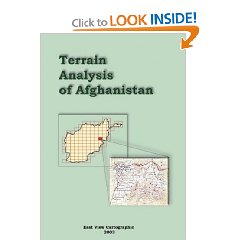
I am a very happy owner of this volume, and I will certify that it is easily worth $2,500 to $5,000 for any construction or paving company bidding for or awarded contracts in Afghanistan.I have known Kent Lee and East View Cartographic since 1995, when they were instrumental in supporting me in a competitive exercise to demonstrate all that could be done with “open sources” of information, versus narrowly-focused classified capabilities. The ability of this individual and this organization to acquire and then exploit Russian, Chinese, and other third-nation source material has made them the single most important geospatial entity in the world after the National Imagery and Mapping Agency.

Every page is clearly printed and the maps, all in color, are extraordinary. The fine print can be a burden if you have to read more than a few sections at a time, but was a necessity–the book would not be easily portable otherwise.

I understand that similar books are in the works for Iraq and other countries where terrain analysis is a vital element of reducing costs and increasing profits and operational successes. This book is both essential to prior planning, and essential to on-going operations.

Vote on Review
Vote on Review

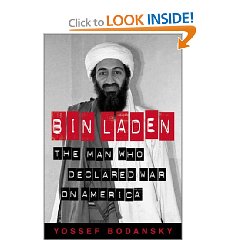
Review: Bin Laden–The Man Who Declared War on America

4 Star, Biography & Memoirs, Terrorism & Jihad
0Shares

Amazon Page
Amazon Page

4.0 out of 5 stars Over the Top in Iraq, Brilliant in All Other Respects,

September 24, 2003
Yossef Bodansky
Edit of 21 Dec 07 to add comment and links.

New Comment: this remains a very important foundation document for understanding the complete failure of US intelligence to detect and monitor Saudi government funding of violent Islam and Wabbabism.

The author is a brilliant Arabist who has refined the art of acquiring and exploiting open sources of information on bin Laden and terrorism to a near science. His “MOSQINT” lectures draw packed houses of professional intelligence officers from over 40 countries.

The book is a hard read, but if one desires to understand the murky inter-relationships among the *governments* of Pakistan, Syria, Saudi Arabia, and Egypt, among others, the businesses and charities working actively to channel government and private funds to terrorists, and the global loosely-knit network of “fellow travelers” and jihadists, then this book is “Ref A.”

In my personal view, the author is a bit over the top in trying to link Iraq to bin Laden. This reminds of the Claire Sterling-Ollie North school of “anything goes” as long as you believe it. Having said that (and so has Vaclav Havel, President of Czechoslovakia, who personally dismissed a lie consistently told by the Bush Administration about a meeting in Prague between a terrorist known by the FBI to have been in Florida at the time, and an Iraqi intelligence officer), I give the book very high marks in all other respects.

The Conclusion, appropriately Chapter 13, is titled “What Next.” The book is worthy of purchase and recurring reference for this chapter alone. Especially troubling is the documentation of how many terrorists are moving around the world on legitimate passports from the United Kingdom, France, Germany, Turkey, Kuwait, Algeria, Albania, Saudi Arabia, Malaysia, and other countries. The book adds confirmation to the many other references I have seen (many posted to OSS.Net news and reference section) regarding the active involvement of the Pakistani intelligence service in funding and training and facilitating travel for bin Laden personally, for his top lieutenants, and for terrorists in general.

The author's focus in the conclusion on the potential for Central Asia (all former khanates, all Muslim, all angry separatists from the Soviet Union) is especially interesting, as we see the beginnings of a “third front” there, with India-Pakistan being a fourth front, and South Asia a fifth front. Latin America and Africa are the sixth front. In brief, the author is one of those documenting the depth and scope of a global terrorism threat that the Bush Administration has unwisely chosen to attack with conventional military means, on six different fronts, none of which is sustainable in the medium or long term.

The author anticipated terrorist attacks against the UN and NATO when he discusses, on page 403, the Muslim declarations that include the UN and NATO in the fatwas against the USA, because the Muslim world “is being deceived by [these organizations], because they are hostile to Muslims and are responsible for all the massacres being perpetrated against Muslims in Afghanistan, Lebanon, Palestine, Albania, and Kosovo.” The UN in Iraq has been hit twice. I expect NATO in Afghanistan to be hit several times between now and the end of 2003, and I expect US special forces units to be massacred in detail in Afghanistan, the Philippines, and Indonesia.

Bin Laden, dead or alive. Right. Bin Laden could not, in his wildest prayers to Allah, have imagined a better partner for fostering terrorism around the world than hip-shooting cowboy and unilateralist George W. Bush. Bin Laden created a global system of terrorism, the fire if you will, and George W. Bush and his neo-conservatives are blindly pouring $250 billion worth of tax-payer funded gasoline on that fire.

The author has recently been the recipient of the Golden Candle Award from the international open source intelligence committee. His citation reads:

“For his global multi-lingual open source investigations into terrorism, and his extraordinary professional achievement in writing and publishing “BIN LADEN: The Man Who Declared War on America”, years before the 9-11 World Trade Center demonstration of what well-funded suicidal terrorism can achieve when intelligence and policy both fail to focus on the threat.”

Whatever research or opinion flaws might be contained in this book, it is an essential reference in understanding both the dangers of terrorism, and the futility of the current US “strategy” for defeating terrorism by hammering and then abandoning Afghanistan and Iraq.

More recent books relevant to this one:
The Looming Tower: Al Qaeda and the Road to 9/11 (Vintage)
The Osama bin Laden I Know: An Oral History of al Qaeda's Leader
9/11 Synthetic Terror: Made in USA, Fourth Edition
Dying to Win: The Strategic Logic of Suicide Terrorism
Vice: Dick Cheney and the Hijacking of the American Presidency
Wars of Blood and Faith: The Conflicts That Will Shape the 21st Century
Fiasco: The American Military Adventure in Iraq

Vote on Review
Vote on Review