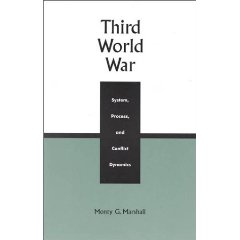
Professor Monty Marshall came to our attention when his book on the Third World War impressed us so deeply. Our review of 15 December 2001 is entitled:
Deeply Important to Our Future, Scholarly, Practical, Urgent
Click on the book cover to reach the Amazon page and also read our review. we continue to be concerned by the chasm between people like Professor Marshall with deep knowledge, and policy makers who plan, program, and budget without any understanding as to true costs and needed investments.
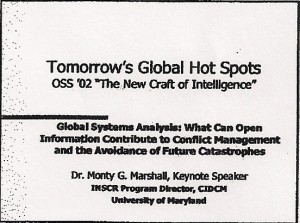
Below is his contribution to oSS '02. Much more remains to be done with this important body of work.
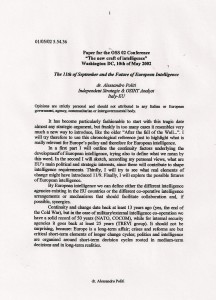
Golden Candle Award: Mr. David Moore and Ms. Lisa Krizan, National Security Agency, USA
OSS '02: For their personal commitment to nurturing intelligence education and the craft of intelligence analysis, in part by studying, defining, and then promulgating “best practices” from both within the government and from the external private sector.
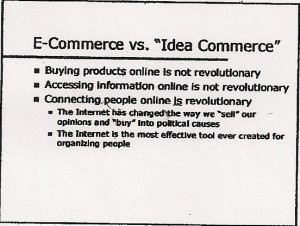
Douglas G. Pinkham is president of the Public Affairs Council, the leading international association for public affairs professionals. The Council is a non-partisan, non-political organization that provides training and development, “best practice” information and benchmarking services to the profession.
His experience is focused primarily on helping very large corporations (some would call them dinosaurs) get agrip on citizen advocacy and the power of the network. As he has shown so many clients, engaging clients, engaging citizens, makes you stronger. They are NOT a threat, they are a foundation for transformation. Below is his contribution to OSS '02. We strongly recommend all of the publications offered by the Public Affairs Council. Both slides lead to the same briefing.
Brilliant Theory, Ugly Corruption, Sad Personal Decay,
December 15, 2002
Robert Coram
In forty years of adult reading, thousands of books, hundreds of biographies, I have not in my lifetime found a better integration of subject, sources, and scholarship. This book will make anyone laugh, cry, and think. There is a deep spirit in this book, and knowing a little about all of this, I was quite simply stunned by the labor of love this book represents. The author's skill and devotion to “getting it right” is breathtakingly evident across the book. His sources, both those close to the subject and those more distant, have been exhaustively interviewed and the quality of this book is a direct reflection of some of the most serious “homework” I have ever been privileged to read.On the theory of war, on the original contributions of John Boyd, the book renders a huge service to all military professionals by dramatically expanding what can be known and understood about the Energy-Maneuverability Theory and the nuances of the OODA Loop (Observe-Orient-Decide-Act–for the real Tigers, Observe-od-Act–a faster loop). Two things stuck out, apart from the heroic manner in which Boyd pursued the intellectual side of combat aviation: first, Boyd consistently had his priorities right: people first, ideas second, hardware last–this is the opposite of the existing Pentagon priorities; and second, truth matters–the book has some extraordinary examples of how both the Air Force and the Army falsified numbers, with disastrous results, while also selecting numbers (e.g. choosing to list an aircraft's weight without fuel or missiles, rather than fully loaded, a distortion that will kill aviators later when the aircraft fails under stress).
On the practical side, the insights into Pentagon (and specifically Air Force) careerism and corruption, as well as contractor corruption and cheating of the government, are detailed and disturbing. There have been other books on this topic, but in the context of Boyd's heroic endeavors as an individual, this book can be regarded as an excellent case study of the pathology of bureaucracy–the Air Force regarding the Navy, for example, as a greater threat to its survival than the Russians. Especially troubling–but clearly truthful and vital to an understanding of why the taxpayer is being cheated by the government bureaucracy, were all the details on the mediocrity and mendacity of Wright-Patterson laboratories and organizations nominally responsible for designing the best possible aircraft. The same thing happens in other bureaucracies (e.g. the Navy architects refusing to endorse the landing craft ideas of Andrew Higgins, who ultimately helped win World War II), but in this instance, the author excels at documenting the horrible–really really horrible–manner in which the Pentagon's obsession with building monstrous systems that increase budgets has in fact resulted in fewer less capable aircraft. The book is a case study in corrupt and ill-considered (mindless) gold-plating and mission betrayal.
As a tiny but extremely interesting sidenote, the book provides helpful insights into the failure of the $2.5 billion “McNamara Line,” a whiz-kid lay-down of sensors in Viet-Nam that Boyd finally ended up terminating.
On a personal level, the author treats Boyd's family life, and his neglect of his family, in objective but considerate terms; the author is also quite effective in identifying and addressing those instances in Boyd's professional life when his fighter-pilot embellishments might be construed by lesser mortals to be falsehoods. There are three sets of heroes in this book, apart from the subject: the ranking officers, including a number of generals, who protected Boyd against the corrupt careerists–there *are* good officers at the top; the enlisted and officer personnel that carried on in the face of poor leadership, mediocre aircraft, and daunting external challenges; and finally, the “Acolytes,” the six specific individuals (Tom Christie, Pierre Sprey, Ray Leopold, Chuck Spinney, Jim Burton, and Mike Wyly), each of whom endured what they call “the pain” to nurture John Boyd and his ideas. I found the author's dissection and articulation of the personal relationships and sacrifices to be quite good and a most important part of the larger story.
Finally, a few tributes en passant. The author does a great job of showing how Boyd ultimately was adopted by the U.S. Marine Corps rather than the U.S. Air Force, and how his ideas have spawned the 4th Generation and Asymmetric Warfare theories, for which the Pentagon does not yet have an adequate appreciation. The mentions in passing of two of my own personal heroes, Mr. Bill Lind and Col G. I. Wilson of the U.S. Marine Corps, and the due regard to the roles played by Dr. Grant Hammond of the Air War College and Mr. James Fallows of the Atlantic Monthly, add grace and completion to the story.
This book is moving–if you care about America, the military, and keeping our children safe into the future, it *will* move you to tears of both laughter and pain.
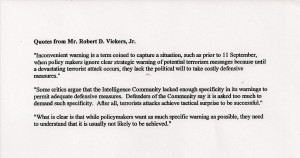
Mr. Vickers, the National Intelligence Officer for Warning (NIO) addressed the American version of policy-maker push-back on warning: “inconvenient warning.” The British call it “warning fatigue.”
The US Intelligence Community–and all other communities with the possible exceptions of the Nordics, The Netherlands, and Singapore, have failed to triage among the urgent important, the long-term important, and the unimportant.
I do not share the disappointment expressed by some of the earlier reviewers, perhaps because I do not read many novels and this was my first exposure to John Sandford. In any event, I found this “airplane book” so interesting that I made time to finish it once I got home.The integration of several sub-plots, the detailed portrait painted of the primary character, the ins and outs of planning the destruction of a corporation, and the final surprise ending, very much an “out of the box” solution for an impossible situation, gave me great satisfaction, to the point that this author joins Robin Cook, Dick Francis, and Michael Creichton as a trusted provider of light entertainment.
Vote on Review