Major Contribution to Loyal Dissent & True Patriotism
December 10, 2009
The book comes in three parts, the first two by the author, the third a collection of well-chosen pieces by others.
I am totally engaged by the idea that liberty is a state of mind, that America the Beautiful is a state of mind, not to be confused with the Wall Street greed and two-party tyranny that is killing the Republic.
The author has done a moderately good job of reviewing the history, and that which she shares is most valuable. I especially like her quoting Robert F. Kennedy on how each generation must win its own struggle to be free, and later in the book, she cites one of the thousands across the country as observing that we have abdicated our citizenship.
The state of mind theme is carried on in a discussion of the difference between a free society and a fear society, and throughout parts I and II we see documented evidence of how America has become a fear society and how the Global War on Terror (GWOT) has been a virtual seizure of power by quasi-fascist mind-sets who may have the best of intentions but in fact have executed a “paper coup” or as the author also puts it, following a long (LONG) summary of restrictions on everything from permits for free speech to travel to voting rules and regulations, “civic death by a thousand cuts.”
As I have previously shown, speculative derivatives (especially credit default swaps) are a primary cause of the economic crisis. And I have pointed out that (1) the giant banks will make a killing on carbon trading, (2) while the leading scientist crusading against global warming says it won't work, and (3) there is a very high probability of massive fraud and insider trading in the carbon trading markets. Now, Bloomberg notes that the carbon trading scheme will be centered around derivatives…
Carbon trading fraudsters may have accounted for up to 90pc of all market activity in some European countries, with criminals pocketing an estimated €5bn (£4.5bn) mainly in Britain, France, Spain, Denmark and Holland, according to Europol, the European law enforcement agency.
AFTERNOON: Bob WoodwardAssistant Managing Editor for Investigative News, Washington Post, Pulitzer Prize winning investigative journalist, Author of Bush at War and Maestro: Greenspan’s Fed And The American Boom among other publications.
EDIT of 9 Dec 09: AFIO has updated its notice to say that Woodward is working on a new book focused on intelligence.
MORNING: John Koehler, a journalist for nearly 40 years. Koehler is a former U.S. Army Intelligence Officer specializing in counter-espionage and intelligence collection, and served as an advisor to President Reagan
Crowne Plaza Hotel Tysons Corner, VA Register securely online HERE.
More than 20 percent of the nation’s water treatment systems have violated key provisions of the Safe Drinking Water Act over the last five years, according to a New York Times analysis of federal data.
Phi Beta Iota: We alerted on this August 21, 2007 with our review of The Blue Death–Disease, Disaster, and the Water We Drink. America has many other problems, below are just a few titles, all persist for lack of a Strategic Analytic Model able to help Congress and the White House harmonize policies intelligently.
The COP15 problem is not climate change skepticism, it is anti nuclear fanaticism
Paradoxically, the AGW skeptics are not the most serious enemies of AGW mitigation. The eco-extremests are. If AGW skeptics are basically in denial about AGW, they are not in denial about the essential role of nuclear power in a future of energy. Many AGW skeptics harbor rational doubts about the use of renewables in future energy schemes. The Green mainstream remains incapable of anything but a dogmatic hostility toward nuclear power. This anti-nuclear attitude, leads anti-nuclear environmentalists to hugely exaggerate the liabilities of nuclear power as well as engage in self-deceptive denials of the liabilities of renewable generation systems.
Houston Chronicle Full Story Online
No denying: In resolving questions about global-warming research, let’s follow the science
We can identify at least two areas where clear answers are required:
• • The methodology. If there was a demonstrable effort made by CRU scientists or others to change data to guide it toward a preferred result, this should be identified and condemned by the scientific community. A consensus built around faulty data is as useless as one built around the premise that water freezes at 50 degrees Fahrenheit rather than 32 degrees Fahrenheit. The scientifically observable facts will not change to accommodate a faulty consensus.
• • The claims that peer review boards have been set up to deliberately exclude climate change skeptics must be answered. The strength of the scientific method rests on full faith in peer review. It must not be rigged.
Forget Survival of the Fittest: It Is Kindness That Counts
A psychologist probes how altruism, Darwinism and neurobiology mean that we can succeed by not being cutthroat.
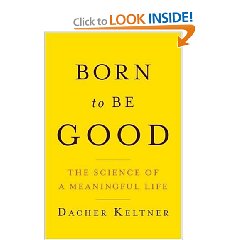
Dacher Keltner, director of the Berkeley Social Interaction Laboratory, investigates these questions from multiple angles, and often generates results that are both surprising and challenging. In his new book, Born to Be Good: The Science of a Meaningful Life, Keltner weaves together scientific findings with personal narrative to uncover the innate power of human emotion to connect people with each other, which he argues is the path to living the good life. Keltner was kind enough to take some time out to discuss altruism, Darwinism, neurobiology and practical applications of his findings with David DiSalvo.
Born to Be Good is something less than the subtitle (The Science of a Meaningful Life) suggests. More accurately, it covers the science of certain selected emotions and, more narrowly still, primarily the research of certain psychologists, bolstered by a bit of neuroscience. Most specifically, it focuses in large part (although not exclusively) on the work of Paul Ekman (the author's mentor) and the research of Keltner himself (along with his students).
Darwin himself observed that sympathetic communities are more likely to produce healthier offspring than cruel ones. Human history shows that compassion always pulls through in times of war. And new studies of our body's physiology show that caretaking emotions are wired within our nervous systems.
Emotion has often been downplayed, restrained, indeed even belittled, in comparison to intellect. We must suppress emotion and let intellect roam free if we are to discover new things, solve life's riddles, and survive in an increasingly competitive and academic business world. Excitement, it is said, kills. Although true and essential when, say, doing a heart bypass, maneuvering a crippled jetliner into safe landing, or simply driving down the highway, we should not forget that — as the book so plainly states — had it not been for our emotions, we as a species might not be here today.