In the first treatise written on the art of war, sometime around 450 BC [1], Sun Tzu explained why “the wise general sees to it that his troops feed on the enemy,”
EXTRACT: The militarization of development aid is a central pillar of General Petaeus's counterinsurgency strategy to buy the hearts and minds of the Afghan people, ninety per cent of whom are spread out in remote rural areas. So it should not be surprising that the military is controlling the bulk of the billions of dollars in aid money flowing into (and being smuggled out of) Afghanistan.
In the very important CounterPunch report on 13 December, Patrick Cockburn, certainly one of the most informed observers of insurgencies in the Middle East and Central Asia, described how the militarization of development aid in Afghanistan is riven with corruption.
“Cyber security is now critical to our survival but as a field of research [it] does not have a firm scientific basis,” according to the Department of Defense. “Our current security approaches have had limited success and have become an arms race with our adversaries. In order to achieve security breakthroughs we need a more fundamental understanding of the science of cyber security.”
To help advance that understanding, the DoD turned to the JASON defense advisory panel, which has just produced a new report (pdf) on the subject.
“There is a science of cyber security,” the JASONs said, but it “seems underdeveloped in reporting experimental results, and consequently in the ability to use them.”
The JASON report began by noting that “A science of cyber security has to deal with a combination of peculiar features that are shared by no other area of study.”
“First, the background on which events occur is almost completely created by humans and is digital. That is, people built all the pieces. One might have thought that computers, their software, and networks were therefore completely understandable. The truth is that the cyber-universe is complex well beyond anyone's understanding and exhibits behavior that no one predicted, and sometimes can't even be explained well [after the fact],” the report said.
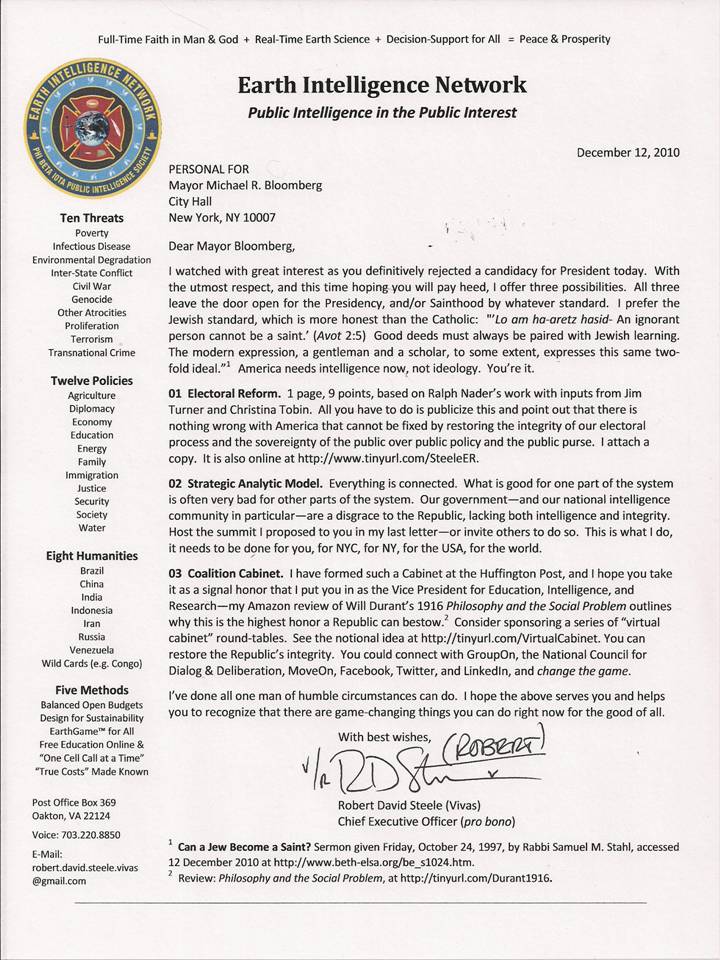
I doubt the letter will be delivered to you in New York, so here it is in the open, for consideration.
I went to Oklahoma four years ago to watch you play in the Dave Boren show. The question the press asked in the closed door session, about the difference between transpartisan and bi-partisan, was my question, given to CNN and various others during my pre-show walk-about. The binder I put together for you back then is online now, at Democracy 2008. I still believe in you. You can change the game, as Tom Atlee has suggested here at Huffington Post. You will not do that with No Labels, or the apparatchiks of the past.
No Labels struck out within 30 days of being floated, in large part because it is completely lacking in authenticity, clarity, diversity, or integrity (in the holistic sense that we Comprehensive Architects seek). IndependentVoting.org has similar issues–both have failed to adapt to the digital native era in which the default is “here comes everybody,” and bottom-up cognitive surplus is the engine of progress.
Let the word go out, indeed. “Those are OUR streets, and we will always be there to demonstrate… people learned a lot… we are no longer that post ideological generation, we are no longer that generation that doesn’t care… we are now the generation that will stand with everyone who’s fighting back…” They’re mad as hell, and they’re not going to take it anymore.
15 year old Tells Establishment to Stick-it.
Coalition of Resistence National Conference 27 November 2010 Camden UK
Not many know that GroupOn, Andrew Mason‘s initiative funded by Eric Lefkofsky, started as Policy Tree “Taking People Out of Politics”. Citizens were not interested in Policy Tree back then for two reasons: the outrage at mortgage fraud, Wall Street derivatives fraud, and Federal Reserve fraud had not peaked yet, and the power of GroupOn to move markets and nations had not been demonstrated. Now that GroupOn has turned down Google's offer of six billion, there is no doubt.
Put simply, GroupOn now has more power than George Soros, to take one example. GroupOn can:
1) Publish true costs for any product or service that is seriously harmful to all of us, and kill it.
2) Publicize a product or service that is good for the community, and make it a standard.
4) Organize citizens to do participatory legislation and participatory policy and participatory budgeting and participatory regulatory and propriety oversight in relation to specific issue areas, zip codes, countries, or states, and empower them as a group that cannot be ignored.
GroupOn has done what all others have failed to do: harnessed citizens in the aggregate. They have just begun. When combined with the emergence of digital natives as a political force whose outrage is now maturing (see Jon Lebkowsky's “The Kids Are All Right“), GroupOn is the game changer–not MoveOn.org, not No Labels, not Americans Elect, not IndependentVoting.org–all “old” models dominated by apparatchicks and not at all open to the collective. GroupOn. As in Group ON, dude!
Some things sell for not much more than they cost to make. Things like steel.
Others? They sell for high multiples of cost. Spa services, fancy ties, long haul airplane tickets, coaching, books–these are things that might cost a bunch to set up, but once the factory is rolling, the marginal cost of one more unit is really low. The challenge, then, is to find a way to get new customers without alienating the folks that have paid full price. Even better, to turn those new trial customers into loyal customers.
One of the challenges of selling to new customers cheap is that you might end up with a price shopper, someone who is always cheap, someone who will never convert into the kind of customer your high margin business needs to survive.
Priceline was a pioneer in figuring out how to isolate one customer type from another. The reason the original Priceline was so incredibly difficult to use (with blind reverse auctions, etc.) was that they wanted it that way. Anyone who was willing to through that hassle and anxiety to save $100 bucks for a ticket on Delta was clearly not someone Delta was going to have an easy time selling a regular ticket to. In other words, Jay Walker had figured out how to create a second type of air travel. One for cheapskates. The alternative to Priceline was a bus ticket or no travel at all… And Delta was fine with offloading excess seats to them, because they didn't have to worry about alienating their core customer.
Groupon is a very different thing. Here, it's not a hassle, it's the fun factor. Buying this way is exciting, you never know what's next, you do it with friends, the copy is funny, it's an adventure. As a result, many Groupon customers in fact do convert to becoming long time patrons of the place they tried, because they're not inherently cheap shoppers. When they're on Groupon they're hunting for fun. But if you offer an astonishing product and great service after they try you, they may convert into shopping with you for the long haul, not because you're a Groupon replacement, but because you bring them more than the alternatives.
And the magic basket? Tim Ferriss just finished offering more than $1600 worth of high-margin items in a basket to people who bought 30 copies of his new book. The marketing partners get trial among a group of people who are each paying more than the cost of a single item in the basket, these customers are proving they're not among the ultra-cheap. And the products are quasi-aligned, appealing to the same sort of consumer. Is there a cheaper way for one of these companies to reach this precise person? I'm not sure there is.
Imagine taking this even further and leaving out the book part. A basket of aligned items, all high margin, none from the market dominator, each holding out the possibility of future business… You could do this with an 8 pack of computer games or phone apps, or drink coupons from a dozen bars in the same town, or even clothing for guys size 38. Alex has experimented with this at Swagapalooza. I'm betting that there's quite a lot to be done in becoming this market creator/differentiator/middleman.
What's missing so far is an intelligent way to get permission, to follow up, to further organize those that do a trial and teach them and connect them so that they see a further incentive in sticking with the thing they just tried.
What's also missing is a willingness on the part of high-margin marketers to use their products and these sort of interactions as a replacement for the unmeasurable and largely ineffective lifestyle advertising they use now.
The net, once again, is making it easier to find and organize tribes of people, even for short durations. When you intersect these aligned groups with high-margin products, you can create fascinating commerce opportunities.
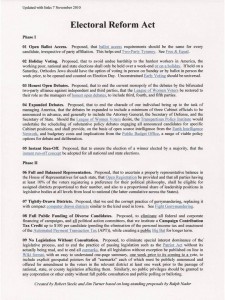
UPDATED 8 Nov 2011 to bury. This is the original that everyone ignored, now that Electoral Reform Act of 2012 has gone viral courtesy of Reddit and YouTube, the updated versions of the proposed Statement of Demand and the Electoral Reform Act of 2012 can be found at http://tinyurl.com/OWS-ER-HO.
Electoral Reform is the “fast track” toward restoring the Constitution and the Republic (We the People must be sovereign or it is not a Republic). As long as the Executive and Congress are led by unethical politicians working for unethical corporations, public intelligence can and should be used to expose each individual, each transaction, each transgression. That is the “slow road.” However, if the Independents, Greens, Reforms, and the honest Libertarians (not faux Libertarians like the Koch Brothers) can get together on this ONE THING, the “fast track” is possible in time for 2012.


 Robert David Steele