Tom Atlee: A New Co-Intelligence Initiative – Let’s Talk: Our New Economy

03 Economy, Collective Intelligence, Commercial Intelligence, Cultural Intelligence
Tom Atlee

A New Co-Intelligence Initiative: Let's Talk: Our New Economy

My intern Patrick Maxwell and CII president John Abbe have initiated a project I'm quite excited about. In high quality dialogue they plan to engage local people together about their personal concerns in today's rough economy – and then to expand the conversation to include how we could change our economic system and create innovations that would be more sustainable and satisfying. They'll include experts in the mix, but the main energy will come from the community itself.

They are starting with a 3-month pilot project to test the concept here in Eugene. They plan to share their learnings and potentially extend the project further in space and time. You can find out more about it in their note below.

I've been studying and writing about the emerging living economy for about 14 months – you'll be hearing more about that soon – and I am very excited with what I'm learning and where this initiative could go.

I invite you to support this ambitious experiment. Since it is being launched with a crowdfunding approach, even very small donations add tremendously to the momentum.

Thanks for any attention and support you give this. In the larger picture, I expect the return on your investment will be very good indeed.

Coheartedly,
Tom

==========

Dear friends of the Co-Intelligence Institute,

We are writing to alert you to an engaging new project from the CII.

For the next few months – and, if all goes well, for many months to come – board president John Abbe and intern Patrick Maxwell will be convening a series of dialogues here in CII's hometown of Eugene, Oregon, focused on our economy and its impact on local people's lives. Community members will explore questions like “How can I meet my needs with less money?” And “How do we create systems that work for us?”

Continue reading “Tom Atlee: A New Co-Intelligence Initiative – Let's Talk: Our New Economy”

David Isenberg: Private Military Corporations – Chapter Twelve

Commerce, Commercial Intelligence, Corruption, Government, Military
David Isenberg

Chapter 12

David Isenberg

Huffington Post, 29 April 2012

After ten years of operation by private military and security (PMSC) contractors in Afghanistan and Iraq, what ethical lessons should we draw from their use?

Namely, that private sector contracting has become an integral part of modern international operations, and in Afghanistan and Iraq contracting has been largely fruitful, despite some well-publicized problems and the enormous difficulties inherent to reconstructions in the midst of violent conflicts.

At least, that is the view of Doug Brooks and Mackenzie Duelge, who co-wrote Chapter 12 in the book Conflict Management and “Whole of Government”: Useful Tools for U.S. National Security Strategy? which was recently published by the U.S. Army War College's Strategic Studies Institute.

Considering that Chapter 12 is best known as a chapter of the U.S. Bankruptcy Code, the authors may have wished for another chapter number. On the other hand, considering the gap between some claims and evidence, perhaps it is appropriate.

Full article below the line.

Continue reading “David Isenberg: Private Military Corporations – Chapter Twelve”

Mini-Me: Goldman Sachs – the Corruption Machine…

Commerce, Commercial Intelligence, Corruption, Government
Who? Mini-Me?

Huh?

Exclusive: How Goldman Sachs Rigs the Game

Andy Rowell

SpinWatch, 20 March 2011

In light of Sunday Times’ revelations concerning MEPs being paid cash to place amendments on financial reform, a report published today by SpinWatch exposes financial lobbying in Brussels.

The report, entitled, Doing God’s Work: How Goldman Sachs Rigs the Game details Goldman Sachs’ secret lobbying activities in the UK and Brussels and links to politicians. It exposes:

The extensive links between Goldman Sachs and the Conservative Party;

* Political donations totalling £8.5million to British politicians in the past decade from Goldman and ex-Goldman people;

* Goldman Sachs’ immense lobbying machine in Brussels, including active membership of over a dozen financial sector lobby groups;

* Extensive meetings between Goldman Sachs and Conservative MEPs including: 9 meetings in six months with a key MEP on the Parliament’s Economics and Monetary Committee; and a total of 36 meetings between just four Tory MEPs and Goldman Sachs, its lobby groups or PR companies acting on their behalf;
* The bank’s lobbying campaign to undermine political reform on derivatives and alternative investment funds including: private dinners and unminuted “after office hours” meetings, high-level conferences and targeted campaigns to Commission officials, MEPs and their assistants;

* How Goldman Sach’s lobbyists tried to undermine amendments in a key report on derivatives, seen as “financial weapons of mass destruction”;

* The bank’s lobbying enabled them to gamble on food futures and drive up prices.

Report author, journalist Andy Rowell said: “A year ago, David Cameron said that lobbying was the next big scandal waiting to happen. This report shows that banks like Goldman Sachs – who are intricately connected to the Tories – continue to lobby to get what they want.”

Rowell continued: “The entire regulatory process – and the lobbying activity that surrounds it – has to become significantly more transparent and accountable. If it is allowed to be captured by bankers, the next financial crisis will only be a matter of time.”

The report is being published just as the debate on financial reform in Brussels reaches a crucial stage. The parliament and commission are finalising plans for reform of the OTC Derivatives market as well as Credit Default Swaps.

It also comes as the government  is due to launch a consultation on a statutory register of lobbying, for the UK.

The report can be downloaded here.

Safety copy:  How Goldman Sachs Rigs the Game (SpinWatch March 2011)

DefDog: 800+ Companies Helping Government Spy on Individuals

Commerce, Commercial Intelligence, Corruption, Government
DefDog

Integrity at risk, extending from an invasive government cloaked under the guise “protection” to the sell out by commercial organizations…..

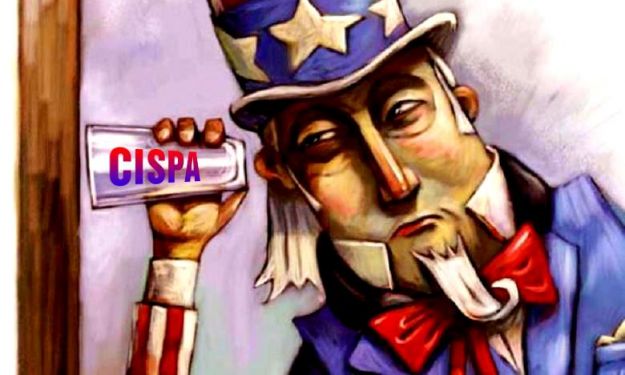
CISPA supporters list: 800+ companies that could help Uncle Sam snag your data

As the campaign against the Cyber Intelligence Sharing and Protection Act (CISPA) heats up, it's important for the opposition movement to understand just how many companies directly or indirectly support the legislation (i.e. through a trade group). Here, the complete list of CISPA supporters.

During the week of April 23, the House of Representatives is expected to vote on the Cyber Intelligence Sharing and Protection Act of 2011 (CISPA). And starting on Monday, a variety of organizations, including the Electronic Frontier Foundation, the American Civil Liberties Union, the Center for Democracy and Technology, The Constitution Project, Demand Progress, Engine Advocacy, Fight for the Future, Free Press, Reporters Without Borders, Techdirt, and TechFreedom plan to launch a “week of action” campaign against CISPA, a bill they believe remains dangerously broad in its language, which could result in abuse by the government, and damages to our civil liberties.

Click on Image to Enlarge

While many are comparing CISPA to the Stop Online Piracy Act (SOPA), the two bills are entirely different for a number of reasons. First, CISPA is a cybersecurity bill that pertains to the sharing of information between the government and private companies. SOPA was an anti-piracy bill that sought to block access to “foreign rogue” websites that illegally distributed copyrighted material. Second, SOPA was opposed by many of the technology and Internet industry’s biggest players. CISPA, on the other hand, effectively has the support of hundreds of technology and Internet companies — a key difference that could drastically affect whether the anti-CISPA crowd can successfully block passage of the bill.

To give you a full picture of just how much political firepower the CISPA has in Congress, we’ve listed most, if not all, of the companies and organizations that have voiced either direct support for CISPA (by writing a letter, or otherwise expressing support for this specific bill), or indirect support through the direct support of a trade group. The organizations or companies listed in bold have voiced direct support. Those companies not in bold have not necessarily given direct support (though quite a few have), but have supported the bill through the trade group, which is listed in bold. The links go to the .pdf files of the letters the company sent to the House Intelligence Committee to express their support of CISPA.

As you can see, the list of CISPA supporters is massive, and should give anyone who thinks this will be an easy political fight a dose of reality. Not that CISPA can’t be stopped but, well, scroll down and you’ll see what we mean.

See full list here.

Marcus Aurelius: Early Warning DoD Reductions in Force 6% to 50%

03 Economy, 07 Other Atrocities, 10 Security, 11 Society, Budgets & Funding, Commercial Intelligence, Corruption, DHS, DoD, Government, IO Impotency, Military, Office of Management and Budget
Marcus Aurelius

Starting to see initial indications that at least one part of DoD is gearing up to cut anywhere from 6% to 50% of its workforce within the fairly near term, perhaps beginning as soon as 01 Oct.  Drivers could be generic deficit reduction, sequestration, and historic limitations on strength levels in certain types of organizations.  Expect it to be ugly — sprung at last minute, execute without finesse.)

Government Workers Are Unfairly Assailed

By Ted Kaufman, US Senator (DE)

Wilmington (DE) News Journal
April 8, 2012

We've heard a lot in the past couple of years, pro and con, about escalating CEO compensation, but it seems to me at least one argument in their defense has merit. It is important to pay enough to recruit and retain the best talent available in the highly competitive global marketplace.

What seems strange to me is that those who believe this is true, that you have to pay well to attract the best talent, usually don't accept the same argument when it comes to government employees.

One of the more dangerous consequences of the financial crisis is how governments at all levels are, in effect, cutting off their noses to spite
their faces. In the rush to balance their budgets, some are indiscriminately firing, freezing and cutting pay, and cutting pensions — too often impacting the people who actually make government work.

Continue reading “Marcus Aurelius: Early Warning DoD Reductions in Force 6% to 50%”

Josh Kilbourn: Global Systemic Risk Is Rising Rapidly Again

03 Economy, 08 Wild Cards, Commerce, Commercial Intelligence, Corruption
Josh Kilbourn

Global Systemic Risk Is Rising Rapidly Again

Submitted by Tyler Durden on

ZeroHedge, 04/11/2012 15:26 -0400

The risk of the 30 most systemically important financial institutions (SIFI) in the world has risen over 30% in the last three weeks as the effects of LTRO fade and encumbrance becomes the new reality.

This less-manipulated, government-bank-reacharound-driven bond-market sense of reality has retraced almost 40% of its improvement from its peak last November at 311bps to its best level mid-March at 171bps.

The current 226bps level is extremely elevated and as one would expect is dominated by European and US banks (with US banks on average trading wider than Europeans – which may surprise many but Europeans dominate the worst names – most specifically the Spanish banks).

Graphics Below the Line.

Continue reading “Josh Kilbourn: Global Systemic Risk Is Rising Rapidly Again”

Patrick Meier: Does the Humanitarian Industry Have a Future in The Digital Age?

Blog Wisdom, Civil Society, Collective Intelligence, Commerce, Commercial Intelligence, Cultural Intelligence, Earth Intelligence, Geospatial, Gift Intelligence, Government, info-graphics/data-visualization, InfoOps (IO), International Aid, IO Impotency, Methods & Process, microfinancing, Mobile, Non-Governmental, Peace Intelligence, Threats
Patrick Meier

Does the Humanitarian Industry Have a Future in The Digital Age?

I recently had the distinct honor of being on the opening plenary of the 2012 Skoll World Forum in Oxford. The panel, “Innovation in Times of Flux: Opportunities on the Heels of Crisis” was moderated by Judith Rodin, CEO of the Rockefeller Foundation. I've spent the past six years creating linkages between the humanitarian space and technology community, so the conversations we began during the panel prompted me to think more deeply about innovation in the humanitarian space. Clearly, humanitarian crises have catalyzed a number of important innovations in recent years. At the same time, however, these crises extend the cracks that ultimately reveal the inadequacies of existing humanita-rian organizations, particularly those resistant to change; and “any organization that is not changing is a battle-field monument” (While 1992).

These cracks, or gaps, are increasingly filled by disaster-affected communities themselves thanks in part to the rapid commercialization of communication technology. Question is: will the multi-billion dollar humanitarian industry change rapidly enough to avoid being left in the dustbin of history?

Crises often reveal that “existing routines are inadequate or even counter-productive [since] response will necessarily operate beyond the boundary of planned and resourced capabilities” (Leonard and Howitt 2007). More formally, “the ‘symmetry-breaking' effects of disasters undermine linearly designed and centralized administrative activities” (Corbacioglu 2006). This may explain why “increasing attention is now paid to the capacity of disaster-affected communities to ‘bounce back' or to recover with little or no external assistance following a disaster” (Manyena 2006).

Continue reading “Patrick Meier: Does the Humanitarian Industry Have a Future in The Digital Age?”

noble gold