Patrick Meier: Departing for Qatar

08 Wild Cards, Advanced Cyber/IO, Blog Wisdom, Civil Society, Collective Intelligence, Commerce, Commercial Intelligence, Cultural Intelligence, Earth Intelligence, Ethics, Government, Media, Mobile
Patrick Meier

Joining the Qatar Foundation to Advance Humanitarian Technology

Big news! I'll be taking a senior level position at the Qatar Foundation to work on the next generation of humanitarian technology solutions. I'll be based at the Foundation's Computing Research Institute (QCRI) and be working alongside some truly amazing minds defining the cutting edge of social and scientific computing, computational linguistics, big data, etc. My role at QCRI will be to leverage the expertise within the Institute, the region and beyond to drive technology solutions for humanitarian and social impact globally—think of it as Computing for Good backed by some serious resources.  I'll spend just part of the time in Doha. The rest of my time will be based wherever necessary to have the greatest impact. Needless to say, I'm excited!

My mission over the past five years has been to catalyze strategic linkages between the technology and humanitarian space to promote both innovation and change, so this new adventure feels like the perfect next chapter in this exciting adventure. I've had the good fortune and distinct honor of working with some truly inspiring and knowledgeable colleagues who have helped me define and pursue my passions over the years. Needless to say, I've learned a great deal from these colleagues; knowledge, contacts and partnerships that I plan to fully leverage at the Qatar Foundation.

It really has been an amazing five years. I joined the Harvard Humanitarian Initiative (HHI) in 2007 to co-found and co-direct the Program on Crisis Mapping and Early Warning. The purpose of the program was to assess how new technologies were changing the humanitarian space and how these could be deliberately leveraged to yield more significant impact. As part of my time at HHI, I consulted on a number of cutting-edge projects including the UNDP's Crisis and Risk Mapping Analysis (CRMA) Program in the Sudan. I also leveraged this iRevolution blog extensively to share my findings and learnings with both the humanitarian and technology communities. In addition, I co-authored the UN Foundation & Vodafone Foundation Report on “New Technologies in Emergen-cies and Conflicts” (PDF).


Continue reading “Patrick Meier: Departing for Qatar”

David Isenberg: Death for Reed-Elsevier, Life for Knowledge

Academia, Access, Advanced Cyber/IO, Collective Intelligence, Commercial Intelligence, Knowledge
David Isenberg

Elsevier Versus Wikipedia: Academics Revolt Against Giant Publisher

by Pratap Chatterjee, CorpWatch Blog

CorpWatch, May 11th, 2012

Over 11,000 academics have pledged to boycott Elsevier, the Dutch publishing giant, for profiting off their work and making it unavailable to the general public. Now Jimmy Wales, the founder of Wikipedia, is about to turn the world of corporate academic publishing on its head, in the same way that his website effectively took down Encyclopedia Britannica.

Elsevier is part of the Anglo-Dutch company Reed Elsevier, which had 2010 revenues of $9.3 billion and annual profits of over $1.67 billion. It publishes over 250,000 articles in some 2,000 journals a year that range from global publications like the Lancet to more specific ones like the Journal of the Egyptian Mathematical Society.

Some of these journals are very expensive. Biochimica et Biophysica Acta, for example, sells for $31,000 to Japanese subscribers and $25,000 a year to European and Iranian subscribers. (The rest of the world can buy it for a mere $20,930 a year!) There is a market: University libraries in the UK alone spend over $320 million to make these publications available to their students.

Publishers like Elsevier knew they were onto a good thing because before the arrival of the Internet, there was no other way for researchers to tell their peers about the important work they were doing, or vice versa. Plus getting published in a respectable journal was also the key to keeping academic jobs and getting promotions, so the researchers and professors  – like rock musicians and best-selling writers – were leery about giving away their work for free.

“(P)ublishing companies became the de facto gatekeepers to scientific knowledge, restricting who could see the latest ideas rather than allowing ideas to spread as far as possible,” writes Aloke Jha in the Guardian.

Continue reading “David Isenberg: Death for Reed-Elsevier, Life for Knowledge”

David Stockman: Emperor Naked, Bond Market Explodes Next

03 Economy, Civil Society, Commerce, Commercial Intelligence, Corruption, Government
David Stockman

The Emperor is Naked: David Stockman

Testosterone Pit, May 9, 2012

Contributed by Karen Roche and JT Long of The Gold Report. A “paralyzed” Federal Reserve Bank, in its “final days,” held hostage by Wall Street “robots” trading in markets that are “artificially medicated” are just a few of the bleak observations shared by David Stockman, former Republican U.S. Congressman and director of the Office of Management and Budget. He is also a founding partner of Heartland Industrial Partners and the author of The Triumph of Politics: Why Reagan's Revolution Failed and the soon-to-be released The Great Deformation: How Crony Capitalism Corrupts Free Markets and Democracy. The Gold Report caught up with Stockman for this exclusive interview at the recent Recovery Reality Check conference (5/4/12).

The Gold Report: David, you have talked and written about the effect of government-funded, debt-fueled spending on the stock market. What will be the real impact of quantitative easing?

David Stockman: We are in the last innings of a very bad ball game. We are coping with the crash of a 30-year–long debt super-cycle and the aftermath of an unsustainable bubble.

Quantitative easing is making it worse by facilitating more public-sector borrowing and preventing debt liquidation in the private sector—both erroneous steps in my view. The federal government is not getting its financial house in order. We are on the edge of a crisis in the bond markets. It has already happened in Europe and will be coming to our neighborhood soon.

TGR: What should the role of the Federal Reserve be?

DS: To get out of the way and not act like it is the central monetary planner of a $15 trillion economy. It cannot and should not be done.

The Fed is destroying the capital market by pegging and manipulating the price of money and debt capital. Interest rates signal nothing anymore because they are zero. The yield curve signals nothing anymore because it is totally manipulated by the Fed. The very idea of “Operation Twist” is an abomination.

Capital markets are at the heart of capitalism and they are not working. Savers are being crushed when we desperately need savings. The federal government is borrowing when it is broke. Wall Street is arbitraging the Fed's monetary policy by borrowing overnight money at 10 basis points and investing it in 10-year treasuries at a yield of 200 basis points, capturing the profit and laughing all the way to the bank. The Fed has become a captive of the traders and robots on Wall Street.

TGR: If we are in the final innings of a debt super-cycle, what is the catalyst that will end the game?

DS: I think the likely catalyst is a breakdown of the U.S. government bond market. It is the heart of the fixed income market and, therefore, the world's financial market.

Because of Fed management and interest-rate pegging, the market is artificially medicated. All of the rates and spreads are unreal. The yield curve is not market driven. Supply and demand for savings and investment, future inflation risk discounts by investors—none of these free market forces matter. The price of money is dictated by the Fed, and Wall Street merely attempts to front-run its next move.

As long as the hedge fund traders and fast-money boys believe the Fed can keep everything pegged, we may limp along. The minute they lose confidence, they will unwind their trades.

On the margin, nobody owns the Treasury bond; you rent it. Trillions of treasury paper is funded on repo: You buy $100 million (M) in Treasuries and immediately put them up as collateral for overnight borrowings of $98M. Traders can capture the spread as long as the price of the bond is stable or rising, as it has been for the last year or two. If the bond drops 2%, the spread has been wiped out.

If that happens, the massive repo structures—that is, debt owned by still more debt—will start to unwind and create a panic in the Treasury market. People will realize the emperor is naked.

Continue reading “David Stockman: Emperor Naked, Bond Market Explodes Next”

Mini-Me: Agents of Religion – Religion of Agents

07 Other Atrocities, 09 Justice, 09 Terrorism, 10 Security, 10 Transnational Crime, Articles & Chapters, Commercial Intelligence, Corruption, Cultural Intelligence, Government, Intelligence (government)
Who? Mini-Me?

Huh?

AGENTS OF RELIGION-RELIGION OF AGENTS (Vol. I): THE INFLUENCE OF FAITH IN THE INTELLIGENCE SERVICES

Zhyldyz Oskonbaeva (RIEAS Senior Advisor & Eurasian Liaison)

NEWSLETTER Issue #5 – May 2012 (Mediterranean Council for Intelligence Studies)

The more followers you have, the stronger is their belief in you. The more believers you have, the greater your chances of getting elected. With both you can rule the nation. The difference between the two is that believers will fight for their cause. This forms the basis for real power (From author).

The influence of religion is such that power, order and government perceive their effects as a stabilizer on society as well as the legitimation of their rule. Depending on the history, the state depends on a society that is moral, consistent and trusting in their institutions.  As decision makers, real power ensures that their decisions will be both supported and followed by society. From the very beginning of society, religious institutions fought for “believers-parishioners.” As a result, politics borrows from religion in that it is a secularization of bureaucratic competencies formally entrusted to an absolute ruler ‘personally’ chosen by a supreme being and counseled by his representative on earth – embodied as the senior religious leader.  Sometimes this symbiotic relationship is equal, sometimes dependent upon the other but always it is both visual and implied.  What both understand is that power is expressed in numbers which is something they both need.

This analysis is a series of articles consisting of historical and contemporary facts in order to examine this relationship in more detail.  By minimizing editorial comment and without bias to any particular religion, the intent to explore a dimension that remains largely underexplored in modern scholarship.  In other words if intelligence professionals are dedicated patriots above the norm then what effect does religion play in the composition of their national identity and their duties in serving the state?

Continue reading “Mini-Me: Agents of Religion – Religion of Agents”

Sepp Hassleberger: Open Source Car Created in Three Months – Interview

03 Economy, 11 Society, Advanced Cyber/IO, Blog Wisdom, Commercial Intelligence, Communities of Practice, Cultural Intelligence, Ethics, Future-Oriented, Hacking, Liberation Technology, Methods & Process
Sepp Hasslberger

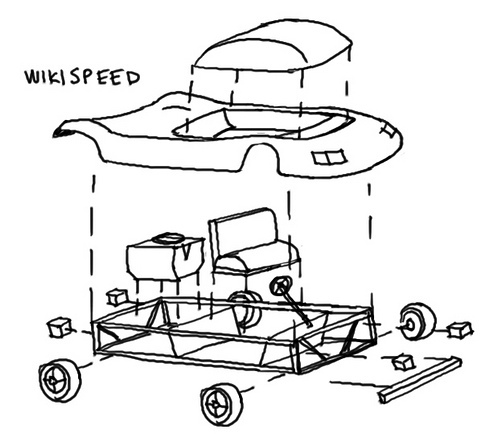
Interviewing Joe Justice from Team Wikispeed on the Future of Manufacturing (and Consumption)

Joe Justice is the ideator of Team Wikspeed: a team of volunteers distributed around the world who recently created a prototype car that is open source, modular and ultra-efficient in just three mo… …YES, in just three months compared with the years it takes traditional car manufacturers to bring out a new model.

See Also:

This is an extremely interesting interview with Joe Justice … it gives the gist of where the manufacturing revolution is going.

The interview is in both English and Italian.

Full interview with photos and video.

Click on Image to Enlarge

VIDEO:

Phi Beta Iota:  Achieving an Open Source Everything world is a three part process:

1.  Creation of Open Source Alternatives.

2.  Creation of Integrated infrastructure–pieces need to intersect.

3.  Abolishment of political parties and governments that try to micro-impose safety standards (e.g. air bags) and other onorous measures whose sole real purpose is to make competition unaffordable for the Open Source Everything movement, while blackmailing commerce into contributing to Political Action Campaigns.

Click on Image to Enlarge

See Also:

The Open Source Everything Manifesto: Transparency, Truth & Trust

NIGHTWATCH: France-Greece Shock Bankers Into Reality

08 Wild Cards, Commercial Intelligence, Cultural Intelligence

Europe: For the record. German Chancellor Merkel and the European Council have changed in the last 48 hours from emphasizing austerity and the importance of adhering to agreements and goals to focusing on growth.

The two economic ideas are not mutually exclusive. Nevertheless, the growth has not been discussed in connection with south European sovereign debt. The rise of the socialists in France and the rejectionists in Greece seems to jolted the European bankers to consider potentially more innovative ideas about continental economic health besides “pay what you owe” policies.

The window of innovation will not last long because the debt exceeds the capacity to pay it down. The demographics of up to 50% unemployment among the most able cohorts of the work forces in Mediterranean European states defeat growth without statism. This is the threat.

NIGHTWATCH KGS Home

See Also:

Chuck Spinney: Why Doesn’t Spain Understand that Integrity is Priceless?

Chuck Spinney: Europe in Crisis Rule by Troika Spain and Hungary Next

Chuck Spinney: Financial Coups Destroying Europe

Chuck Spinney: German Economic Imperialism Killing Europe?

John Steiner: Iceland Defies Banks, Recovering Rapidly

Michel Bauwens: Michael Hudson on the crucial link between democracy and debt throughout history

Mini-Me: Iceland Breaks the Back of Western Banking

Mini-Me: Iceland Triumphs Over Banks, Western Governments Continue the Charade

NIGHTWATCH: Financial Crisis Now a Crisis of Fundamentals

Mini-Me: US Dollar Out, Yuan, System D, and Open Money In + Meta-RECAP

Reference: Defense and Energy Deficit Reduction: $688 Billion

03 Economy, 04 Inter-State Conflict, 05 Energy, 07 Other Atrocities, 08 Proliferation, 09 Justice, 10 Security, 11 Society, Budgets & Funding, Commercial Intelligence, Corruption, General Accountability Office, Government, Military, Office of Management and Budget, Officers Call

POGO Source Page, May 8, 2012

national security spending

Wasteful Spending in the Department of Defense Budget
Wasteful Spending on Nuclear Weapons Programs
Service Contracts
Conclusion
Endnotes

Americans are tightening their belts, and it’s time for the U.S. government to do the same. In light of the Budget Control Act of 2011 and the subsequent failure of the “Super Committee,” Congress is still desperately seeking ways to reduce spending. To this end, the Project On Government Oversight and Taxpayers for Common Sense have closely examined the proposed national security budget[1] and found plenty of wasteful spending. Adjusted for inflation, U.S. national security spending is higher than at any point during the Cold War and accounts for more than half of all discretionary spending.[2] However, the U.S. faces no existential threats as it did then, and U.S. defense needs are changing as the military draws down its presence in Iraq and Afghanistan.

Still, military spending at the Department of Defense (DoD) has increased by an astounding 95 percent from FY 2001 to the FY 2013 estimate, adjusted for inflation.[3] Nuclear weapons spending at the Department of Energy (DOE) is projected to grow by billions of dollars over the next decade.[4] And the federal government’s reliance on contractors, most of whom work on national security-related work and cost on average nearly twice as much as the federal workers who do the same job, is also driving budgets through the roof.[5] It’s clear that any serious proposal to shrink the U.S. deficit must include cuts to the national security budget.

The following list updates our recommendations from 2011[6] and details nearly $700 billion in savings over the next ten years, including cuts to wasteful weapons systems as well as limits on out-of-control contract spending. We found programs for which there are cheaper yet equally effective alternatives, and programs that can be cancelled or delayed without putting America’s security at risk.

The Project On Government Oversight is a nonpartisan independent watchdog that champions good government reforms. POGO’s investigations into corruption, misconduct, and conflicts of interest achieve a more effective, accountable, open, and ethical federal government.

Taxpayers for Common Sense is a nonpartisan budget watchdog serving as an independent voice for American taxpayers. Its mission is to achieve a government that spends taxpayer dollars responsibly and operates within its means. TCS works with individuals, policymakers, and the media to increase transparency, expose and eliminate wasteful and corrupt subsidies, earmarks, and corporate welfare, and hold decision makers accountable.

Wasteful Spending in the Department of Defense Budget

Continue reading “Reference: Defense and Energy Deficit Reduction: $688 Billion”

noble gold