Hmmmm. Can you spell unethical idiocy? AT BEST, the Iranian Liberation Nut-Jobs. AT WORST, another Israeli false flag operation. In the middle, the usual out-of-control lunatic covert action wanna-bees.
Robert Steele adds: if and when this becomes fully exposed, it will qualify as a “precipitant” of revolution, showing the public with stark immediacy the degree to which the US government lacks integrity as well as intelligence.
Fedor Dostoevsky:A man who lies to himself, and believes his own lies, becomes unable to recognize truth, either in himself or in anyone else.
Carl Jung: The maintenance of secrets acts like a psychic poison which alienates the possessor from the community.
Daniel Ellsberg speaking to Henry Kissinger: The danger is, you’ll become like a moron. You’ll become incapable of learning from most people in the world, no matter how much experience they have in their particular areas that may be much greater than yours” [because of your blind faith in the value of your narrow and often incorrect secret information].
“The US secret intelligence community is long overdue for a draconian reduction of its budget from the $80-90 billion a year today that it wastes on contractors producing vaporware, to something closer to the $20 billion a year that Jim Woolsey is on record as saying would be sufficient, and for once I agree with him.”
“General Tony Zinni is on record as saying that when he was in charge of the US Central Command, the secret intelligence community provided, ‘at best' 4% of what he needed to know. The fact is that the secret world is primarily a means of transferring wealth from taxpayers to corporations and banks–it not only lacks intelligence, it lacks integrity.”
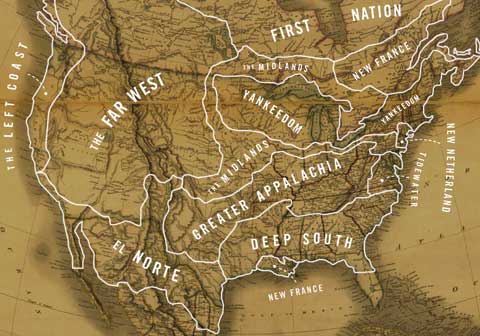
Below is a very interesting essay analyzing the evolution of culture, economics, and politics in United States. Other authors have done similar types of analyses, but this one has some interesting twists. It is a synopsis of a book just written by the author that blends together aspects of cultural, geographic and even religious anthropology, with history, politics, and political economy in a way that illustrates obvious synthetic potential of using GIS (computerized Geographic Information Systems) in efforts to evolve our understanding of history, political economy, anthropology and patterns of cultural evolution in general. The author ends on a shallow political note, laying out a counter-Tea Party strategy, but don't let that crassness turn you off from the larger intellectual possibilities implicit in this kind of work.
Even as the movement’s grip tightens on the GOP, its influence is melting away across vast swaths of America, thanks to centuries-old regional traditions that few of us understand.
By Colin Woodard, Washington Monthly,November/December 2011
Before Tuesday this week, Secretary of Defense Leon Panetta had been sprinkling Washington D.C. with words like “doomsday mechanism,” “catastrophic,” and “shooting ourselves in the head” to describe any cuts in the Pentagon's budget beyond the $450 billion over 10 years (overall a 4 percent reduction) he and President Obama have already committed to. Panetta had set a new standard for overheated rhetoric to defend the Pentagon's budget.
Phi Beta Iota: Panetta, like Gates and others before him, is a political toad incable of telling the truth or pursuing the public interest. He is telling two major lies in all of his speeches: 1) that cutting the defense budget will weaken national security; and 2) that what we pay $1 trillion a year (in borrowed money) for is “the finest fighting force in the world.” Not so less the infantry, which is 4% of the force, takes 80% of the casualties, and receives 1% of the budget. In an honest government, Panetta would be impeached–and all his senior generals and senior executive sychopants retired.
The first of a four-part investigation into a world of greed and recklessness that led to financial collapse.
In the first episode of Meltdown, we hear about four men who brought down the global economy: a billionaire mortgage-seller who fooled millions; a high-rolling banker with a fatal weakness; a ferocious Wall Street predator; and the power behind the thron
Meltdown examines how an epidemic of fear caused banks to stop lending, triggered protests and led to industrial action.
In the second episode of Meltdown, we look at how the financial tsunami swept the world. We hear about a renegade executive who nearly destroyed the global financial system and the US treasury secretary who bailed out his friends.
As the toll of the financial crisis continues to mount, many are looking for its true causes – and finding a crime.
The third episode of Meltdown looks at how the victims of the 2008 financial crash fight back. A protesting singer in Iceland brings down the government; in France a union leader oversees the kidnapping of his bosses; and thousands of families are made homeless in California.
Some responded with denial, others by re-thinking capitalism, but who is preparing for the next crisis?
In the final episode of Meltdown, we hear about the sheikh who says the crash never happened; a Wall Street king charged with fraud; a congresswoman who wants to jail the bankers; and the world leaders who want a re-think of capitalism.
Phi Beta Iota: This is a world-class series that misses just two things:
A. Goldman Sachs has owned the US Treasury–providing the Secretary of the Treasurer (and today also the National Security Advisor to the President–for three critical administrations, each of which willfully eradicated safeguards.
B. Senator Phil Graham (R-TX) and the other Senators who had and still have zero integrity, passing 200 pages of lobbyist written deregulation inserted into the bill five minutes before the vote.
Penguin adds:
C. The perfidy of Clinton in his Glass-Steagall sellout and his CONTINUED malignant hyping of its ethic through obfuscation and the pimping of what “reputable” analysts who want access to his solon. For him America was built on deal making and networking.
Here are some more good articles and websites about the Occupy Together movement, the global extension of Occupy Wall Street.
In this posting there are a number of pieces about strategy and tactics – appeals to and descriptions of nonviolence (including some tips useful in everyday life as well as demonstrations); what contributed to their success in holding onto their NYC site; the logic of their non-partisan messages that are not tied to specific demands; etc. You'll also find a powerful video highlighting the hypocrisy of US officials condemning crackdowns on Arab Spring protests while condoning crackdowns on domestic Occupy protests.
I've also excerpted an inspiring, sober open letter from long-time Christian activist Jim Wallis. His whole article is worth reading. It was sent to me by my friend and colleague Rosa Zubizarreta who writes:
“I highly recommend that people GO. visit. see for yourself. engage in wonderful conversations. volunteer. contribute…. yes, there are clearly challenges and difficulties (it's certainly not perfect, as Rainbow Gatherings and Peace Camps and Soup Kitchens and all of those various manifestations of “free zones” are not perfect…) AND, it is so very much alive, filled with many wonderful moments and lots of learning and creativity and connection… On Friday morning in Occupy Boston, there were several classrooms visiting… their teachers bringing them in for a field trip… it was awesome!”
Others have written to me about conversations happening among finance professionals about the changes that are needed in their sector – conversations stimulated and energized by the Occupy Wall Street protests. Increasingly, this aspect of nonviolent protest – encouraging urgently needed conversations about change – is becoming the trademark of this movement. And this is an invitation to those of us who know how to make conversations meaningful and productive…
Blessings on this 13.7 billion year old highly interactive Journey.
One is primarily a psychology of exclusion, the other inclusion. But both start with deep similarities: anger, fear, frustration, resentment, and an enduring faith in democratic ideals (why else participate?).
. . . . . .
The differences between the Tea Party position and that of Occupy Wall Street emerge in how that upset is expressed, in how solutions are sought. If we think of the Tea Party starting with a rebel’s yell of “get your f-in hands off my f-in stuff” then OWS begins with a naive complaint about being hungry while others unfairly have too much, “how much stuff do you really need, really, to have a good life?”
. . . . . .
From the start the Tea Party was about safety through exclusion, protecting oneself from outside influences—including a President seen as an un-American “other,” perhaps for racial reasons, perhaps other reasons as well. What the Tea Party rejected was anything perceived by them as coming from outside the center of America. It’s not us, it’s never us; it’s them.
. . . . . .
The start of OWS is radically different. Everyone is included, everyone gets to have a say. Rather than policy they have process. The “we” of OWS is worldwide, a globalized, networked “we” full of good and bad existing simultaneously and everywhere. The messier the better; better to let in those you don’t want then miss out on including those you do.
. . . . . .
For Tea Party members, the world will always remain full of persecutory others (Obama’s the devil!!) while OWS holds out the promise of community, no, of communities of difference.
. . . . . .
Of course, moving from the psychology of protest to specific policy recommendations is the responsibility not of the protestors whose message needs to be heard but of political leaders. And I want to note that there’s something profoundly anti-capitalist about the critics of OWS. It’s a movement about which capitalists, real capitalists who work hard and smart, have nothing to fear. Oligarchs, on the other hand, should be afraid, very afraid.
. . . . . .
More than anything else, OWS is helping facilitate a shift in psychological values from more—and then more more—to enough, from the destructive envy of raging at someone who has more to the genuine satisfaction of appreciating what one has.