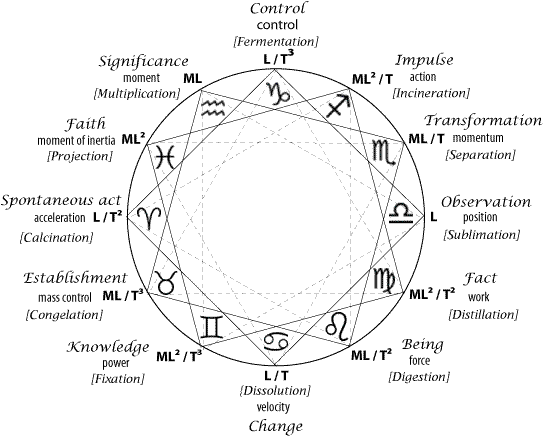
Graphic: 12 Elements in the Universe of Meaning
Cultural Intelligence, Data, Governance, Graphics, Knowledge
The truth at any cost lowers all other costs — curated by former US spy Robert David Steele.
Eliciting a Universe of Meaning
within a global information society of fragmenting knowledge and relationships
Introduction
Eliciting meaning of universal significance
Resolving vs. Developing
Eliciting meaningful identity: resolution vs. resolving
Solve et coagulo: neither changing nor resolving?
Pop concert of democracies as a vehicle for meaning?
Dynamic transformation of static reporting of global processess
State sovereignty in a meaningful universe?
Symbolic connotations of sovereignty in a meaningful process
Illicit meaning and “illiciting meaning”?
Mnemonic clues to configuration and containment of meaningful identity
Sustaining a universe of meaning within a questioning process
Eliciting a universe of meaning from nothing through alchemical processes
Geometry of meaning: an alchemical Rosetta Stone?
References

EXTRACT:
The Keys of Enoch®teaches us that a greater unity can and must occur between the scientific and spiritual pathways in order for the problems of Earth to be solved. Its ultimate purpose is the advancement of humanity, with the goal of changing our orientation so that we are prepared for a higher spiritual attunement and a quantum shift that will move humanity and the earth forward into the next step in our evolution. In this process an ultimate interaction is foretold, as we discover “greater families of intelligence in the universe who share the same Higher Evolution and the same Divine Source.”
The Book: The Book of Knowledge
The Web Site: Academy of Future Science
The 30 Minute Video:
Continue reading “Berto Jongman: Keys of Enoch – 20 Minute Video, Book,”

Secrecy and National Security Whistleblowing
Daniel Ellsberg on January 8, 2013
[Originally published in Social Research]
I) Reflections on Secret-keeping and Identity
In the “national security” area of the government–the White House, the departments of state and defense, the armed services and the “intelligence community,” along with their contractors–there is less whistleblowing than in other departments of the executive branch or in private corporations. This despite the frequency of misguided practices and policies within these particular agencies that are both more well-concealed and more catastrophic than elsewhere, and thus even more needful of unauthorized exposure.
The mystique of secrecy in the universe of national security, even beyond the formal apparatus of classification and clearances, is a compelling deterrent to whistleblowing and thus to effective resistance to gravely wrongful or dangerous policies. In this realm, telling secrets appears unpatriotic, even traitorous. That reflects the general presumption–even though it is very commonly false–that the secrecy is aimed not at domestic, bureaucratic or political rivals or the American public but at foreign, powerful enemies, and that breaching it exposes the country, its people and its troops to danger.
Even those insiders who have come to understand that the presumption is frequently false and that particular facts are being wrongly and dangerously kept secret not so much from foreigners but from Congress, courts or the public are strongly inhibited from speaking out by an internalized commitment to keep official secrets from outsiders, which they have promised to do as a condition of employment or access.
Complete post by Ellsberg below the line.
Continue reading “Daniel Ellsberg: On Secrecy & Whistleblowing with Comment by Robert Steele”
 One clearly sees the character of these corporations in times of disaster. They have obviously spent billions developing extraction technologies, and virtually nothing on how to cope with what happens if it all goes wrong. Here is as clear an example as anyone could provide.
Dead Dolphins and Shrimp With No Eyes Found After BP Clean-up
EMILY DUGAN – The Independent (UK)
Hundreds of beached dolphin carcasses, shrimp with no eyes, contaminated fish, ancient corals caked in oil and some seriously unwell people are among the legacies that scientists are still uncovering in the wake of BP's Deepwater Horizon spill.
This week it will be three years since the first of 4.9 billion barrels of crude oil gushed into the Gulf of Mexico, in what is now considered the largest marine oil spill in the history of the petroleum industry. As the scale of the ecological disaster unfolds, BP is appearing daily in a New Orleans federal court to battle over the extent of compensation it owes to the region.
R D Laing came up with an amazingly creative way to express complex cognitive processes in a very simple and concrete way, so that the truth beneath them is revealed.
Cognitive psychology is the most influential and productive branch of contemporary psychology by far.
The point of this post is that all of the negative social dynamics that humankind suffers from are the result of skewed and irrational thinking. They can rightly be called cognitive knots. And that's what R. D. Laing's book “Knots” was all about. We have internal “knots” because we have the world inside us. Inside each of us is a representation of our known universe filtered through the lens of our subjective experience, which of course alter our “reality.”

Some of our knots are conflicts within ourselves (our subjective self and objective self), but they're all tangled up in we, because we are inextricable from society because we are a social species. So some of these knots are both internal arguments between aspects of ourselves and arguments between us and other individuals, or between our group and their group. But the dynamics are the same at every level, just like a fractal.
Here is the book free online, R. D. Laing, Knots.
It may seem like a pain in the ass to negotiate, at first, but it becomes simple if you look at the little square with the page number. All you have to do is keep typing the next page number. It's easier than scrolling.
Laing made a study of schizophrenics and their families. It was a long term study and he interviewed these families over a long period of time. What he found was that most of the families of schizophrenics engaged in double-bind communication. The most common example is, “You don't love me; you only pretend to.” The reason it's a double bind communication is that it's a demand for a demonstration of love, but at the same in makes it clear that no demonstration of love will ever be sufficient.
The central feature of cognitive psychology is the idea that most of our thought processes are below our conscious awareness. And it is because they are below our awareness that they have such control over us. It is only when they are unearthed that we can gain control over them. These cognitive “knots” come from his journals. In other words, he didn't invent them. They are schematics that he drew up to represent actual cases.
The reason I think they are important is because I have never seen a technique that can make complex cognitive knots so vivid and understandable. And that was exactly why he developed them, as a tool that he could use to untangle the cognitive knots he encountered so that he could understand them. In other words, this book is the expression of a teaching technique that he used to teach himself, so that he could untangle otherwise impenetrable social, cognitive knots.
And I think this technique could be used as a great tool for making complex social dynamics vivid and graspable. For example, I think I could work one up for the conflict dynamics between Palestinians and Israelis. And I think I could make the self-destructiveness (on both sides and interactively) clear to everyone.
That's why I think there is such genius in this book.
Continue reading “Theophillis Goodyear: RD Laing and Cognitive Knots”
Millions face starvation as world warms, say scientists
World is unprepared for changes that will see parts of Africa turned into disaster areas, say food experts
John Vidal, The Observer, 13 April 2013
Millions of people could become destitute in Africa and Asia as staple foods more than double in price by 2050 as a result of extreme temperatures, floods and droughts that will transform the way the world farms.
As food experts gather at two major conferences to discuss how to feed the nine billion people expected to be alive in 2050, leading scientists have told the Observer that food insecurity risks turning parts of Africa into permanent disaster areas. Rising temperatures will also have a drastic effect on access to basic foodstuffs, with potentially dire consequences for the poor.
Frank Rijsberman, head of the world's 15 international CGIAR crop research centres, which study food insecurity, said: “Food production will have to rise 60% by 2050 just to keep pace with expected global population increase and changing demand. Climate change comes on top of that. The annual production gains we have come to expect … will be taken away by climate change. We are not so worried about the total amount of food produced so much as the vulnerability of the one billion people who are without food already and who will be hit hardest by climate change. They have no capacity to adapt.”
Continue reading “Berto Jongman: World Food Crisis + Food RECAP”
