SmartPlanet: Why algorithms need humans to predict the weather

Advanced Cyber/IO, Earth Intelligence, Knowledge

Why algorithms need humans to predict the weather

| September 11, 2012

History is rich with intellectuals who have revered theories of determinism; ideas that suggest if we could only know every facet of a situation, every molecule of the landscape, we could predict and even shape future political, economic, and cultural outcomes.

But when it comes to the weather, forecasters long ago gave up any hope of cataloging all of the variables that could impact rainfall in Seattle, or the arrival of a cold front in New York. At least that’s what Nate Silver reports in his new book, The Signal and the Noise: Why So Many Predictions Fail — but Some Don’t, an excerpt of which was adapted for a recent article in The New York Times Magazine.

Continue reading “SmartPlanet: Why algorithms need humans to predict the weather”

Yoda: Mind-Mapping Advances–Listening Does Not

Civil Society, Collective Intelligence, Crowd-Sourcing, Government, IO Impotency, IO Mapping, P2P / Panarchy
Got Crowd? BE the Force!

Behold the Awesome Science of Mind-Mapping An Instructionalicious Guide

Mindmapping is a very serious and well researched subject, or art … or something . Whatever it is a map of the mind is definately something to be valued and this ‘instructionalicious' guide is no exception. Allow this infographic to simultaneously blow and map your mind.

DuckDucklGo Mind-Mapping

Phi Beta Iota:  Tens of billions of dollars are being spent on covert surveillance including the recording of all emails, telephone conversations, and other forms of exchange, but most of this is not being processed.  Worse, it is not being processed toward making sense in the public interest.  It is one thing to focus on the needle in the haystack threat warning.  It is quite another to focus on harnessing the distributed intelligence of the public.  That will be the next big leap for “national intelligence.”

See Also:

Continue reading “Yoda: Mind-Mapping Advances–Listening Does Not”

Venessa Miemis: CultureHacking, IntentCasting, & Connecting with Strangers

Advanced Cyber/IO, Cultural Intelligence, Culture
Venessa Miemis

Culture Hack: Collaborating with Strangers

The culture hacking story I want to share with you is almost ten years old now. Back then I was a Ph.D. student in Computer Science with a deep interest in social software. I was posting to my blog daily, and building a reputation as a thinker in the field.

One of my issues with the blogosphere (as we called the universe of all blogs) was that it appeared as this galaxy of nebulously-connected personal streams. As a result, people with a shared interest in a given topic had a hard time finding each other; conversation on any given topic was discouragingly scattered.

So, one Wednesday in October I wrote in a blog post tiled “Making group-forming ridiculously easy“:

“I’d like to explain an idea that I have been bouncing around for a while. It might well be a reformulation of what others have said previously. I believe that implementing this properly would give a nice boost to the blogosphere’s social aggregation capability. ”

I then offered a short blueprint of a system for pulling together blog posts from all over the blogosphere with a shared topic into a single stream, thus helping people connect around shared interest. I then wrote, “I haven’t worked it out in detail, but wouldn’t it be possible to hack a beta of this together as follows?” and spelled out how the thing might be built. The idea was slightly peripheral to my focus, and I didn’t have time to learn all that was needed for me to implement it myself.

What followed exceeded my expectations many-fold. On the other side of the planet, in New Zealand, a programmer named Philip Pearson came across my post and read it. He had been working blog-based systems for a while and must have thought the idea had merit, because over the weekend he hacked together a complete working prototype version of the system I had dreamed up, and unassumingly sent me an email telling me about it.

Read rest of article.

Chuck Spinney: Russian Land, Chinese Labor – The North Evolves

01 Agriculture, 02 China, 03 Economy, 06 Russia, 11 Society, Cultural Intelligence, Culture, Economics/True Cost
Chuck Spinney

Interesting evolution of Russo-Chinese relations

Nation Rich in Land Draws Workers From One Rich in People

By ANDREW E. KRAMER

The New York Times, 10 September 2012

OSTANINO, Russia — When a Chinese investor bought a farm outside this village a few years back, he was pleased enough to name it Golden Land. The soil was rich, the sunshine and rain bountiful.

The land, deep in rural Russia, was also largely devoid of people.

No more. Today, row upon row of greenhouses here teem with dozens of Chinese farmhands picking tomatoes. And in a season with a bumper crop of tomatoes, the foreman said he would happily have employed hundreds more.

The influx of Chinese farm labor in Russia reflects the growing trade and economic ties between the two countries, one rich in land and resources, the other in people.

For years after the breakup of the Soviet Union, both countries have struggled to convert these complementary strengths into real business opportunities. A few mining ventures are succeeding. And state companies have struck big oil, coal and timber deals that form the backbone of the economic relationship.

Read full article.

Bin Laden Show #89 – Conflicting Accounts of the Kill

Commerce, Corruption, Cultural Intelligence, Economics/True Cost, Government, Knowledge, P2P / Panarchy, Politics
Bean Laden

Navy SEAL: Why We Shot Osama Bin Laden on Sight

Lee Ferran

ABC News, 10 Sep 2012

As top American officials and a Navy SEAL who was on the raid that killed Osama bin Laden grapple over whether the al Qaeda leader “resisted” before he was shot, the SEAL said in a recent interview that in the heat of battle, the men on the ground weren't going to take any chances with their target.

It wasn't until other members of the team entered the room and saw a man twitching on the ground that they realized he had been hit in the head. Then, after shooting the man in the chest a few more times until he stopped moving, they realized it was bin Laden, the book says. America's most wanted man was unarmed and though there was a rifle and a handgun in a room nearby, neither had a bullet loaded in the chamber.

“He hadn't even prepared a defense. He had no intention of fighting,” Owen writes.

Read full article (two screens)

Continue reading “Bin Laden Show #89 – Conflicting Accounts of the Kill”

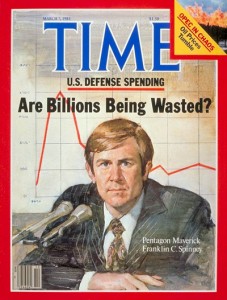
Chuck Spinney: US Navy – More Admirals than Ships? Comprehensive Survey of Flag Officer Bloat as Foundation for Failed Militaries Across History

Corruption, Cultural Intelligence, Economics/True Cost, Military
Chuck Spinney

How bad is our bloat of generals? How does it compare with other armies?

Fabius Maximus, 10 September 2012
Summary:  As a followup to yesterday’s rant by Richard A Pawloski (Captain, USMC, retired) about our bloated corps of senior generals, today we look at the actual numbers.  They show that if anything Pawloski understated the situation, and that only many more rants can reform our military. It’s not just expensive, but might become a risk to the Republic.
“In place of that optimax of 5% {officers} that the MI never can reach, many armies in the past commissioned 10% of their number, or even 15%! This sounds like a fairy tale but it was a fact, especially during the 20th century. What kind of an army has more officers than corporals? And more noncoms than privates! An army organized to lose wars — if history means anything. An army that is mostly red tape and overhead, most of whose soldiers never fight.”
— Robert Heinlein’s Starship Troopers (1959). Heinlein was Annapolis class of 1929, discharged in 1934 due to TB.

Contents

  1. About our bloated roster of generals
  2. Our economy has not grown, but our officers corps has
  3. Comparing our Army to successful & unsuccessful past armies
  4. Research about inflation in our officers corps
  5. Other articles about our senior officers
  6. Other posts about our military, & the potential risk to the Republic

Read full post with many supporting links and excellent graphics.

Phi Beta Iota:  The review charts the rather troubling migration of Pentagon flag officers and Pentagon methods of fraud, waste, and abuse, over to the Department of Homeland Security, the new pork-fest.  Our focus is always on the public interest, and in the military, the public interest cannot be separated from the welfare of the enlisted force, and particularly that portion of the force, the infrantry, 4% of the total force, taking 80% of the casualties, and receiving 1% of the Pentagon budget.  This is a crime by politicians and policymakers and so-called professional flag officers, against our very own.  On a positive note, we are meeting more and more “insiders” that confirm our view that the US Government is comprised of good people trapped in a bad system — senior grades — who have pretended to drink the kool-aid, abhor all that they do, and would be profoundly appreciative of any leadership oriented toward reform.

Berto Jongman: Internet Rising – Collective Consciousness

Collective Intelligence, Cultural Intelligence, P2P / Panarchy, YouTube
Berto Jongman

Internet Rising – documentary film

Released on 11.29.11, ‪http://internetRISING.net‬ is a digi-documentary investigating the evolving relationships between the Internet and collective consciousness of humanity. It provokes many questions about ancient and modern paradoxes of life, its pleasures and pains… and the gray area contrasts in between – but most of all it is meant to be an inspiring conversation starter

See Also:

Andrew Blum, Tubes: A Journey to the Center of the Internet (Ecco 2012)

noble gold