Good News: Sea Otters Combat Climate Change

Earth Intelligence, Economics/True Cost

Sea Otters To Combat Climate Change?

Does a large population of sea otters reverse one of the principal causes of climate change? New research from the UC Santa Cruz is suggesting that a population boom of sea otters would go a long way to reduce sea urchin numbers, and therefore allow kelp forests to become very large.

“The spreading kelp can absorb as much as 12 times the amount of CO2 from the atmosphere than if it were subject to ravenous sea urchins, the study finds.” Of course, altering a food chain so significantly could have unintended consequences.

The theory was just outlined in a paper published September 7 in the journal Frontiers in Ecology and the Environment.

“It is significant because it shows that animals can have a big influence on the carbon cycle,” said Wilmers, assistant professor of environmental studies.

“Wilmers, Estes, a professor of ecology and evolutionary biology, and their co-authors, combined 40 years of data on otters and kelp bloom from Vancouver Island to the western edge of Alaska’s Aleutian Islands. They found that otters “undoubtedly have a strong influence on the cycle of CO2 storage.”


Read full article.

Yoda: Integrating Arts Into Sciences

04 Education, Academia, Commerce, Cultural Intelligence, IO Impotency, Knowledge, P2P / Panarchy
Got Crowd? BE the Force!

Knights know that the arts–especially music–are essential to developing the creative and innovative impulses of entrepreneurs.  Put more directly:  no arts in education – fewer entrepreneurs.

Lesson Plans and Resources for Arts Integration

Dance in science, pop art in Spanish, or photography in math — there’s no end to the ways arts can be integrated into other curricula. Educators from Bates Middle School, in Annapolis, Maryland, share arts-integrated lessons and resources that you can use in your school.

Mini-Me: Marine Officer on 9/11 – The Anomalies Continue to Surface

07 Other Atrocities, 09 Justice, Commerce, Corruption, Cultural Intelligence, Government, Knowledge, Law Enforcement, Media, Military, Politics
Who? Mini-Me?

Huh?

Phi Beta Iota:  As President Barack Obama faces what David Gergen calls one of three “choice” or turning point elections in modern US history, one has to wonder where he stands on the subject of the truth.  Below the line is a methodical review with many links from retired Marine Corps officer Jim Fetzer, who focuses on the Cheney-dominated US Government at the time.  Equally troubling facts can be asserted on the New York end by focusing on Larry Silverstein and Rudy Guliani.  If ever a sitting President had a ready-made opportunity for eradicating an opposing political party by enabling the truth to be told about a major event in modern US history, Barack Obama is that President.  We do not favor a traditional justice approach here, but rather a Truth & Reconciliation Commission.  If Barack Obama were to sponsor The Smart Nation Act, the Electoral Reform Act of 2012, a Truth & Reconciliation Commission on 9/11, and the immediate decriminalization of marijuana and then of all other drugs [with a jobs program equal to the challenge of existing unemployment and emptied prisons with restored voting rights], it would be game over.  Then instead of having to fight for credibility and traction every day, he might actually be able to govern in 2013-2016.  On the other hand, if President Barack Obama and the Democratic Party are intent on demonstrating there is no substantive difference between the two parties that control the electoral process and the disbursement of the public treasury, they should continue to do precisely what they are doing now.

Continue reading “Mini-Me: Marine Officer on 9/11 – The Anomalies Continue to Surface”

Pierre Levy: Etienne Chouard on A True Democracy

Cultural Intelligence, Politics
Pierre Levy

For all, this 55 year old teacher reveals that “our misfortunes” (ecological catastrophy, destruction of civil services in public administration, work slavery, the reign of money…) have been made possible “because of our incapacity to resist”. He indicates “I will do like Hippocrates did. I try to find the root of the causes. It is vain to fight against consequences.” He believes that this “impotency to resist”, this “infantilization”, is “programmed in the Constitution”. Since “those who write the Constitutions first think of how to preserve their own interests”, to “change things” and put in place “a real democracy”, he sees only one way forward: to randomly draw citizens who will write by themselves a new Constitution.

YouTube (1:08:55)

Phi Beta Iota:  In French (verbal) with superbly executed English sub-titles.  As soon as the film starts, roll the cursor over the second red button in lower right of the YouTube screen (has small white CC inside the red box) and click, this turns on the subtitles.

More by the same speaker, seven-part series on “Is Democracy a Trap?”

David Isenberg: Private Military Contractors (PMC) – A Stake in the Heart of DoD and USG

Commerce, Corruption, Cultural Intelligence, Government, Military


David Isenberg

Negative Views of Civilian and Private Security Contractors

Concerns over their cost effectiveness and strategic value make the deployment of PMSCs a risky proposition. More worryingly, argues David Isenberg, is that they may permit governments to circumnavigate democratic debates over the necessity of sending armed forces into battle.

By David Isenberg for the ISN

From the outset, it needs to be established that the use of private military and security contractors (PMSC) – whether in wars or humanitarian and stabilization operations – is not necessarily a bad thing. Indeed, even if this was the case, the United States is unlikely to decrease its reliance on them in the future, if for no other reason than the fact that contractors are now essential to maintaining the U.S. military’s vast network of overseas bases and facilities. But it is also true that the deployment of PMSCs does not always make sense. Indeed, just because contractors are often unfairly vilified doesn’t mean that their claims should be taken at face value. Yet, like any other issue worthy of debate the devil is always in the details. Questions concerned with how PMSCs will be used, who monitors contracts for proper implementation – not to mention the challenge of developing transparency and accountability processes – are questions that have far too often been answered by trial and error.

A Checkered Past

Continue reading “David Isenberg: Private Military Contractors (PMC) – A Stake in the Heart of DoD and USG”

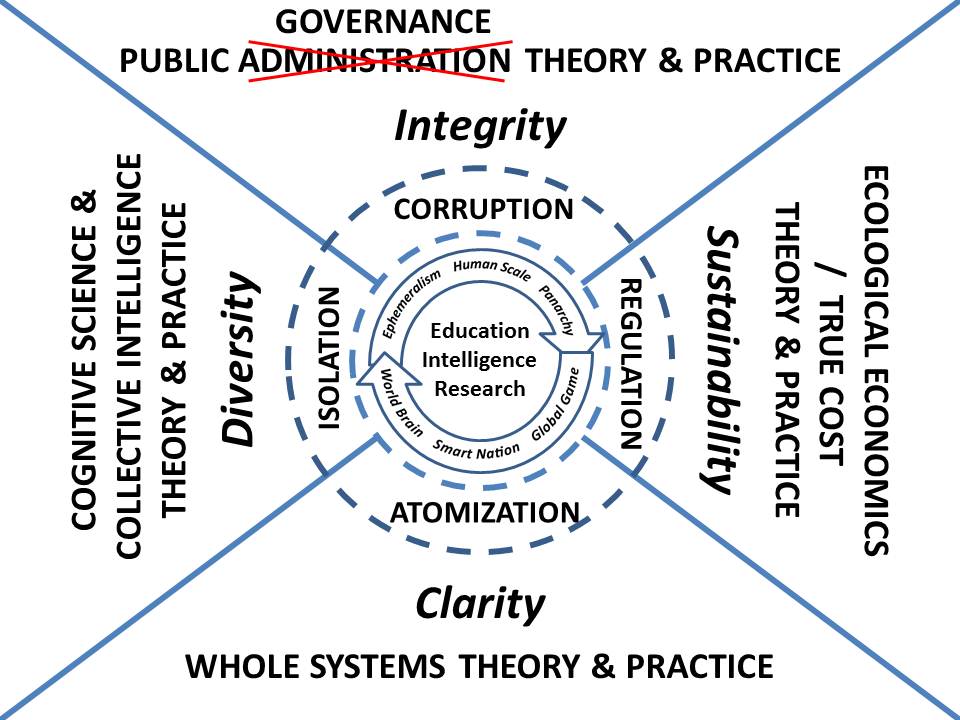
Graphic: Public Governance in the 21st Century

Advanced Cyber/IO, Analysis, Balance, Capabilities-Force Structure, Citizen-Centered, Collaboration Zones, Communities of Practice, Corruption, Ethics, Graphics, ICT-IT, Innovation, Key Players, Leadership-Integrity, Policies, Policies-Harmonization, Strategy-Holistic Coherence, Threats, True Cost
Click on Image to Enlarge

Preliminary thoughts of Robert Steele in Response to

15 Nov 2012 Proposal Deadline 30-31 May 2013 San Francisco Public Administration Theory Network 2013

See Also:

2013 Public Governance in the 21st Century: New Rules, Hybrid Forms, One Constant – The Public [Work in Progress]

Journal: Reflections on Integrity UPDATED + Integrity RECAP

noble gold