Koko: Another Earth Found – This is Good

Earth Intelligence
Koko

Potentially Earth-Like Planet Has Right Temperature for Life

Govert Schilling, ScienceNow

WIRED, 5 december 2011

For the first time, astronomers have found a planet smack in the middle of the habitable zone of its sunlike star, where temperatures are good for life. “If this planet has a surface, it would have a very nice temperature of some 70° Fahrenheit [21°C],” says William Borucki of NASA’s Ames Research Center here, who is the principal investigator of NASA’s Kepler space telescope. “[It's] another milestone on the journey of discovering Earth’s twin,” adds Ames director Simon “Pete” Worden.
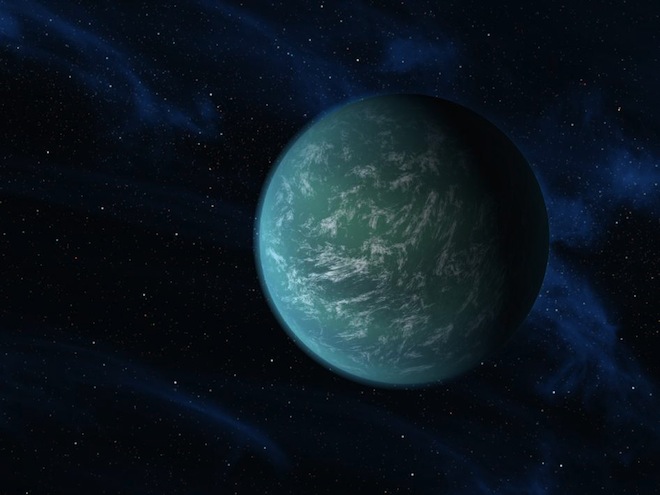
Click on Image to Enlarge

Unfortunately, the true nature of the planet, named Kepler-22b, remains unknown. It is 2.4 times the size of Earth, but its mass, and hence its composition, has not yet been determined. “There’s a good chance it could be rocky,” Borucki says, although he adds that the planet would probably contain huge amounts of compressed ice, too. It might even have a global ocean. “We have no planets like this in our own solar system.”

. . . . . .

Forty-eight of these planet candidates orbit in the habitable zone of their parent stars. Most are substantially larger than Earth, but 10 are about the same size as our home planet. Some of these are in multiplanet systems. “It’s conceivable that any — or many — of these 48 habitable zone candidates, or their moons, could have life,” Borucki says.

Read more.

See Also:

extraterrestrial Disclosures Increase….

Journal: Humans Living 50% Beyond Earth Capacity

OOPS. Extra-Terrertial Life Compounded…

Reference: Summary of Earth’s Terminal Conditions & Radical Necessary Changes

Reference: Water, Earth, and We

Reference: WATER–Soul of the Earth, Mirror of Our Collective Souls

Science: The Habitable Exoplanets Catalog, a New Online Database of Habitable Worlds

Joichi Ito: Internet is an Open-Source Philosophy

Advanced Cyber/IO, Civil Society, Collective Intelligence, Cultural Intelligence, Ethics, Hacking, Methods & Process

In an Open-Source Society, Innovating by the Seat of Our Pants

JOICHI ITO

New York Times, December 5, 2011

The Internet isn’t really a technology. It’s a belief system, a philosophy about the effectiveness of decentralized, bottom-up innovation. And it’s a philosophy that has begun to change how we think about creativity itself.

. . . . . .

The ethos of the Internet is that everyone should have the freedom to connect, to innovate, to program, without asking permission. No one can know the whole of the network, and by design it cannot be centrally controlled. This network was intended to be decentralized, its assets widely distributed. Today most innovation springs from small groups at its “edges.”

. . . . . . .

I don’t think education is about centralized instruction anymore; rather, it is the process establishing oneself as a node in a broad network of distributed creativity.

Read full article.

David Brin: Three-Quarters Climate Change Man-Made

Earth Intelligence
David Brin

Three-Quarters of Climate Change Is Man-Made

An independent study quantifies the human and natural contributions, with solar radiation contributing only minimally

Quinn Schiermeier and Nature Magazine

Scientific American, 5 december 2011

Natural climate variability is extremely unlikely to have contributed more than about one-quarter of the temperature rise observed in the past 60 years, reports a pair of Swiss climate modelers in a paper published online December 4. Most of the observed warming—at least 74 percent—is almost certainly due to human activity, they write in Nature Geoscience.

Read full article.

Phi Beta Iota:  Yes BUT!  First off, Environmental Degradation, high-level threat number three, includes Climate Change, which is less than 10% of Environmental Degradation (and within Climate Change, carbon is vastly less important than mercury or sulpher).  Secondly, the real looming catastrophes are man-made increases in the frequency and severity of weather.  We have destroyed the earth's natural feedback loops and self-correcting mechanisms.

See Also:

Worth a Look: Book Reviews on Climate Change

Worth a Look: Book Reviews on Disease

Worth a Look: Book Reviews on Environmental Degradation (Other than Emissions)

Worth a Look: Book Reviews on Peak Oil

Worth a Look: Book Reviews on Water

Mini-Me: US Gasoline Exports–Reason for Tar Sands Fraud

03 Economy, 03 Environmental Degradation, 05 Energy, 07 Other Atrocities, 11 Society, Civil Society, Commerce, Corruption, Earth Intelligence, Government, Power Behind-the-Scenes/Special Interests
Who? Mini-Me?

Gasoline: The new big U.S. export

Steve Hargreaves

CNN Money, 5 December 2011

NEW YORK (CNNMoney) — The United States is awash in gasoline. So much so, in fact, that the country is exporting a record amount of it.

The country exported 430,000 more barrels of gasoline a day than it imported in September, according to the U.S. Energy Information Administration. That is about twice the amount at the start of the year, and experts and industry insiders say the trend is here to stay.

The United States began exporting gas in late 2008. For decades prior, starting in 1960, the country used all the gas it produced here plus had to import gas from places in Europe.

But demand for gas has dropped nearly 10% in recent years. It went from a peak of 9.6 million barrels a day in 2007 to 8.8 million barrels today, according to the EIA.

Read full article.

Phi Beta Iota:  The entire Tar Sands scheme is a scam on the US public, and atrocity against the Canadian public.  In Canada, they are proposing to use precious water they do not have to spare, to flush tar we do not need out of the sands; in the US, there is no need for the tar sands as the sleazy campaigns suggest, the oil companies want the tar sands so they can externalize the costs to the US public and privatize the profits of exporting the gasoline.

Koko: Mammoth find raises hopes of successful cloning

Earth Intelligence
Koko

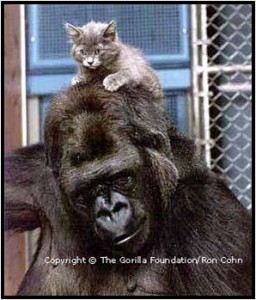
Koko Sign:  Like diversity.

Mammoth find raises hopes of successful cloning

Emma Woollacott

TG Daily,  December 5, 2011

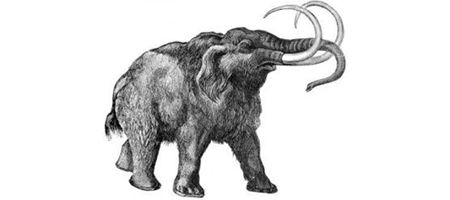
A Japanese team which has been hoping to clone a mammoth says that a specimen discovered this summer looks likely to yield up the necessary DNA.

The team, from Japan's Kinki University and the Sakha Republic's mammoth museum, announced its plans last January before setting off for Siberia in search of frozen mammoth tissue.

And they've now announced that one of their finds – a thigh bone discovered in northern Sakha – contains well-preserved bone marrow with intact cell nuclei.


Click on Image to Enlarge

Global warming has decreased the proportion of the Siberian tundra that's covered with permafrost, meaning that new mammoth carcases have increasingly been coming to light. However, past efforts to recreate the mammoth – which have been going on since the 1990s – have failed as cell nuclei have been in too poor a condition.

This latest specimen, though, is reported to be in very good condition, and scientific techniques for extracting viable DNA have improved. As a result, according to Japan's Kyodo News, the Japanese team is now confident that it can replace the nuclei of egg cells from an African elephant with nuclei taken from the mammoth bone marrow.

This would create create embryos which can be implanted into elephants' wombs for gestation.

Any resulting baby mammoth would be the first to walk the earth for thousands of years. The species is believed to have largely died out at the end of the Pleistocene, 10,000 years ago, with a dwarf species hanging on for another 5,000 years.

Josh Kilbourn: War Against Iran Has Been Underway

04 Inter-State Conflict, 07 Other Atrocities, 10 Security, 11 Society, Corruption, Government, IO Deeds of War, Military, Peace Intelligence, Power Behind-the-Scenes/Special Interests
Joshua Kilbourn

Is Iran Already Under Attack?

The Atlantic, Dec 2, 2011

Adam Chandler, the Goldblog deputy-editor-for-monitoring-Iran-obsessively-even-though-Goldblog-himself-also-monitors-Iran-obsessively, pointed out to me the other day that perhaps the West has already begun the attack on Iran's nuclear facilities, that perhaps we ought to reframe this issue a bit. The attacks he mentioned are not the usual sub-rosa, eyebrow-raising tech and computer virus sort of attacks, but outright physical attacks. This is more a semantic issue, I suppose (and yes, I realize the Iranian regime is virulently anti-semantic), but operations against Iran are seeming to move away from the pure Mossad-in-the-70s-style attacks to straight-up military confrontations. I don't know if this is a sign of escalation or desperation or both, though it seems fair to say that less subtlety on the part of Israel, the U.S. and whoever else is doing this suggests that the previous tactics were deemed insufficient.

Following a (perhaps not-so-mysterious) explosion on a military base last month that took with it the life of Gen. Hassan Tehrani Moghaddam–one of the Iranian missile program's most distinguished OGs–comes news of a second explosion in Isfahan this past Monday, which according to sources “struck the uranium enrichment facility there, despite denials by Tehran.”

Of course, accurate news out of Tehran is hard to come by, but if you want to take this a step further, one might consider Tuesday's (perhaps not-so-spontaneous) storming of the British embassy by Iranian “students” to be quite an effective smokescreen in keeping news of this second explosion from making serious waves. If you've had a lot of coffee, it's also worthy to note that on Monday evening, following the explosion in Iran, four missiles fired from southern Lebanon struck Israel–the first such incident in over two years.

I'm not entirely convinced, but it's not unreasonable to group these recent explosions with the Stuxnet virus of last summer that haywired an uranium enrichment facility in Natanz; last October's explosion at a Shahab missile factory; the killing of three Iranian nuclear scientists in the past two years, last November's attempted assassination of Fereydoun Abbasi-Davan–a senior official in the nuclear program — and rumblings of a second supervirus deployed this month as proof that the West's war on Iran's nuclear program is getting less covert by the minute.

noble gold