Phi Beta Iota: This is the month's good news story–the silver lining in the cloud over America resulting from the loss of political integrity within both political parties. We continue to support both universal service (to bond the public and keep Congress honest), and military service as the finest possible coming of age experience. The crucible of Iraq and Afghanistan have hurt America as an international political and economic entity, but they have also raised a new generation of young leaders–not just officers, but non-commissioned officers down to the “strategic corporal,” that could be the Greatest Generation of our era.
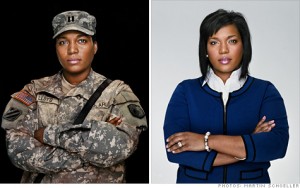
Battle-tested: From soldier to business leader
“The thinking was that we could bring in world-class leadership talent that was already trained and ready to go,” says Jennifer Seidner, a senior recruiting manager at Wal- Mart. “And then we could teach them retail, because we know that pretty well.”
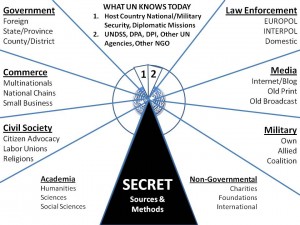
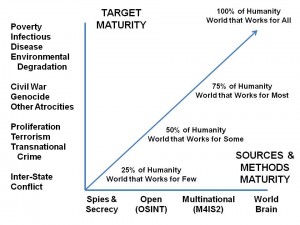
Phi Beta Iota: We are detecting a fascinating evolutionary process within the United Nations “system” which is not a system at all, more like an archipelago with a different cat in charge of each island. Information-sharing is coming into vogue, but more importantly, the United Nations, perhaps stimulated by the report of the United Nations High-Level Panel on Threats, Challenges, and Change, A more secure world: our shared responsibility, appears to finally be realizing that all threats are connected and that poverty is the foundation for all of the other threats thriving–one cannot defeat transnational crime (threat #10) without first addressing poverty (threat #1).
With the top United Nations anti-drug official urging concerted global action to “break the vicious circle between insecurity and underdevelopment” being increasingly fuelled by criminal networks, drug smugglers and human traffickers, the Security Council today called on the world body’s Member States to increase international and regional cooperation to tackle transnational organized crime.
The Council invited Secretary-General Ban Ki-moon, who opened today’s meeting, to consider transnational threats as a factor in conflict prevention strategies, conflict analysis, integrated missions’ assessment and planning and to consider including in his reports, as appropriate, analysis on the role played by those threats in situations on the Council’s agenda. [Phi Beta Iota: Emphasis Added.]
UNITED NATIONS (Reuters) – International criminal gangs and traffickers are exploiting large geographic blind spots where radar, satellite or other surveillance is minimal or nonexistent, the U.N. crime and drugs czar said on Wednesday.
Antonio Maria Costa, head of the Vienna-based U.N. Office on Drugs and Crime (UNODC), told members of the 15-nation U.N. Security Council that countries must improve their systems of sharing intelligence to reduce these surveillance gaps.
“We need a change in attitude,” Costa told the council. “It is time to regard information sharing as a way of strengthening sovereignty, not surrendering it.”
Phi Beta Iota: We strongly recommend McGovern's article be read in its entirety. Key points:
1. US has no mutual defense treaty with Israel and no order to the US military to support Israel is Constitutionally valid without a Senate validation.
2. Israel will not get away with a USS Liberty atrocity on Admiral Mike Mullen's watch.
3. Washington is remains a moral and intellectual cesspool with the White House lacking a strategic analytic model, intelligence (decision-support) or any clue as to how to restore democracy and prosperity in America and peace in the rest of the world. Partisanship–uninformed partisanship–is what runs the White House today and it is NOT WORKING.
4. C/JCS has the right idea but the wrong company–no one now working in the US national security “establishment” has the combination of brains and integrity to actually propose a strategic analytic model; a reconstruction of secret intelligence so it provides non-secret decision-support to everybody now flying deaf, dumb, and blind in the NCA; and a redirection of the Pentagon so its budget funds the four forces after next–reform can be revenue and jobs neutral!
President Obama is at a fork in the road. He can stick with business as usual–partisanship, polling, and proxies that pay lip service to concepts like “national security,” or he can commit to creating a national strategy that gets a grip on reality and then connects means, ways, and ends to achieve a prosperous world at peace. From where we sit, C/CJS is the only person with both the right idea and the courage to speak the truth in public. Three immediately useful references:
Meme 1: Separate Agency Budget Intelligence (SABI). The United Nations Educational, Scientific and Cultural Organization (UNESCO) may be within a year of a huge management advance, understanding, with decision-support, the relative return on investment (ROI) of its investments in relation to the ten high-level threats, many of which it is uniquely positioned to address. Understanding that clean water and sanitation is the most important medical advancement since 1840, UNESCO is poised to call into question its excessive investments in vaccinations that yield little return and often create broader health issues, as opposed to focusing on micro-education (see meme 3) and micro-financiing of clean water initiatives.
Meme 2: integrated missions’ assessment and planning. This is the United Nations (UN) equivalent of Whole of Government planning, programming. and budgeting. While non-existent within most governments, the UN appears to be realizing that with its back to the fall and the fate of over 175 “failed states” on the table, it might be time to add intelligence (decision-support) to how it does business. This means understanding that all threats and all policies have to be evaluated together and in relation (the Eastern way), and that all budgets and behaviors must be planned–harmonized–so as to achieve integrated outcomes, not outcomes in isolation that undermine “rest of system” stability.
Meme 3: micro-education. This is a brand new meme but it defines practices that already exist and could be brought together. With the vast majority of subsistence farmers still using ancient methods such as furrow irrigation, and many not recognizing the value of rain harvesting, there is a route opening for UNESCO by which it can leverage Alvin Toffler's insight and substitute information for capital, labor, time, and space. Put bluntly, some micro-education is vastly more important than a complete (albeit mediocre) elementary education. Micro-education on water and health appears to be the center of gravity for jump-starting the entrepreneurial possibilities among the extreme poor. What no one has done is create a stacked list of “Essential Elements of Information” (EEI) that should be taught to the poor in priority order as part of “any and all” encounters.
EXTRACT (1 of 2 Innovations): If you combine CO2 with seawater, or any kind of briny water, you produce CaCO3, calcium carbonate. That is not only the stuff of corals. It is also the same white, pasty goop that appears on your shower head from hard (calcium-rich) water. At its demonstration plant near Santa Cruz, Calif., Calera has developed a process that takes CO2 emissions from a coal- or gas-fired power plant and sprays seawater into it and naturally converts most of the CO2 into calcium carbonate, which is then spray-dried into cement or shaped into little pellets that can be used as concrete aggregates for building walls or highways — instead of letting the CO2 emissions go into the atmosphere and produce climate change.
If this can scale, it would eliminate the need for expensive carbon-sequestration facilities planned to be built alongside coal-fired power plants — and it might actually make the heretofore specious notion of “clean coal” a possibility.

 A C-130 was lumbering along when a cocky F-16 flashed by.
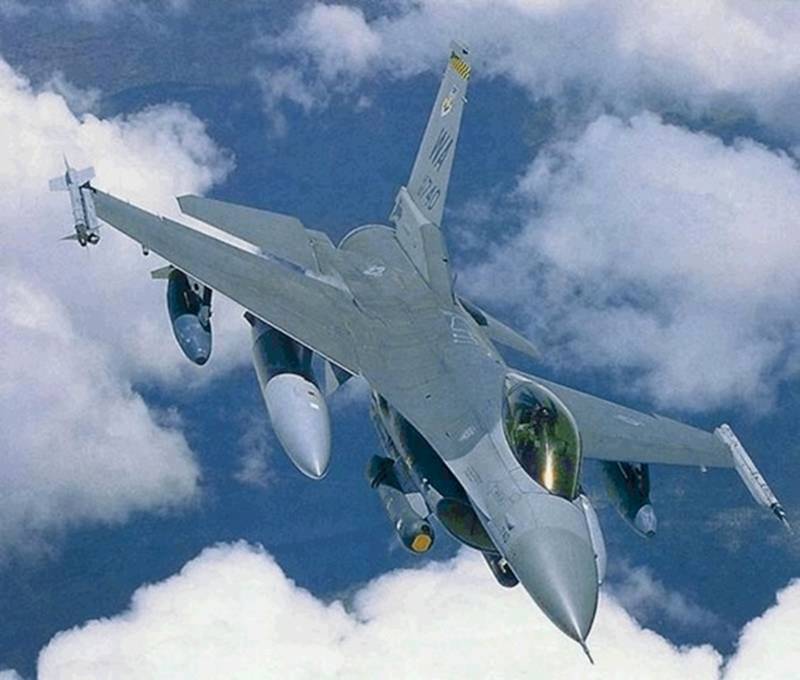 The C-130 droned along for about 5 minutes and then the C-130 pilot came back on and said, “What did you think of that?”