The food trend becomes ever more alarming. For people like Ronlyn and myself, who eat out of our garden, it has little impact, but for millions who don't have that option, the story is becoming ever bleaker. The Obama Administration's active complicity in this trend should be a national scandal.
It was a dark time in a long, drawn-out war. Afghanistan was festering with resentment. The Pentagon brass were desperate. It was the kind of last-ditch moment when authorities start throwing an era’s weirdest ideas at its most hopeless bureaucratic mistakes.
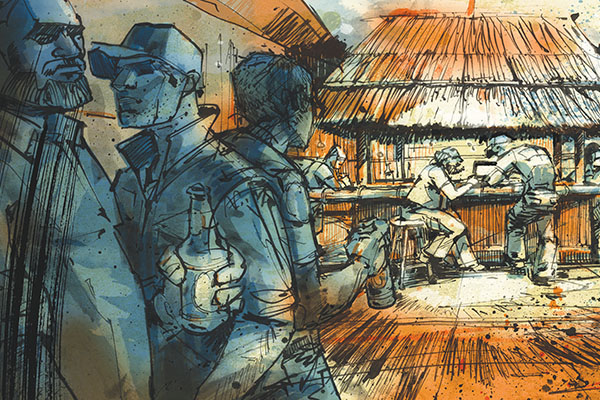
For a long time, the Taj Guest House was about the only place you could get a beer in Jalalabad. The provincial capital, about 30 miles from the infamous mountains of Tora Bora, has been the main staging ground for U.S.-led forces in the eastern part of Afghanistan since the early days of the war. When I showed up in the city in November 2011 to report on the propaganda efforts of a franchising Taliban, I found myself at the Taj. There wasn’t much to the pub—just a bamboo-covered bar, a fireplace, a glass-fronted cooler with some Heineken stacked inside, and a few bottles of vodka and other spirits lined up under the red glow of a lamp.
Plus there was an odd little sign: “We share information, communication, (and beer).”
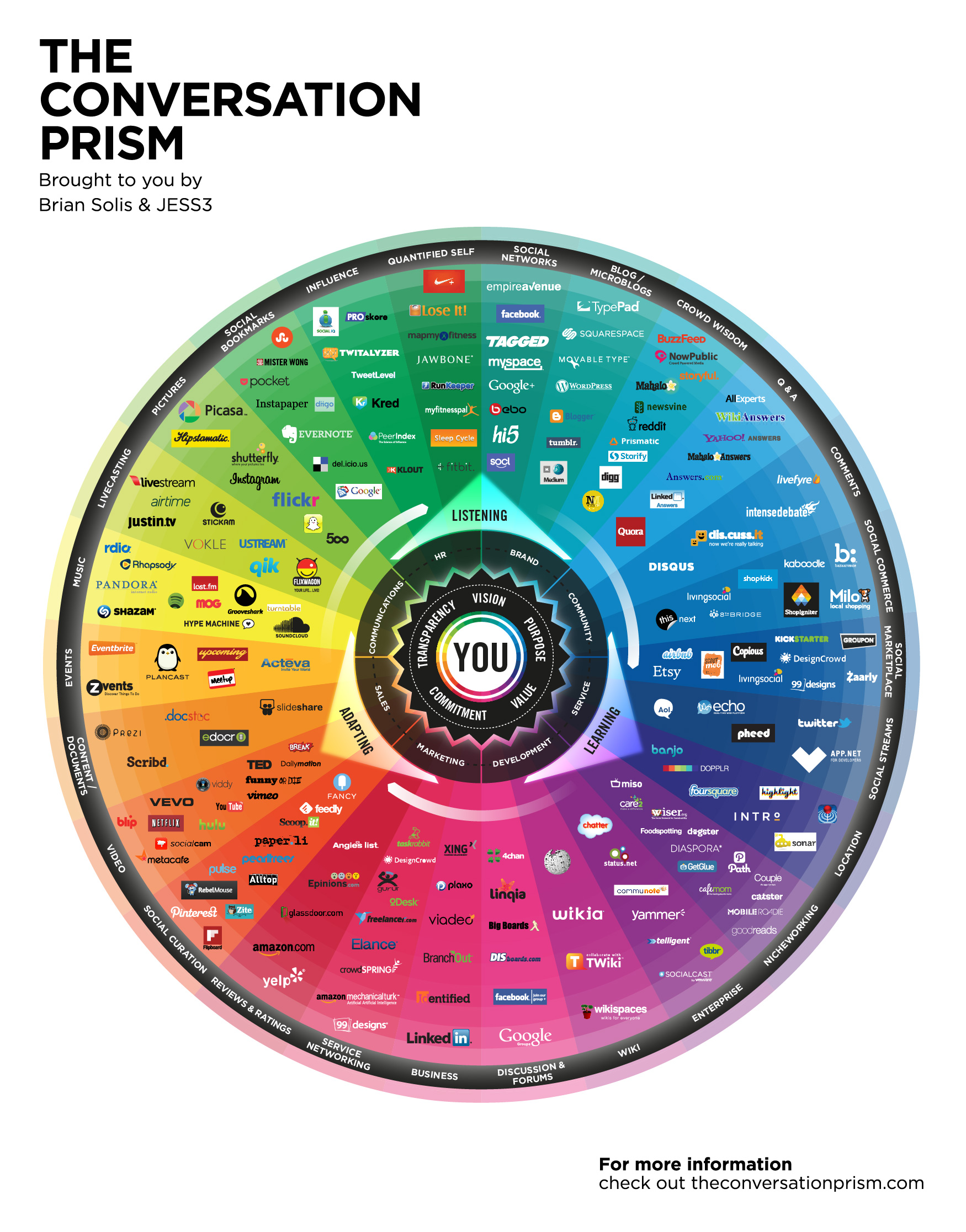
Phi Beta Iota: Well worth careful examination. A useful categorization of many services, all of which have something to do with sharing, and none of which actually contribute to sense-making, decision-support, or true cost accountability. Now imagine this same map, but this time every single element is part of a world brain and global game in which all data is inter-operable and geospatially as well as time tagged, and every datum is weighted and also linked to all true cost information, all in a whole systems context. Cost and corruption anomalies will “light up” — achievable savings and individual needs that — if met — will generate surplus wealth for the community. Yahoo overpaid for tumbl — and will probably overpay for a few other things — instead of actually thinking through how to entice best in class, one from each, while building the other half — the sense-making in context half — that does not exist.
In this video, Dane Wigington gives a presentation in Northern California on the harmful effects of Geoengineering, declaring that there is no more critical topic today. The very essentials needed to sustain life on earth are being recklessly destroyed by these programs. This is not a topic that will begin to affect us in several years, but is now already causing massive animal and plant die off around the world, as well as human illness.
Free information will be our doom, Quartz‘s Jaron Lanier asserts in, “Free Information, as Great as it Sounds, Will Enslave Us All.” From high-frequency trading to online marketing, insists Lanier, big data is being used by those with the resources to collect and manipulate it to enrich themselves. Meanwhile, those of us with just paltry, personal devices are the ones creating the information, creating the value that fuels such systems. It is an argument that has been advanced before, and Lanier pursues the thread:
“Something seems terribly askew about how technology is benefiting the world lately. How could it be that so far the network age seems to be a time of endless austerity, jobless recoveries, loss of social mobility, and intense wealth concentration in markets that are anemic overall? How could it be that ever since the incredible efficiencies of digital networking have finally reached vast numbers of people that we aren’t seeing a broad benefit? . . .
“While people are created equal, computers are not. When people share information freely, those who own the best computers benefit in extreme ways that are denied to everyone else. Those with the best computers can simply calculate wealth and power away from ordinary people.”
See the article for its supporting arguments. Lanier does not leave us hanging for a potential solution. He recalls a suggestion he credits to Ted Nelson, which the IT pioneer made back in 1960: embed a “universal micropayment system” into any digital communication network, so that each individual who contributes any bit of data would get a bit of compensation in return. In that reality, for any tweet each of us sent, search query we made, or even security-camera image of us that was later used by any organization (for whatever purpose), we might become a few cents richer.
Interesting idea; can it gain any traction before the current system is set in stone?
I spotted a blog post called “Could Palantir Technologies Be Raising Additional Funding?” I have no clue who or what is behind this interesting item. The main idea is that Palantir, a high profile company which has been in the news about litigation and other matters, has been funded already. According to Crunchbase, the company has more than $300 million in funding. For the sake of comparison, Attivio and Coveo — both in the content processing space — have been able to drum up about $30 million in funding. Most of the companies in the search and content processing space — Digital Reasoning, for instance — have garnered a fraction of what long time players Attivio and Coveo have been able to gather. At the time of its sale to Oracle, Endeca — another content processing and intelligence vendors — was generating an estimated $150 million in revenues. At the time of its sale to Hewlett Packard, Autonomy was nosing into the $800 million range. But the key figure for Autonomy is that it sold to the prescient managers at HP for more than $10 billion.
Let’s assume that Palantir has received funding in the $300 million range. Let’s assume that the company is not raising any additional funding. Let’s assume that the company, founded in 2004, is going to pay back its investors, operate at a profit, and fund necessary research to keep the content processing system in step with competitors like Cybertap, among others.
So what does the gargantuan funding suggest to me, this fine, humid Sunday morning in rural Kentucky?
I know of three ways to get from today to a prosperous world at peace, a world that works for all — all three merit consideration as a whole.
Click on Image to Enlarge
01. Open Source Everything (OSE). This is the technical solution. The US Government is ignorant and arrogant in part because the cult of secrecy and the ineptitude of chief technical officers, combined with the corruption of political figures that have no interest in knowing anything useful (they attend to those that pay to be heard), have resulted in Washington operating on less than 2% of the relevant information [a typical Country Team collects 20% at most and spills 80% of that in how it handles it] and in the case of the secret world, producing “at best” 4% of what the President or a major commander needs. The future of governance is to be found in bottom-up information sharing and sense-making across all boundaries. Only OSE is affordable, inter-operable, and scalable. This is where the BRICS, the EU, and NATO should be focusing as they create 21st Century Alternative C2 (collaboration and consensus have replaced command and control) — one must give up unilateral command and control in order to gain multilateral command and control.
Click on Image to Enlarge
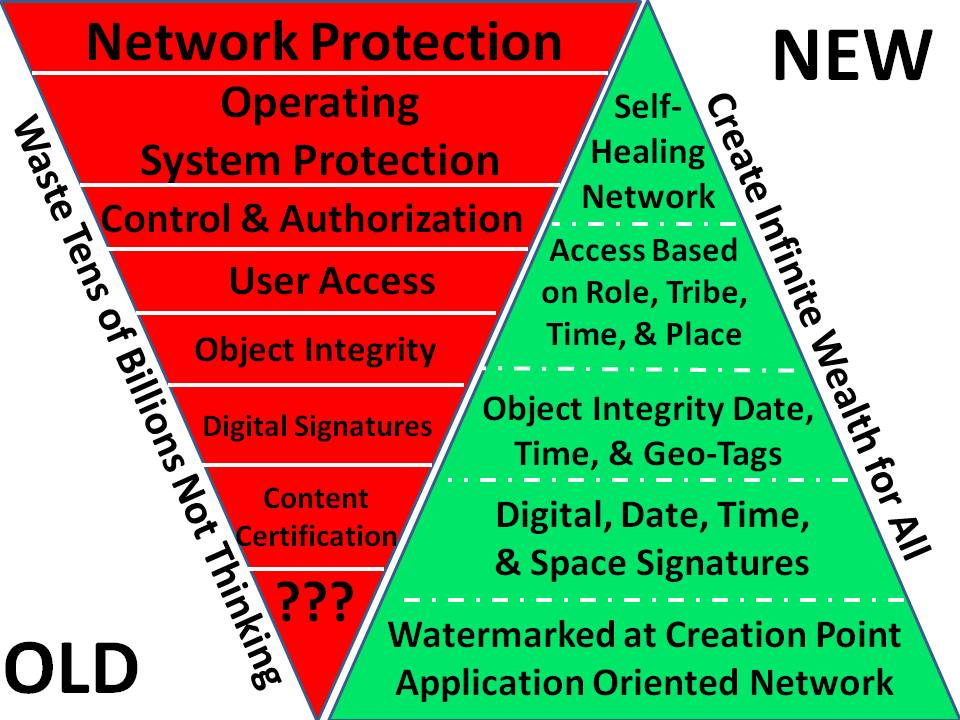
Robert Garigue (RIP) understood what none of the US cyber-chiefs understand: in a decentralized technical environment, human trust is the measure of merit, and security must be embedded such that it is NOT reliant on centralized points that are often asleep, ignorant, arrogant, under-funded, and generally useless. As Col Dr. Max Manwaring and his various contributing authors point out in The Search for Security: A U.S. Grand Strategy for the Twenty-First Century (Praeger, 2003), the primary foundation for both prosperity and peace is LEGITIMACY. A Nobel prize was awarded to the economist that demonstrated that trust lowers the cost of doing business. In brief, proprietary and predatory forms of capitalism have become one. The time has come to create Open Source Ecologies (a fine model is provided by Open Source Ecology, creating a toolkit for civilization), starting with an Autonomous Internet and Liberation Technologies that enable the five billion poor to create infinite wealth. If freedom is our objective, rather than fraud, it demands open source everything. My long-standing vision for an Open Source Agency (OSA) has morphed toward the nurturing of all of the opens as I have discovered that no one open alone will do — they form an unbeatable force for good when combined.

 The food trend becomes ever more alarming. For people like Ronlyn and myself, who eat out of our garden, it has little impact, but for millions who don't have that option, the story is becoming ever bleaker. The Obama Administration's active complicity in this trend should be a national scandal.