John Steiner: Super Rich Plan to Own Global Media

Commerce, Corruption, Media
John Steiner

Check out the video the mining industry never expected you to see:

http://www.getup.org.au/minersmediaplan

You simply have to see this video to believe it.

This week mining billionaire Gina Rinehart became the largest shareholder in Fairfax, having already bought a stake in Channel Ten. But this new video reveals this move is bigger than one woman’s ambition – it’s part of a coordinated and very deliberate strategy, with climate skeptic ‘Lord’ Monkton seen here advising a room full of mining executives on how the industry must gain control of Australia’s media.

Can you help share this video so all Australians understand what's really going on in the mining industry?

http://www.getup.org.au/minersmediaplan

We've seen what happened in the USA when coordinated, super-wealthy corporate interests set about deliberately reshaping the media landscape to suit their agendas. It's bad news for democracy and it's bad news for the issues we care about. And while this most recent purchase was a brazen move, it's hardly the first time a mining industry executive has used their vast wealth to push an agenda.

Last year, Rinehart helped set up a new lobby group calling for a special ‘Northern Economic Zone’ demanding lower tax, government concessions and cheap migrant labor from Asia. She helped bankroll the campaign against Government efforts to ask the mining industry to pay their fair share of tax through the Mining Super Profits tax and she's been actively sponsoring prominent climate skeptics like Monckton, Ian Plimer and Andrew Bolt, who got his own TV show weeks after she invested in Channel Ten.

Phi Beta Iota:  The Internet, the schools, and how the general public is informed are the battleground for 21st century peace and prosperity.  All are rotten to the core right now, but all signs point to a global public rebellion that is insistent on getting back to the truth, the whole truth, and nothing but the truth.

See Also:

Note: this book will NOT be available free online.  Pre-orders are offered by Amazon at a $5 discount.

THE OPEN SOURCE EVERYTHING MANIFESTO: Transparency, Truth, & Trust

Eagle: Corporate Public Relations as Death Wave

03 Economy, 07 Health, Civil Society, Commerce, Commercial Intelligence, Corruption, IO Impotency


DEADLY SPIN: An Insurance Company Insider Speaks Out on How Corporate PR Is Killing Health Care and Deceiving Americans

Since Wendell Potter walked away from his executive position at a top health insurance company in May of 2008, he has worked tirelessly as an outspoken critic of corporate PR and the distortion and fear manufactured by America’s health insurance industry. It is a PR juggernaut that is bankrolled by millions of dollars, rivaling lobbying budgets and underwriting many “non-partisan” grassroots organizations. How would Potter know? He wrote many of the industry’s talking points himself.

Source

Sjai Hajela: The Days of “Manager Knows Best” Are Ending

Civil Society, Collective Intelligence, Commerce, Commercial Intelligence, Cultural Intelligence

The Days of “Manager Knows Best” Are Ending

Sujai Hajela

Harvard Business Review, 1 February 2012

EXTRACT:

As companies resolve these issues, management styles will evolve. The days when a leader can confidently say “I know best” will come to an end. Managers will no longer be able to communicate with just a small circle of trusted advisers — they'll be expected to interact digitally with a much broader range of people both inside and outside the company.

Not every company will be pleased by this turn of events, of course, but those that embrace it will have new competitive opportunities. With knowledge flowing more freely throughout the organization and decisions being made more quickly, the company will be able to react more nimbly to the ever-increasing pace of change.

Read full article.

Phi Beta Iota:  Stewart Brand, founder of the Co-Evolution Quarterly and then Whole Earth Review, knew all this in the 1960's and 1970's.  Herman Daly, Paul Hawken and many others got it in the 1980's.  What we are seeing here is a fascinating extension of the ignorance in place timeline.  It used to be that the “avant guard” was 20 years ahead of the mainstream.  Now we see them a half-century ahead o fthe mainstream.  What this really tells us is that the 1% have held off constructive change to the bitter end, and we are now about to see a clash of cultures–Epoch A top down because I said so versus Epoch B bottom up because it makes sense to all of us.  The US Government generally, and the US intelligence community specifically, have wasted a quarter-century of time–the one strategic variable that cannot be bought nor replaced–because of their refusal to abandon the secrecy paradigm for the openness paradigm.  Intelligence, not.  Integrity, not.  It's called collective intelligence – integrity comes inside.

See Also:

1957 Quincy Wright (US) Project for a World Intelligence Center

1989 Al Gray (US) on Global Intelligence Challenges

1992 AIJ Fall ‘New Paradigm” and Avoiding Future Failures

Mini-Me: Workers Kill Company President in India

03 Economy, 03 India, 07 Other Atrocities, 11 Society, Civil Society, Commerce, Corruption, Cultural Intelligence
What? Mini-Me?

India Factory Workers Revolt, Kill Company President

Workers at the Regency Ceramics factory in India raided the home of their boss, and beat him senseless with lead pipes after a wage dispute turned ugly.

The workers were enraged enough to kill Regency’s president K. C. Chandrashekhar after their union leader, M. Murali Mohan, was killed by baton-wielding riot police on Thursday. The labor violence occurred in Yanam, a small city in Andra Pradesh state on India’s east coast. Police were called to the factory by management to quell a labor dispute. The workers had been calling for higher pay and reinstatement of previously laid off workers since October. Murali was fired a few hours after the police left the factory.

. . . . . .

India’s factory workers are the lowest paid within the big four emerging markets. Per capita income in India is under $4,000 a year, making it the poorest country in the BRICs despite its relatively booming economy.

. . . . . . .

Once news of Murali’s death spread, the factory workers allegedly destroyed 50 company cars, buses and trucks and lit them on fire. They ransacked the factory. Residents joined hands with around 600 workers, while others were enroute to Chandrashekhar’s house.

Read full article.

Phi Beta Iota:  A very famous experiment in the 1970's added one rat at a time to an empty aquarium, and found that at the same point each time, there was a crowding “tipping point” at which the rats would begin eating each other.  The world is ready to explode.  The resource split between the 1% and the 99% is unsustainable.

See Also:

2012 Reflexivity = Integrity: Toward Earth/Life 4.0

2011 Thinking About Revolution in the USA and Elsewhere (Full Text Online for Google Translate)

Dr. Russell Ackoff on IC and DoD + Design RECAP

Graphic: Preconditions of Revolution in the USA Today

Mini-Me: World Revolting Against US Economic Model [Full Text Online for Google Translate]

Paul Fernhout: Encouragement for the Sick at Heart – Planning for US Collapse, Learning from Soviet Collapse

Review: No More Secrets – Open Source Information and the Reshaping of U.S. Intelligence

Review: Who’s To Say What’s Obscene – Politics, Culture, and Comedy in America Today

Josh Kilbourn: Overspending in Three Charts

Commerce, Corruption, Government, Military
Josh Kilbourn

Everything You Need To Know About Europe In Three Charts

Tyler Durden

Zero Hedge, 30 January 2012

Juxtaposing Merkel's (righteous and principally correct) insistence on debt brakes and fiscal discipline with the socialist tendencies of her European (let us print) comrades is at the heart of the crisis in Europe.

Click on Image to Enlarge

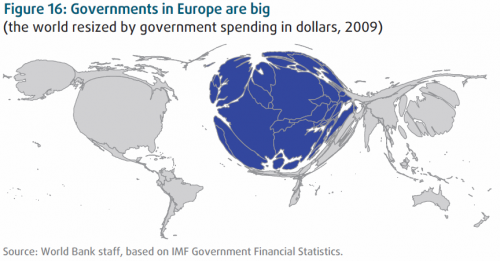
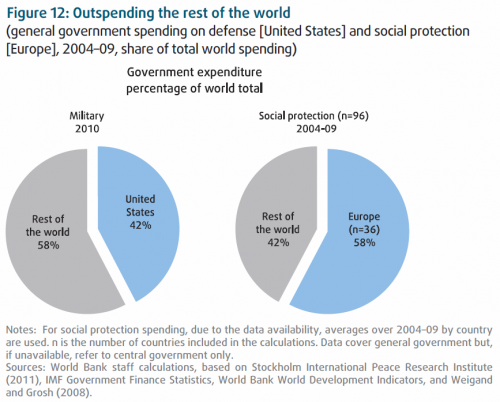
Nowhere is that more apparent than in these three charts, from the World Bank, which highlight just how large in absolute and relative terms Europe's social protection based government spending has become. This situation will only get more demanding as by 2060 almost a third of Europeans will be over 65 years old. While there was a belief that Europeans were willing to accept less growth for better growth (cleaner, smarter, kinder?), in order to meet the needs of an increasingly heavy ‘social' burden, government debt brakes will clearly have to be unhitched further, no matter what Merkel demands (increasing tensions), or the ‘new growth model' that is heralded but not yet substantive will have to be a miracle.


Click on Image to Enlarge

World Bank: THE PRECIPITATE PROMISE OF SOCIAL PROTECTION

Europe will have to make big changes in how it organizes labor and government. The reasons are becoming ever more obvious: the labor force is shrinking, societies are aging, social security is already a large part of government spending, and fiscal deficits and public debt are often already onerous.

In dealing with government spending, deficits, and debt, it is sensible to start by asking whether European governments are too big; that is, whether they spend too much. They are obviously bigger than their peers. In the EU15, governments spent 50 percent of GDP in 2009; in much of the rest of Europe, this share was about 45 percent—versus less than 40 percent in the United States and Japan, 33 percent in Latin America, and about 25 percent in emerging East Asia. A map of the world resized to reflect government spending instead of land area shows how Europe might look to outsiders (figure 16 below).

Read rest of article, see additional chart.

Phi Beta Iota:  Three themes jump out.  First, governments are too big, will fail, the era of small government leveraging new tools and new ways and new mindsets is emergent.  Second, the US overspends on the military and Europe overspends on social protection–both of these are culturally-insulated forms of corruption.  Third, the Industrial Era model of making decisions and allocating resources is no longer affordable and needs to be abandoned.  Assuming that national government refuse to heal themselves, we see local and state jurisdictions becoming very aggressive about resilience and sustainability, to the point of nullifying national regulations and if necessary declaring secession.  It is noteworthy that those governments that refused to bail out the banks and instead turned to their public for common sense solutions, are now the strongest governments.

Chuck Spinney: F-35 Out of Everything Except Money

Commerce, Corruption, DoD, Government, Military
Chuck Spinney

F-35: Out of Altitude, Airspeed, and Ideas — But Never Money

Chuck Spinney

TIME, 30 January 2012

No program better illustrates the pathologies of the weapons acquisition process as it is currently practiced by the Military – Industrial – Congressional Complex (MICC) than the entirely predictable, and in this case, predicted, problems dragging the F-35 Joint Strike Fighter into a dead man’s spiral.

The F-35 in on track to be the most expensive program in the history of the Defense Department, and it has repeated just about every mistake we invented since Robert McNamara concocted the multimission, multi-service  TFX — a program conceived with the same kind of fanciful one-shoe fits all imaginings as the F-35.

Read full article.

Read USMC Boats Against the Current and Comments

Robert Steele

For reflection.  When I created the strategic generalizations in the first edition of the Expeditionary Factors study, that was responding to General Gray's guidance that we be relevant to USMC acquisition–that was actually his primary focus, we lost our integrity by the third generation of leadership and went into production for the sake of production, without a genuine understanding of either the craft of intelligence or the mission needs of the USMC.  That was enabled by flag officers who have no clue what it means to integrate true cost economics with strategic generalizations to arrive at a force that has a very low logistics foot-print, a very high availability ratio, and a very low cost in relation to all the crap that the big three services sign for without thinking.

1990 Expeditionary Environment Analytic Model
1991 MCG Intelligence Support for Expeditionary Planners
2008 U.S. Naval Power in the 21st Century
2009 Perhaps We Should Have Shouted: A Twenty-Year Retrospective

Berto Jongman: Russian Sixth Generation Warfare and Role of Openness

Advanced Cyber/IO, Commerce, Commercial Intelligence, Earth Intelligence, Government, Military
Berto Jongman

Russian Sixth Generation Warfare And Recent Developments

Eurasia Daily Monitor Volume: 9 Issue: 17

While press attention on developments in Russia focused on the disputed parliamentary elections and the following protests, which seemed to revive political activism in Moscow and other urban centers, there have been some military developments that deserve some attention. One such theme is an old topic, sixth generation warfare and its impact upon the nuclear threshold – do advanced conventional systems, which approach nuclear effects, blur the line on nuclear deterrence? The Russian press has had several recent articles that suggest this issue is becoming more acute.

In the aftermath of Desert Storm in 1991, the late Major-General Vladimir Slipchenko coined the phrase “sixth generation warfare” to refer to the “informatization” of conventional warfare and the development of precision strike systems which could make the massing of forces in the conventional sense an invitation to disaster and demand the development of the means to mass effects through depth to fight systems versus systems warfare. Slipchenko looked back at Ogarkov’s “revolution in military affairs” with “weapons based on new physical principles” and saw “Desert Storm” as a first indication of the appearance of such capabilities. He did not believe that sixth generation warfare had yet manifested its full implications (Vladimir Slipchenko, Voina budushchego. Moscow: Moskovskii Obshchestvennyi Nauchnyi Fond, 1999).

Click on Image to Enlarge

However, Slipchenko did believe that sixth generation warfare would replace fifth generation warfare, which he identified as thermonuclear war, and had evolved into a strategic stalemate, making nuclear first use an inevitable road to destruction (from the end of the Soviet Union until his death in 2005, he had analyzed combat experience abroad to further refine his conception until he began to speak of the emergence of “no-contact warfare” as the optimal form for sixth generation warfare; Vladimir Slipchenko, Beskontaktnye voiny. Moscow: Izdatel’skii dom: Gran-Press,” 2001). In his final volume, Slipchenko redefined sixth generation warfare as involving the capacity to conduct distant, no-contact operations and suggested that such conflict would demand major military reforms. Slipchenko made a compelling case for the enhanced role of C4ISR in conducting such operations (Vladimir Slipchenko,Voina novogo pokoleniia: Distantsionnye i beskontaktaktnye, Moscow: OLMA-Press, 2004).

Continue reading “Berto Jongman: Russian Sixth Generation Warfare and Role of Openness”

noble gold