“THE SECRET LIFE OF BEEF” REVEALS BEEF’S ENVIRONMENTAL IMPACTS
INFORM launches third video in “The Secret Life” series
(New York City) INFORM, Inc., the educational and advocacy nonprofit that raises environmental consciousness through visual media, has just launched “The Secret Life of Beef,” an engaging and enlightening six-minute video. The video increases awareness about the environmental impacts of industrial beef production, illustrates how it contributes to global warming, and offers more sustainable alternatives.
Americans consume over twenty-eight billion pounds of beef a year, one of the highest per capita rates in the world, yet few beef eaters are aware of the connection between their dietary choices and the environmental damage caused by beef production.
Livestock production produces one-fifth of all global greenhouse gases, more than all transportation sources combined
It takes seven pounds of grain and 2,500 gallons of water to produce one pound of hamburger
Seventy percent of all antibiotic use in the U.S. is used in livestock production
“The Secret Life of Beef” tells its story through academic experts, grass-fed beef farmers, chefs, sustainable butchers, educators, and restaurant owners. It also offers more eco-friendly alternatives to the heavy meat consuming habits of most Americans—from going meatless one day a week to purchasing grass-fed beef.
If every American went meatless one day a week, it would be equivalent to taking eight million cars off the road.
The best way to reduce your carbon footprint is to reduce your overall beef consumption.
The Federal Reserve will pump $600 billion more into the US economy and keep interest rates at historical low levels. The short-term impact of the Fed’s move, known as quantitative easing, has been a jump in stock prices across the globe. Many nations, however, have accused the United States of waging a currency war by devaluing the dollar. We speak to former Wall Street economist and University of Missouri professor Michael Hudson. “The object of warfare is to take over a country’s land, raw materials and assets, and grab them,” Hudson says. “In the past, that used to be done militarily by invading them. But today you can do it financially simply by creating credit, which is what the Federal Reserve has done.” [includes rush transcript]
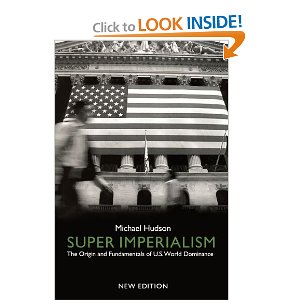
Amazon Page -- New Edition (2003)
QUOTE from the Introduction: “The last time there were a series of devaluations like this it led to WW II.”
QUOTE from the TV Interview: “A legalized way for Wall Street to loot other Central Banks.”
QUOTE from the TV Interview: “In Europe it is illegal for the Central Bank to finance government debt.”
Phi Beta Iota: This interview, viewed in its entirety, destroys the myth of Barack Obama and clarifies with stunning detail the degree to which the Obama Administration is blocking all forms of relief for the public at the state level at the same time that he is assuring that the Chinese yuan will become the global reserve currency. We anticipate all sales of anything to US currency to be blocked by other countries, and we hope that US Governors will start nullifying federal interference with justice at the state level.
In my last Counterpunch essay, “How Obama's Initial Personnel Decisions Hardwired the Wipeout” I organized my argument around verbiage describing how Obama “fatal move” to the middle,” leaving the misleading impression that his connection to the middle occurred after the election. This was sloppy wording and in retrospect it is clear to me that impression did not even reflect what I was trying to say. “Irrevocable” would have been a better modifier than “fatal.” And the word “move” was more related to the perceptions of the people whose enthusiasm he unleashed during the campaign, not Obama's political proclivities.
Obama has always been a center-right politician tightly connected to ruling oligarchs in the US. I have been concerned about this connection with the oligarchy since December 2007, when I became aware of the people who were advising him on defense, foreign policy, and treasury matters. I publicly expressed concerns about his defense advisors in July 2008 and all of them on 5 November 2008, (see last paragraph here) the day after he was elected. “Hardwiring the Wipeout” was basically a first-cut bookend to the 5 November piece (what I called the outer layer of the onion).
Lest you think I am quibbling about what the meaning of “is” is, for the record, I agree with the critical comments (attached below) from my good friend Pierre Sprey, who has taken the trouble to give an incisive correction to my sloppy wording, and which he has graciously agreed to let me forward. Think of this as a roadmap for probing into the second and more rancid layer of the onion.
——————————- [Sprey's Comment]————————
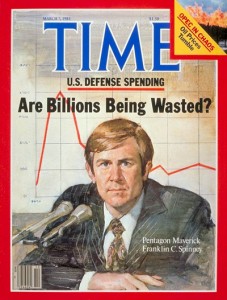
Pierre Sprey
Chuck,
Superb analysis of why the voters tossed out Bush and his cohorts, how Obama generated such strong support and, two years later, why many of those supporters felt betrayed enough to stay home or to vote Republican. The article is most certainly needed and timely to fend off the tsunami of obfuscation that both the Republican and Democratic pundits are about to unleash.
On the other hand, I view your chronology of Obama's (and the Democratic Party's) “move to the middle” a bit differently–and our differences have serious implications for judging Obama's character, his decision-making and the futility of expecting change in anything but his rhetoric:
1. I see no evidence that there's been any change or “move” in substantive actions and stated policies going from Senator Obama to Candidate Obama to President Obama. Needless to say, over this entire time most of his policy “positions” were (and are) rhetoric cleverly crafted to avoid any specific position at all.
2. Given that early financial backers of Obama in Chicago politics were the Crown family (General Dynamics and super-Zionists) and the Pritzker family (credit business, Goldman Sachs allies and super-Zionists), I'd say it's likely that Obama's commitment to the MICC, to Wall Street and to Israel predated his run for the Senate.
In trying to understand why the Democrats just crashed and burned, I think the first layer in peeling the onion takes the form of an admission to two crucial mistakes made by Obama before he took office. He campaigned brilliantly on a vague theme of change. In so doing, he unleashed a hornet's nest of intense expectations that would have been hard to fulfill in the best of circumstances, but Obama's personnel decisions made during the transition period guaranteed the worst of circumstances.
Two big reasons underpinned the power of his appeal and placed his uplifting narrative into sharp contrast with the visceral disgust felt toward Bush by the mass of Obama's supporters in the Democratic party and Independents.
A sense of unfair economic hardship embodied in the widespread feelings of insecurity and anger that emanated from the combined effects of stagnating living standards, the continuing loss of jobs due to deindustrialization, and the systematic transfer of wealth from the middle to the upper classes. The anger reached a bi-partisan critical mass with the onset of a massive middle-class bloodletting in the Great Recession, while the wealthy perpetrators of the bloodletting were bailed out by and even profited from the Bush Administration's so-called counter-recessionary policies.
Growing disgust with Bush's lawless policy of unilateral militarism and never ending war, reflected in the increasingly costly, unfocused wars in Iraq and Afghanistan and elsewhere (and perhaps augmented by a vague feeling of fear fatigue, reflecting a sense that it was time to end the politics of fear and return to less abnormal state of affairs).
Both Hillary Clinton in the primaries or John McCain in the general election danced to Obama's music of change, but neither was able (or wanted?) to smoke out how Candidate Obama's planned to change directions. In effect, their failure to do so, freed President Obama from having to live within tight policy constraints imposed by specific campaign promises. This opened the door toward a cynical “move to the middle” via a series of timid compromises and accommodations, justified by the shopworn theory that his most committed supporters had nowhere else to go. That tired justification may play well to the self-referencing political class in Versailles on the Potomac, but Obama's supporters did have places to go: the hard core base could simply stay home, and independents like to switch sides.
Obama's fatal move to middle began immediately after his election when he chose to rearrange the deck chairs on the Titanic by picking members of the oligarchical establishment who helped to create and benefitted from the economic and national security messes he inherited — i.e., Timothy Geithner, Lawrence Summers, Robert Gates, and Hillary Clinton, plus the plethora of 2nd tier policy wonks and wannabes who came out the Clinton economic and national security apparat in waiting, eg, the “good war mafia” of precision-strike/coercive diplomacy dilettantes in defense, like Michele Flournoy, whose main achievement to date has been to completely gomer up the Quadrennial Defense Review.
These personnel decisions set the stage for a continuation of the Reagan/Bush/Clinton/Bush business-as-usual under a kinder and gentler face, taking the forms of policies that (1) continue the redistributive economic policies to favor the people who caused the meltdown, albeit softened by a highly visible albeit insufficient stimulus policy and (2) continue shoveling money into the Military – Industrial – Congressional Complex via (a) an escalation of war policy — e.g., by embracing the idea of the AFPAK theater of operations — under the guise of a phony distinction between expanding a good war against terrorism in Afghanistan (and elsewhere) while ending the bad war in Iraq (which was merely in temporary remission, as the recent escalation of murderous events in Baghdad and Anbar Province show) and (b) increased funding of an outdated cold-war inspired weapons modernization program that does not modernize a shrinking, aging force structure.
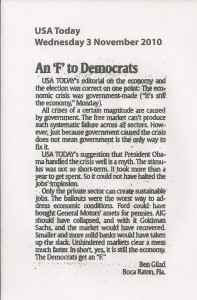
Phi Beta Iota: Ben Gilad, one of the top commercial intelligence analysts around, has a point, but he forgets that the modern looting of the USA began in 1981 and reached a cresendo with the Phil Gramm (R-TX) deregulation of the financial “services” industry. For the most recent and most superb story on the axis of crime from Wall Street to the two political parties sharing the power of the public purse, see Matt Taibbi's book, Griftopia–Bubble Machines, Vampire Squids, and the Long Con That Is Breaking America.
Europe is seeing some of the largest demonstrations since World War II, with labor agitation being the major trademark. The reasons for this labor unrest are easy to see. Let’s look at several facts, starting with unemployment. Europe has always had lower unemployment than the United States. No longer. Since 1982, unemployment (as an average of the EU-15) has been higher in the European Union than in the United States. Actually, unemployment had already started to rise in Europe by the late 1970s, coinciding with the first steps by the EU-15 countries to construct what they later called the European Union. One consequence of forming this Union was higher unemployment, and from that time, unemployment has increased, eventually exceeding that in the United States.
Does a Green Speed Bump Block the Road to Energy Independence?????? In this remarkable and remarkably unwelcome opinion piece, my good friend Robert Bryce, author of Power Hungry, explains why the subsidization of green technologies that are dependent on rare earth elements should not be justified as pathway toward energy independence, and in fact, could actually make the US more dependent on foreign energy related imports.
Over the past few months, industry and government officials in the U.S. and Japan have been increasingly alarmed as China, which has a near-monopoly on rare earths, has reduced its exports of those elements by some 40 percent. Adding yet more anxiety to the situation are projections about a possible shortfall in the supply of these elements. London-based Roskill Consulting Group, a research firm that specializes in metals and minerals, recently predicted that demand for rare earths could outstrip supply as soon as 2014. Rare earths are important because they have special features at the quantum mechanics level that allow them to have unique magnetic interactions with other elements. A myriad of “green” technologies — from electric and hybrid-electric cars to wind turbines and compact fluorescent light bulbs – depend on rare earths. And there are no cost-effective substitutes for them.
Clinton’s willingness to question China about rare earths is indicative of just how seriously the U.S. is taking the rare earths issue. But it also underscores a fundamental miscalculation by the U.S. and other countries when it comes the reconfiguration of their automotive fleets.
Over the last few years, a growing number of environmentalists and national security hawks have teamed up to denounce America’s dependence on foreign oil. Their solution: all-electric and hybrid-electric vehicles. Those vehicles, they insist, will help the environment while reducing oil imports from countries in the Persian Gulf and elsewhere.
While that vision appeals to certain segments of the political class and to a myriad of subsidy-seeking corporations, the push to build more electric and hybrid cars will simply result in the U.S. trading one type of import dependence for another.
Those vehicles might cut oil consumption but they will dramatically increase America’s thirst for rare earth elements. And therein lies a crucial choice: We can continue to rely on the liquidity, price transparency, and diversity of the global oil market, the biggest market in human history. Or we can choose the “green” route. And in doing so, we will have no choice but to rely on the market for lanthanides, which is rife with smuggling, has no price transparency, and depends almost wholly on a single producer, China.
The Chinese control about 95 percent of the global market in rare earths, a group of 17 elements that includes scandium, yttrium, and the 15 lanthanides, the elements that occupy the second-to-last row of the Periodic Table. The most famous of the lanthanides is probably neodymium, a critical ingredient in the high-strength magnets used in motor-generators in hybrid cars and wind turbines.
Phi Beta Iota: This is a perfect example of what happens when a government is both ideologically driven and therefore not intelligence-driven, and when a government lacks a strategic analytic model that can clearly demonstrate how what might be good for one part of the system is bad for other parts of the system. This is called system INTEGRITY. Not only is the US bankrupt, according to the last Comptroller General to brief Congress on the subject in 2007, David Walker, but what the US government is borrowing and spending on in our name makes no sense at all from a public interest point of view.