Reference: How Goldman Sachs Looted America

03 Economy, 07 Other Atrocities, 09 Justice, 10 Transnational Crime, Analysis, Articles & Chapters, Blog Wisdom, Budgets & Funding, Commerce, Commercial Intelligence, Corruption, Cultural Intelligence, Government, Journalism/Free-Press/Censorship, Law Enforcement, Money, Banks & Concentrated Wealth, Secrecy & Politics of Secrecy
Amazon Page

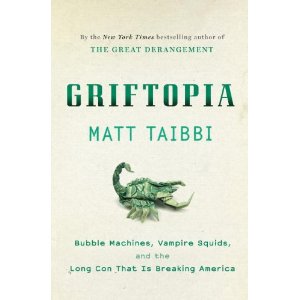
Exclusive Excerpt: America on Sale, From Matt Taibbi's ‘Griftopia'

Matt Taibbi's unsparing and authoritative reporting on the financial crisis has produced a series of memorable Rolling Stone features. He showed us how Goldman Sachs, that “great vampire squid,” played a central role in creating not only the housing bubble but four other big speculative booms that filled its coffers while wrecking the American economy. He explained how Wall Street banks cooked up schemes that helped decimate municipal budgets and cost countless jobs, and how Wall Street lobbying led to a financial reform bill that won't prevent another meltdown. Taibbi builds on that eye-opening work in his new book, Griftopia: Bubble Machines, Vampire Squids, and the Long Con That Is Breaking America , due out from Spiegel & Grau on November 2. In this exclusive excerpt, he describes how our cash-strapped country is auctioning off its highways, ports and even parking meters at fire sale prices — and finding eager buyers in the unregulated sovereign wealth funds of oil-rich Middle Eastern countries.

Read the exclusive Griftopia excerpt.

Journal: The Death of Responsible Government

03 Economy, 07 Other Atrocities, 10 Transnational Crime, Civil Society, Collective Intelligence, Commerce, Commercial Intelligence, Corruption, Cultural Intelligence, Government, Law Enforcement
Chuck Spinney Recommends

October 23, 2010

What Happened to Change We Can Believe In?

By FRANK RICH

The New York Times

Phi Beta Iota: Extracts are provided.  This is an important document that confirms the total abdication by Congress and the Executive of their Constitutional duties with respect to the public interest.  The USA is owned and operated by Wall Street for its benefit, and We the People have been completely disenfranchised at the same time that the Commonwealth has been looted.

EXTRACT:

No matter how much Obama talks about his “tough” new financial regulatory reforms or offers rote condemnations of Wall Street greed, few believe there’s been real change. That’s not just because so many have lost their jobs, their savings and their homes. It’s also because so many know that the loftiest perpetrators of this national devastation got get-out-of-jail-free cards, that too-big-to-fail banks have grown bigger and that the rich are still the only Americans getting richer.
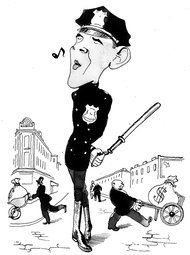
This intractable status quo is being rubbed in our faces daily during the pre-election sprint by revelations of the latest banking industry outrage, its disregard for the rule of law as it cut every corner to process an avalanche of foreclosures. Clearly, these financial institutions have learned nothing in the few years since their contempt for fiscal and legal niceties led them to peddle these predatory mortgages (and the reckless financial “products” concocted from them) in the first place. And why should they have learned anything? They’ve often been rewarded, not punished, for bad behavior.

EXTRACT:

The much acclaimed new documentary about the global economic meltdown, “Inside Job,” has it right. As its narrator, Matt Damon, intones, our country has been robbed by insiders who “destroyed their own companies and plunged the world into crisis” — and then “walked away from the wreckage with their fortunes intact.” These insiders include Dick Fuld and four other executives at Lehman Brothers who “got to keep all the money” (more than $1 billion) after Lehman went bankrupt. And of course Robert Rubin, who encouraged Citigroup to step up its investment in high-risk bets like Countrywide’s mortgage-backed securities. Rubin, now back as a rainmaker on Wall Street, collected more than $115million in compensationduring roughly the same period Mozilo “earned” his half a billion. Citi, which required a $45 billiontaxpayers’ bailout, recently secured its own slap-on-the-wrist S.E.C. settlement — at $75 million, less than Rubin’s earnings and less than its 2003 penalty ($101 million) for its role in hiding Enron profits.

It should pain the White House that its departing economic guru, the Rubin protégé Lawrence Summers, is an even bigger heavy in “Inside Job” than in the hit movie of election season, “The Social Network.” Summers — like the former Goldman Sachs chief executive and Bush Treasury secretary Hank Paulson — is portrayed as just the latest in a procession of policy makers who keep rotating in and out of government and the financial industry, almost always to that industry’s advantage. As the star economist Nouriel Roubini tells the filmmaker, Charles Ferguson, the financial sector on Wall Street has “step by step captured the political system” on “the Democratic and the Republican side” alike. But it would be wrong to single out Summers or any individual official for the Obama administration’s image of being lax in pursuing finance’s bad actors. This tone is set at the top.

Asked in “Inside Job” why there’s been no systematic investigation of the 2008 crash, Roubini answers: “Because then you’d find the culprits.” With the aid of the “Manhattan Madam” (and current stunt New York gubernatorial candidate) Kristin Davis, the film also asks why federal prosecutors who were “perfectly happy to use Eliot Spitzer’s personal vices to force him to resign in 2008” have not used rampant sex-and-drug trade on Wall Street as a tool for flipping witnesses to pursue the culprits behind the financial crimes that devastated the nation.

EXTRACT:

Even as the G.O.P. benefits from unlimited corporate campaign money, it’s pulling off the remarkable feat of persuading a large swath of anxious voters that it will lead a populist charge against the rulers of our economic pyramid — the banks, energy companies, insurance giants and other special interests underwriting its own candidates. Should those forces prevail, an America that still hasn’t remotely recovered from the worst hard times in 70 years will end up handing over even more power to those who greased the skids.

We can blame much of this turn of events on the deep pockets of oil billionaires like the Koch brothers and on the Supreme Court’s Citizens United decision, which freed corporations to try to buy any election they choose. But the Obama White House is hardly innocent. Its failure to hold the bust’s malefactors accountable has helped turn what should have been a clear-cut choice on Nov. 2 into a blurry contest between the party of big corporations and the party of business as usual.

Read Full Article….

Phi Beta Iota: The Tea Party is an unwitting circus act fully funded and controlled by the New York mandarins.  The lack of responsible alternatives on the left or the right, combined with the naivete of the public in thinking that the Tea Party is anything other than a side show, could lead–we never thought we would say this–to a new Administration and Congress even more ineffective than the last two.  The further American governance moves from the truth, the deeper our grave.

See Also:

Election 2008 Chapter: Paradigms of Failure

Election 2008 Chapter: The Substance of Governance

Event: 4 Nov, Wash DC, Blue Ribbon Commission on America’s Nuclear Future, Disposal Subcommittee

03 Environmental Degradation, Commerce, Government

DATES: Thursday, November 4, 2010 8:30 a.m. – 1:15 p.m.
ADDRESSES: St. Regis Hotel
923 16th Street and K Street, NW
Washington, DC
Telephone: (202) 638-2626

[6450-01-P]
DEPARTMENT OF ENERGY
Blue Ribbon Commission on America’s Nuclear Future, Disposal Subcommittee
AGENCY: Department of Energy, Office of Nuclear Energy
ACTION: Notice of Open Meeting
SUMMARY: This notice announces an open meeting of the Disposal Subcommittee.
The Disposal Subcommittee is a subcommittee of the Blue Ribbon Commission on America’s Nuclear Future (the Commission). The establishment of subcommittees is authorized in the Commission’s charter. The Commission was organized pursuant to the Federal Advisory Committee Act (Public Law No. 92-463, 86 Stat. 770) (the Act). This
notice is provided in accordance with the Act.

Continue reading “Event: 4 Nov, Wash DC, Blue Ribbon Commission on America’s Nuclear Future, Disposal Subcommittee”

Journal: Bank of America into Receivership?

03 Economy, 07 Other Atrocities, 10 Transnational Crime, Commerce, Commercial Intelligence, Corporations, Corruption, Money, Banks & Concentrated Wealth

‘FORECLOSE ON THE FRAUDSTERS'
White Collar Crime Expert Calls For FDIC To Take Control Of Bank Of America

Full Story Online

Charging that the ongoing foreclosure fraud epidemic is the work of precisely the same unrepentant bank officers whose fraudulent mortgage schemes crashed the financial system in the first place, two leading critics of the financial industry are calling on the FDIC to put some of the nation's biggest banks into receivership — starting with the Bank of America — and make them clean house.

William K. Black, a former regulator and white-collar crime expert who cracked down on massive fraud during the savings and loan scandal of the 1980s, and his fellow economics professor at the University of Missouri-Kansas City, L. Randall Wray, write in the Huffington Post that it's time to “foreclose on the foreclosure fraudsters”. They write:

Read on….

Journal: Paradigm & Integrity Revolution in Medicine

02 Infectious Disease, 07 Health, Academia, Civil Society, Collective Intelligence, Commerce, Commercial Intelligence, Earth Intelligence, Government

Jon Lebkowsky Home

Science, lies, evidence, knowledge

In so many fields, owing to the Internet-driven democratization of knowledge, we learn that that the power associated with hoarded knowledge has been abused, and the position of leadership – the priesthood – associated with the acquisition of knowledge has been leveraged to manipulate and deceive. “Everything you know is wrong!”

David Freedman has a great article in the Atlantic about medical deception, called “Lies, Damned Lies, and Medical Science,” which focuses on Dr. John Ioanniddis’ dedication to exposing bad science in medicine.

He’s what’s known as a meta-researcher, and he’s become one of the world’s foremost experts on the credibility of medical research. He and his team have shown, again and again, and in many different ways, that much of what biomedical researchers conclude in published studies—conclusions that doctors keep in mind when they prescribe antibiotics or blood-pressure medication, or when they advise us to consume more fiber or less meat, or when they recommend surgery for heart disease or back pain—is misleading, exaggerated, and often flat-out wrong. He charges that as much as 90 percent of the published medical information that doctors rely on is flawed. His work has been widely accepted by the medical community; it has been published in the field’s top journals, where it is heavily cited; and he is a big draw at conferences. Given this exposure, and the fact that his work broadly targets everyone else’s work in medicine, as well as everything that physicians do and all the health advice we get, Ioannidis may be one of the most influential scientists alive. Yet for all his influence, he worries that the field of medical research is so pervasively flawed, and so riddled with conflicts of interest, that it might be chronically resistant to change—or even to publicly admitting that there’s a problem.

At e-Patients.net, Peter Frishauf writes a response to the Atlantic article, called “Fixing those Damn Lies.” How do we fix them? The Atlantic piece discusses Ioannidis’ suggestions to change the culture of medical research, and reset expectations. It’s okay to be wrong in science – in fact, it’s almost a requirement. The scientific method is about testing and proving hypotheses – proving can be “proving wrong” as well as “proving right.” Either way, you’re learning, and extending science.

Frishauf also mentions how medicine and science should embrace the Internet “and figure out a way to better incorporate patient self-reported and retrospective data in trials,” which is one goal of participatory medicine. He also suggests “giving up on tenure-tied-to-the-peer-reviewed-literature, and embracing a moderated form of pre and post-publication peer review,” something that came up in discussion when I spoke at the Central Texas World Future Society Tuesday evening. (More about this in an earlier e-Patients.net post by Frishauf.)

Knowledge is not a citadel or ivory tower, but a network that we could all be working, challenging, and improving.

NIGHTWATCH Extract: China Using Rare Earth Elements (REE) to Test Economic & Technical Pressure Options

02 China, 03 Economy, 10 Security, Commerce, Commercial Intelligence, Earth Intelligence, Government, Military

China and Rare Earth Elements: China's new Five-Year Program will fail to bring any rapid change in export quotas for rare earth elements (REE), Chinese Ambassador to the World Trade Organization Sun Zhenyu said, Reuters reported. He also said China's REE reserves were depleting quickly and that Beijing must conserve them. According to Sun, China's reserves have fallen from 33 percent of the world's total in 1996 to 30 percent presently, and that they will last only for another 15-20 years. He urged other nations to begin developing their own REE reserves.

China-Japan: Japan's stockpile of rare earth elements (REE), if China does not restart REE exporting, could empty by March or April 2011, said Yoshikatsu Nakayama, Japanese vice-minister of the economy, trade and industry, Agence France-Presse reported on 21 October.

China-Germany: German companies have been told by Chinese officials to increase their investments in China if they wish to continue to receive rare earth elements (REE) and two other elements China mines, tungsten and antimony, The New York Times reported on 21 October, citing a spokeswoman for the German engineering federation.

On 21 October, unidentified German industry officials said that Chinese customs officials were for the fourth day blocking the final paperwork approval necessary for REE to be exported to Germany. The officials said China is still exporting REE that had paperwork approved before 18 October.

NIGHTWATCH Comment: The Chinese appear to be using rare earth elements exports for testing economic pressure tactics against potential rivals or adversaries. Rare earth elements are used in many high technology applications.

NIGHTWATCH KGS Home

Phi Beta Iota: This is what happens when government becomes irresponsible, divorced from reality, without a strategic analytic model, and so ideologically insane as to make a lobbyist for Goldman Sachs the National Security Advisor.  This all started in the 1970's, it is not new, but now it is close to a fatal sucking chest wound for the Republic.

See Also:

Election 2008 Chapter: The Substance of Governance
TED Video on “Connectivity=Productivity” Growth of Bangladesh Telecom to Allieviate Poverty

01 Poverty, Commerce, Mobile, Technologies, TED Videos, Videos/Movies/Documentaries

Iqbal Quadir Creates a Culture of Entrepreneurship in Bangladesh

Why does poverty exist? That's no small question for an individual to ask, but in Iqbal Quadir's homeland, Bangladesh, there may be no other question that matters more.

His answer is twofold: First, European prosperity resulted from the devolution of authorities and the empowerment of citizens, while Western aid to developing countries simply empowered authorities to marginalize the citizenry. Even looking at oil-rich countries, the autocratic regimes grew spectacularly wealthy, while poverty remained entrenched. “Economic development,” Quadir concludes, “is of, by and for the people.” Second, his life experience had demonstrated that connectivity is a powerful weapon against poverty. The ability to communicate eliminates massive and avoidable waste in productivity, which in turn  creates greater commerce and economies.

In Bangladesh 12 years ago, only one in 500 people had access to a telephone. “In whole areas where 100 million people lived, there were no telephones,” he says. “Vast amounts of wasted time results. The only way people can depend on each other is to connect to each other, which leads to productivity.” He decided to bring cell phones to them all–although not to each of them individually.

The New York-banker-turned-Bangladeshi-entrepreneur faced the hurdles you would imagine, the most prominent being that poor people could not afford cell phones. But in fine entrepreneurial fashion, Quadir contended, “If a cell phone creates productivity, why would you worry about [people's ability to pay]?” With backing from microbank GrameenBank, Quadir started GrameenPhone, a locally based shared cell phone service. He approached a single woman entrepreneur in each village and provided her with a cell phone. The local woman would lease its access on a per-call basis, making cell phone communication available to more than 52,000 Bangladeshi villages and 80 million people. As for the women entrepreneurs, there are now 115,000 of them within GrameenPhone, each making a profit of $700 a year, far more than the average per capita income of the country.

Thanks to Entrepreneur.com for listing various TED videos

noble gold