Fact #1: Only one country in the Middle East has nuclear weapons – Israel. The quantity is unknown, with estimates of the Israeli arsenal range between 60 and 400 bombs, the upper range of 200-400 being the most often cited. Fact #2: Only one country in the Middle East has refused to the sign the Non Proliferation Treaty – Israel. These two facts are not in dispute.
While most observers (except for the leadership of Israel and its agents of influence in the west, especially the US) believe making the Middle East a nuclear free zone would be a positive step toward peace, no one is pressuring Israel to give up its weapons. The goal of a nuclear free zone may be great for raising grant money, but without a commitment to pressure Israel into giving up its weapons, it will remain a pipe dream.
On the other hand, Israel and the US claim the unilateral right to insure that all of the Middle East other than Israel remains a nuclear free zone, by preemptive military action, if either country deems it to be necessary. To this end Israel, attacked the Osirak reactor without warning in Iraq (1981) and an alleged Syrian nuclear site without warning in 2007. Ironically, at the time of the Osirak attack, the Iraqi program was moribund and going nowhere, but the attack spurred Saddam into developing a more vigorous covert program. [Pillar] The real purpose of the alleged “nuclear” site in Syria remains in dispute, with some arguing that recent evidence proves it was a textile factory. Ironically, the Osirak attack set in course a chain of events that eventually combined to lead to the US attacking and destroying Iraq in 2003, justified primarily by false claims that Saddam Hussein was close to fielding nuclear weapons.
Now Iran is in the crosshairs for the same reason, although Iran is complying with IAEA nuclear safeguards and inspection requirements. Given the sorry history of “nuclear preemption,” perhaps it is time to ask the unmentionable question: So what? What is the debate really about? The attached essay by William Pfaff takes a stab at this question. One interesting point, an Israeli general indirectly confirmed Pfaff's hypothesis about Israel's real reason for going beserk over the possibility of Iran getting a nuclear weapon — you can find it here, but read Pfaff's op-ed first.
PARIS — The obsession of the American foreign policy community, as well as most American (and a good many international) politicians, by the myth of Iran's “existential” threat to Israel, brings the world steadily closer to another war in the Middle East.

(1) See particularly page 5; (2) Mr. Baer, perhaps a somewhat controversial CIA retiree, may have more credibility than Matthews' husband gives him credit for with respect to knowing what women can and cannot do operationally. According to the book “The Company We Keep,” which Baer co-authored with his wife, his wife Dayna was a CIA security officer who served overseas in some challenging circumstances; (3) I know a female with traits similar to those ascribed to Matthews.)
“The suicide bomber was a bad guy, but at the time, nobody could clearly see it,” Anderson said. “I think the agency prepared my wife to be a chief of the Khost base, but not in terms of preparing for this asset. This guy wasn’t vetted.” And the mother of his three children is dead because of it.
Phi Beta Iota: Bauer has it right–this is not about “girls” being inept, it is about “analysts” being inept at command in the field, especially in a paramilitary environment. CIA is a bureaucracy and most if not all of its managers are so out of touch with reality as to be a danger to the current director and the agency as a whole. 90% of the Human Intelligence (HUMINT) that CIA produces is from foreign liaison hand-outs and domestic overt collection by the domestic division from legal travelers.
Phi Beta Iota: Delusional fluff. The good news is that most of the stuff that is vulnerable to single point of failure interruptions is not all that important if you have a proper strategy that is based on reality and true cost information. What they do not get is the urgent need to create jobs that are directly related to resilience and sustainability from the local level up.
While press attention on developments in Russia focused on the disputed parliamentary elections and the following protests, which seemed to revive political activism in Moscow and other urban centers, there have been some military developments that deserve some attention. One such theme is an old topic, sixth generation warfare and its impact upon the nuclear threshold – do advanced conventional systems, which approach nuclear effects, blur the line on nuclear deterrence? The Russian press has had several recent articles that suggest this issue is becoming more acute.
In the aftermath of Desert Storm in 1991, the late Major-General Vladimir Slipchenko coined the phrase “sixth generation warfare” to refer to the “informatization” of conventional warfare and the development of precision strike systems which could make the massing of forces in the conventional sense an invitation to disaster and demand the development of the means to mass effects through depth to fight systems versus systems warfare. Slipchenko looked back at Ogarkov’s “revolution in military affairs” with “weapons based on new physical principles” and saw “Desert Storm” as a first indication of the appearance of such capabilities. He did not believe that sixth generation warfare had yet manifested its full implications (Vladimir Slipchenko, Voina budushchego. Moscow: Moskovskii Obshchestvennyi Nauchnyi Fond, 1999).
Click on Image to Enlarge
However, Slipchenko did believe that sixth generation warfare would replace fifth generation warfare, which he identified as thermonuclear war, and had evolved into a strategic stalemate, making nuclear first use an inevitable road to destruction (from the end of the Soviet Union until his death in 2005, he had analyzed combat experience abroad to further refine his conception until he began to speak of the emergence of “no-contact warfare” as the optimal form for sixth generation warfare; Vladimir Slipchenko, Beskontaktnye voiny. Moscow: Izdatel’skii dom: Gran-Press,” 2001). In his final volume, Slipchenko redefined sixth generation warfare as involving the capacity to conduct distant, no-contact operations and suggested that such conflict would demand major military reforms. Slipchenko made a compelling case for the enhanced role of C4ISR in conducting such operations (Vladimir Slipchenko,Voina novogo pokoleniia: Distantsionnye i beskontaktaktnye, Moscow: OLMA-Press, 2004).
Economic imbalances and social inequality risk reversing the gains of globalization, warns the World Economic Forum in its report Global Risks 2012. These are the findings of a survey of 469 experts and industry leaders who worry that the world’s institutions are ill-equipped to cope with today’s interconnected, rapidly evolving risks. The findings of the survey fed into an analysis of three major risk cases: Seeds of Dystopia; Unsafe Safeguards and the Dark Side of Connectivity. Report also analyses the top 10 risks in five categories – economic, environmental, geopolitical, societal and technological.
Phi Beta Iota: The report fails to address the absence of both intelligence and integrity among all “institutions” be they public or private. This is the entire point of the global Occupy movement. This is also the entire point of this website, which predates Occupy by some time.
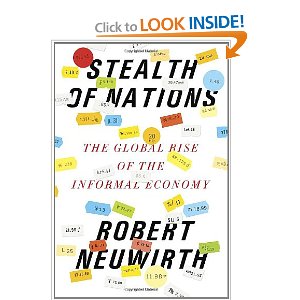
Not many people think of shantytowns, illegal street vendors, and unlicensed roadside hawkers as major economic players. But according to journalist Robert Neuwirth, that’s exactly what they’ve become. In his new book, Stealth of Nations: The Global Rise of the Informal Economy, Neuwirth points out that small, illegal, off-the-books businesses collectively account for trillions of dollars in commerce and employ fully half the world’s workers.
Amazon Page
Further, he says, these enterprises are critical sources of entrepreneurialism, innovation, and self-reliance. And the globe’s gray and black markets have grown during the international recession, adding jobs, increasing sales, and improving the lives of hundreds of millions. It’s time, Neuwirth says, for the developed world to wake up to what those who are working in the shadows of globalization have to offer. We asked him how these tiny enterprises got to be such big business.
Wired: You refer to the untaxed, unlicensed, and unregulated economies of the world as System D. What does that mean?
Robert Neuwirth:There’s a French word for someone who’s self-reliant or ingenious: débrouillard. This got sort of mutated in the postcolonial areas of Africa and the Caribbean to refer to the street economy, which is called l’économie de la débrouillardise—the self-reliance economy, or the DIY economy, if you will. I decided to use this term myself—shortening it to System D—because it’s a less pejorative way of referring to what has traditionally been called the informal economy or black market or even underground economy. I’m basically using the term to refer to all the economic activity that flies under the radar of government. So, unregistered, unregulated, untaxed, but not outright criminal—I don’t include gun-running, drugs, human trafficking, or things like that.
Click on Image to Enlarge
Wired: Certainly the people who make their living from illegal street stalls don’t see themselves as criminals.
Neuwirth: Not at all. They see themselves as supporting their family, hiring people, and putting their relatives through school—all without any help from the government or aid networks.
Wired: The sheer scale of System D is mind-blowing.
Neuwirth: Yeah. If you think of System D as having a collective GDP, it would be on the order of $10 trillion a year. That’s a very rough calculation, which is almost certainly on the low side. If System D were a country, it would have the second-largest economy on earth, after the United States.
Phi Beta Iota: System D is completely separate from straight forward black crime (organized crime) or white crime (Goldman Sachs et al). What this really means is that governments have lost all legitimacy and two thirds of the global economy now considers governments to be at best a meddling (and costly) nuisance and at worst the enemy to be defeated by any means necessary. Governments brought this on themselves.
While the US is distracted at home by warmongering politicians competing for the Republican nomination and Israeli-neocon warmongering for launching a new war against Iran, a crisis may be metastasizing in cancer that is Afghanistan.
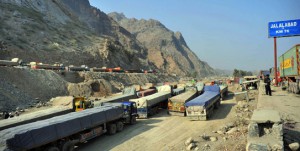
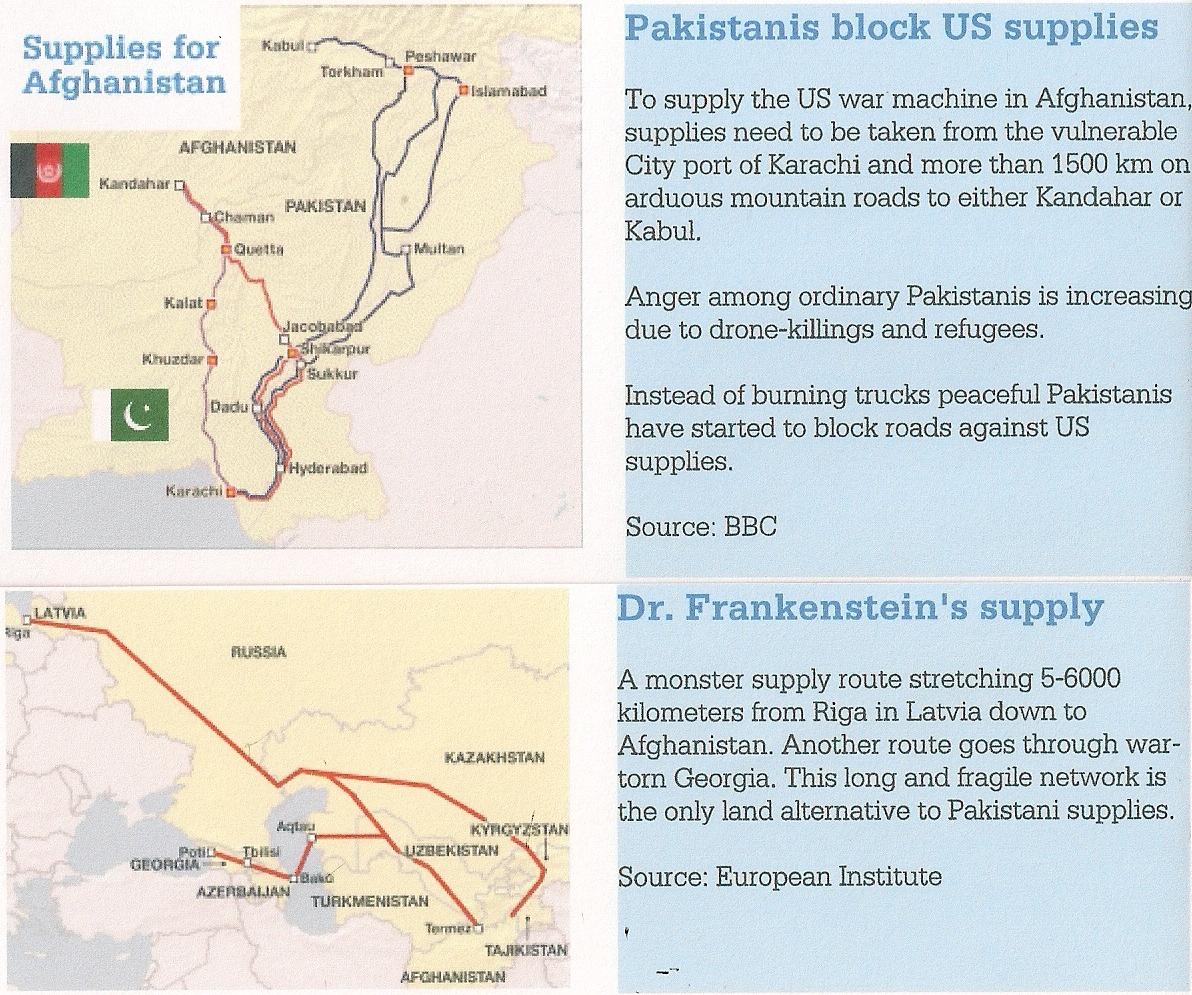
Below is a report in the Pakistani newspaper Dawn that describes the logistics bottleneck in the port of Karachi caused by Pakistan's closure of the Nato's crucial southern supply route.
There are three logistics routes to sending supplies into Afghanistan: one by air and two by land. Air is too expensive and of limited carrying capacity. The least costly route is the long vulnerable highway net thru Pakistan — this is the southern route (top map) that has been shut down as described below. The northern route (lower map) is much longer going from either the Baltic or the Black Seas and is dependent on the good will of Russia, Kazakhstan, and Uzbekistan. According to the AP, The northern route at $104 million per month in total cost is at least six times as expensive as the southern route.
The AP report contained no information on the cost per ton, but that factor is likely to be much higher that six-to-one, because prior to the closure (as of last June), about 50% of Nato's total supply requirement was was flowing through the southern route, with the other 50% being divided between the norther route and the air route.]
Thousands of Nato trucks in Pakistan backlog
Dawn [Pk], 26 Jan 2012
KARACHI: Two months into Pakistan’s blockade on Nato supplies crossing into Afghanistan, thousands of trucks are crowding the port in Karachi where drivers, fed up with waiting, are starting to desert.