Paul Craig Roberts: The Real Economic Picture

03 Economy, 07 Other Atrocities, Analysis, Blog Wisdom, Commercial Intelligence, Corruption, General Accountability Office, Government, IO Impotency, Misinformation & Propaganda, Office of Management and Budget
Paul Craig Roberts

The Real Economic Picture

If you have any money and you want to understand the lies that “your” government tells you with statistics, subscribe to John Williams shadowstats.com.

John Williams is the best and utterly truthful statistician that we the people have.

The charts below come from John Williams Hyperinflation Report, January 25, 2012. The commentary is supplied by me.

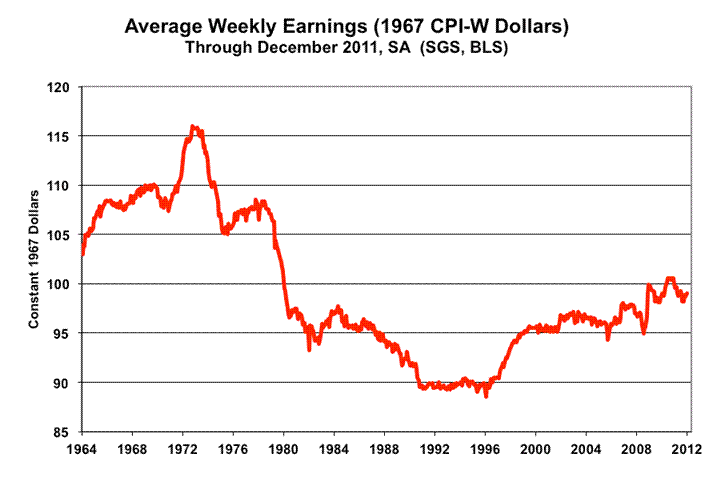
Here is the chart of real average weekly earnings deflated by the US government’s own measure of inflation, which as I pointed out in my recent column, Economics Lesson 1, understates true inflation.
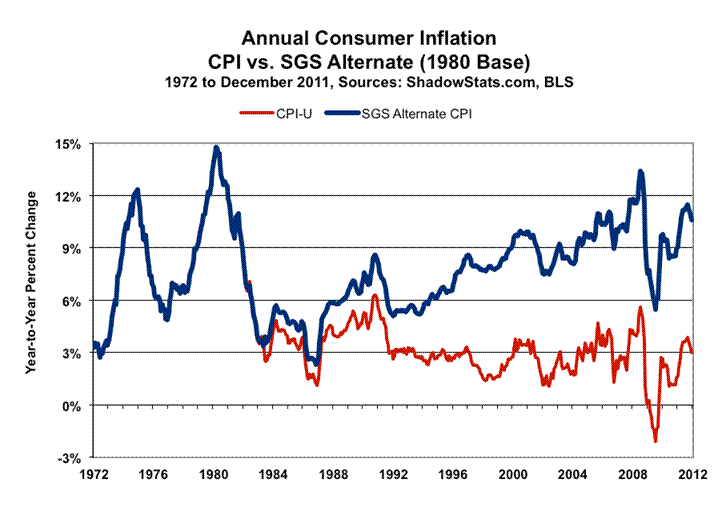
This chart (below) shows the behavior of inflation as measured by “our” government’s official measure, CPI-U (bottom line) and John Williams measure which uses the official methodology of when I was Assistant Secretary of the US Treasury. The gap between the top and bottom lines represents the amount of money that was due to Social Security recipients and others whose income was indexed to inflation that was diverted by the government to wars, police state, and bankers’ bailouts.
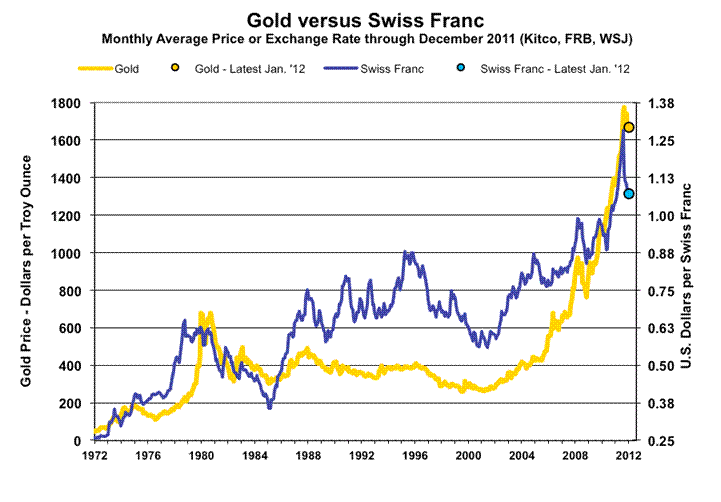
This next chart shows the gains that gold and the Swiss franc have made against the US dollar. The Swiss franc is the top line and gold is the bottom. When gold and the Swiss franc rise, the dollar is falling. Notice that during President Reagan’s first term, when I was in the Treasury, gold and the Swiss franc dropped, that is, the dollar rose in purchasing power. Obviously, the supply-side policy that Reagan implemented strengthened the US dollar. It was only with the advent of the Bush policy of endless trillion dollar wars, reaffirmed by Obama, that the US dollar and economy collapsed relative to gold and hard currencies.

The recent drop in the Swiss franc is due to the Swiss government announcing that the country’s exports could not tolerate any further run up in the franc’s value, and that the Swiss central bank would print new francs to accommodate future inflows of dollars and euros. In other words, Switzerland was forced to import US inflation in order to protect its exports.
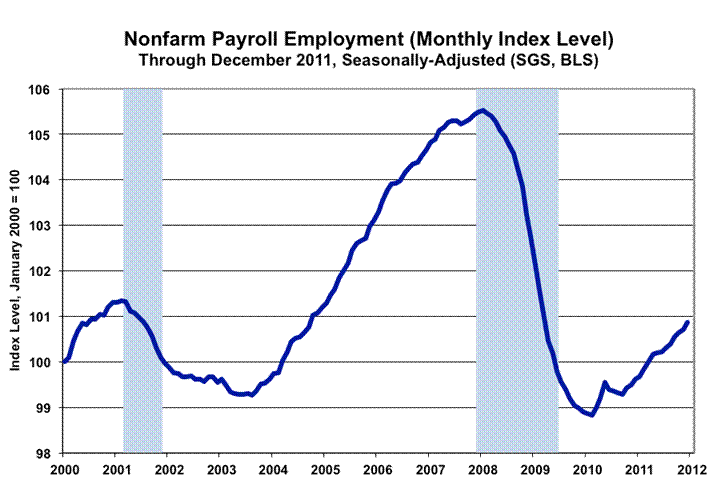
Here is nonfarm payroll employment. As you can see, the US economy has been in recession for four years despite the easiest monetary policy and largest government deficits in US history.
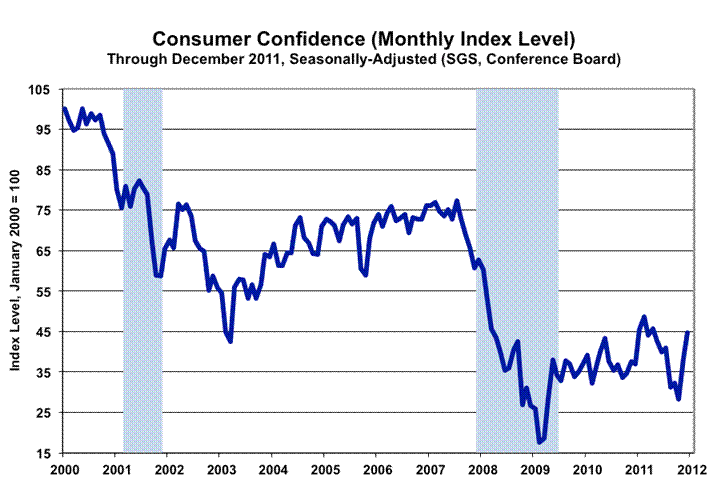
Here is consumer confidence. Do you see a recovery despite all the recovery hype from politicians and the financial media?
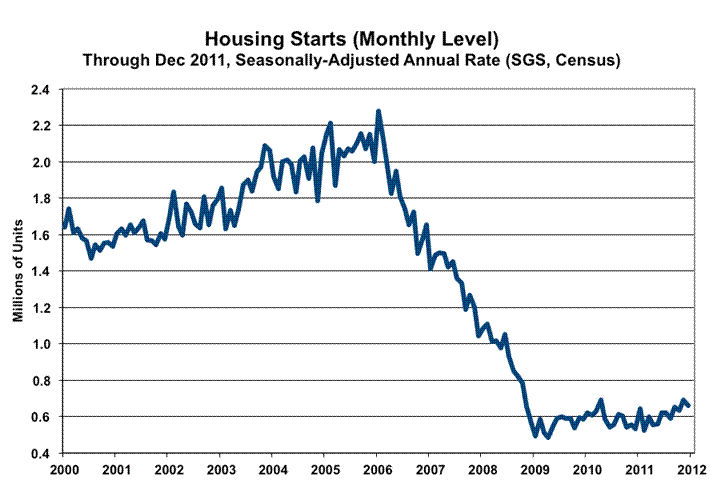
Here is housing starts. Do you see a recovery?
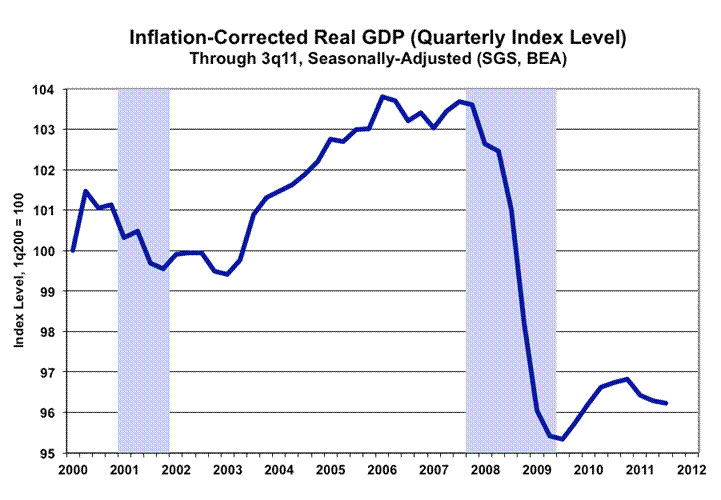
Here is real GDP deflated according to the methodology used when I was in the US Treasury.
Here is real retail sales deflated by the traditional, as contrasted with the current, substitution-based, measure of inflation.

These graphs courtesy of John Williams make it completely clear that there is no economic recovery. In place of recovery, we have hype from politicians, Wall Street, and the presstitute media. The “recovery” is no more real than Iraqi “weapons of mass destruction” or Iranian “nukes” or the Obama regime’s phony story of assassinating last year an undefended Osama bin Laden, allegedly the mastermind of Islamic terrorism, left by al Qaeda to the mercy of a US Seal team, a man who was widely reported to have died from renal failure in December 2001, a man who denied any responsibility for 9/11.

A government and media that will deceive you about simple things such as inflation, unemployment, and GDP growth, will lie to you about everything.

Phi Beta Iota:  Here is the paraphrase as reported previously, from Ellen Seidman, former member of the National Economic Council:

CIA reports only focus on foreign economic conditions. They don't do domestic economic conditions and so I cannot get a strategic analysis that compares and contrasts strengths and weaknesses of the industries I am responsible for. On the other hand, Treasury, Commerce, and the Fed are terrible at the business of intelligence — they don't know how to produce intelligence.[1]

When you add a lack of integrity across the board to basic incompetence on the part of both consumers and producers of intelligence, you end up with lies that neither patriotic nor helpful.


[1] Seidman was speaking to the Open Source Lunch Club on January 1, 1994. Her observations were subsequently reported in OSS Notices 94001 dated February 21, 1994


Patrick Meier: How to Crowdsource Better Governance in Authoritarian States

Advanced Cyber/IO, Collective Intelligence, Government
Patrick Meier

How to Crowdsource Better Governance in Authoritarian States

I was recently asked to review this World Bank publication entitled: “The Role of Crowdsourcing for Better Governance in Fragile States Contexts.” I had been looking for just this type of research on crowdsourcing for a long time and was therefore well pleased to read this publication. This blog posts focuses more on the theoretical foundations of the report, i.e., Part 1. I highly recommend reading the full study given the real-world case studies that are included.

“[The report serves] as a primer on crowdsourcing as an information resource for development, crisis response, and post-conflict recovery, with a specific focus on governance in fragile states. Inherent in the theoretical approach is that broader, unencumbered participation in governance is an objectively positive and democratic aim, and that governments’ accountability to its citizens can be increased and poor-performance corrected, through openness and empowerment of citizens. Whether for tracking aid flows, reporting on poor government performance, or helping to organize grassroots movements, crowdsourcing has potential to change the reality of civic participation in many developing countries. The objective of this paper is to outline the theoretical justifications, key features and governance structures of crowdsourcing systems, and examine several cases in which crowdsourcing has been applied to complex issues in the developing world.”

The research is grounded in the philosophy of Open-Source Governance, “which advocates an intellectual link between the principles of open-source and open-content movements, and basic democratic principles.” The report argues that “open-source governance theoretically provides more direct means to affect change than do periodic elections,” for example. According to the authors of the study, “crowdsourcing is increasingly seen as a core mechanism of a new systemic approach of governance to address the highly complex, globally interconnected and dynamic challenges of climate change, poverty, armed conflict, and other crises, in view of the frequent failures of traditional mechanisms of democracy and international diplomacy with respect to fragile state contexts.”

Read full article.

John Robb: Drone Diplomacy – Comply or Die + Meta RECAP

07 Other Atrocities, Blog Wisdom, Corruption, Cultural Intelligence, DHS, Director of National Intelligence et al (IC), DoD, Government, IO Deeds of War, Military, Officers Call
John Robb

Drone Diplomacy: Comply or Die

Gunboat diplomacy was the essence of military power projection for centuries. Want to coerce a country? Sail a aircraft carrier battle group into their national waters.

However, carrier battlegroups are hideously expensive, increasingly vulnerable to low cost attack, and less lethal than they appear (most of the weapons systems are used for self-defense).

What are nation-states replacing them with? Drones. You can already see it in action across the world as drone staging areas are replacing traditional military bases/entanglements. Further, drones already account for the vast majority of people killed by US forces.

Of course, the reason for this is clear. Drones are relatively cheap, don't require many people to deploy/operate, don't put personnel directly at risk, can be easily outsourced, can be micromanaged from Washington, and are very effective at blowing things up.

The final benefit of Drone Diplomacy: drones make it possible to apply coercion at the individual or small group level in a way that a blunt instrument like a carrier battle group can't.
What does this mean?

It allows truly scalable global coercion: the automation of comply or die.

Call up the target on his/her personal cell (it could even be automated as a robo-call to get real scalability — wouldn't that suck, to get killed completely through bot based automation).

Ask the person on the other end to do something or to stop doing something.

If they don't do what you ask, they die soon therafter due to drone strike (unless they go into deep hiding and disconnect from the global system).

With drone costs plummeting, we could see this drop to something less thanWhat can we look forward to?

The mid term future of a national security apparatus in secular ($$) decline?

Drones, drones, and more drones. Shrink the headcount. Cut training. Put manned weapons systems in life support mode. Cut mx.

All the money is on cyber intel (to generate targets based on “signatures”) and drones to kill them. When domestic unrest occurs in the US due to economic decline, these systems will be ready for domestic application.

Oh joy.

See Also:

Is There a Defense Against Drones?

Chuck Spinney: Real Cost vs Real Value of Drones? + RECAP

DefDog: Iran Hijacks US Drone Shows Film + RECAP

G.I. Wilson: Killer Drones, Moral Disengagement, + War Crimes RECAP

John Robb: Micro Drones Threaten US Citizens at Home

Marcus Aurelius: US Navy Hypes Water Drone Threat

Mini-Me: Assassination – Made in America – At What Cost? Impeachable Treason.


Josh Kilbourn: DHS to Twitter – What You Write Can and Will Be Used Against You….

07 Other Atrocities, Corruption, Cultural Intelligence, Government, IO Impotency, Law Enforcement
Josh Kilbourn

Twitter Users Beware: Homeland Security Isn’t Laughing

Two British tourists were detained after tweeting a joke about Marilyn Monroe. Is Homeland Security monitoring social media too closely?

Mathew Ingram

Bloomberg/Businessweek, 30 January 2012

Planning to make a joke on Twitter about bombing something? You might want to reconsider: According to a report from Britain, two tourists were detained and denied entry into the U.S. recently after they joked about destroying America and digging up Marilyn Monroe. That the Homeland Security Dept. and other authorities—including the FBI—are monitoring such social media as Twitter and Facebook isn’t surprising. That these authorities are willing to detain people based on what is clearly a harmless joke, however, raises questions about what the impact of all that monitoring will be.

Leigh Van Bryan, a 26-year-old bar manager from Coventry, told The Sun that he and friend Emily Bunting were stopped by border guards when they arrived at Los Angeles International Airport and were questioned for five hours about messages Van Bryan had tweeted saying he planned to “destroy America.” After the questioning, during which Homeland Security agents threatened the two, said Van Bryan, they were put into a van and taken—along with a few illegal immigrants—to a holding cell and held overnight. The next morning, they said, Van Bryan and Bunting were forced to take a plane back to England.

According to a report in the Daily Mail, the officers gave Van Bryan a document that detailed why he was refused admission into the U.S. The document reads like a bad joke itself, saying:

“He had posted on his Tweeter [sic] website account that he was coming to the United States to dig up the grave of Marilyn Monroe. … Also on his tweeter [sic] account Mr. Bryan posted that he was coming to destroy America.”

Van Bryan told the newspaper he tried to explain to Homeland Security officials that the term “destroy” was British slang referring to a party and that his comments about “digging up Marilyn Monroe” were an attempt at humor, but the officers didn’t listen. The authorities even searched the two tourists’ luggage for shovels and other tools, he said.

Read full article.

Phi Beta Iota: Good news is that our experiences with TSA do not bear out the many horror stories in the media.  Bad news is that DHS may be retarded beyond all expectations.

Josh Kilbourn: Overspending in Three Charts

Commerce, Corruption, Government, Military
Josh Kilbourn

Everything You Need To Know About Europe In Three Charts

Tyler Durden

Zero Hedge, 30 January 2012

Juxtaposing Merkel's (righteous and principally correct) insistence on debt brakes and fiscal discipline with the socialist tendencies of her European (let us print) comrades is at the heart of the crisis in Europe.

Click on Image to Enlarge

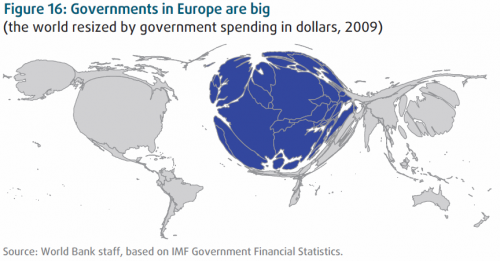
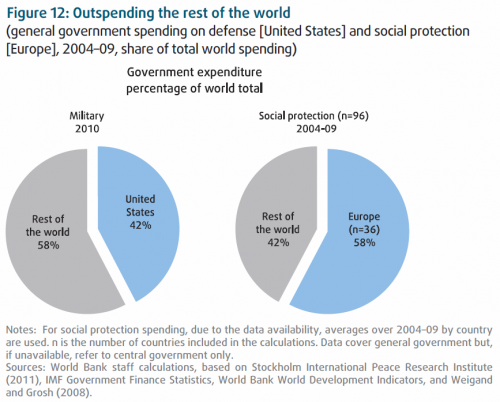
Nowhere is that more apparent than in these three charts, from the World Bank, which highlight just how large in absolute and relative terms Europe's social protection based government spending has become. This situation will only get more demanding as by 2060 almost a third of Europeans will be over 65 years old. While there was a belief that Europeans were willing to accept less growth for better growth (cleaner, smarter, kinder?), in order to meet the needs of an increasingly heavy ‘social' burden, government debt brakes will clearly have to be unhitched further, no matter what Merkel demands (increasing tensions), or the ‘new growth model' that is heralded but not yet substantive will have to be a miracle.


Click on Image to Enlarge

World Bank: THE PRECIPITATE PROMISE OF SOCIAL PROTECTION

Europe will have to make big changes in how it organizes labor and government. The reasons are becoming ever more obvious: the labor force is shrinking, societies are aging, social security is already a large part of government spending, and fiscal deficits and public debt are often already onerous.

In dealing with government spending, deficits, and debt, it is sensible to start by asking whether European governments are too big; that is, whether they spend too much. They are obviously bigger than their peers. In the EU15, governments spent 50 percent of GDP in 2009; in much of the rest of Europe, this share was about 45 percent—versus less than 40 percent in the United States and Japan, 33 percent in Latin America, and about 25 percent in emerging East Asia. A map of the world resized to reflect government spending instead of land area shows how Europe might look to outsiders (figure 16 below).

Read rest of article, see additional chart.

Phi Beta Iota:  Three themes jump out.  First, governments are too big, will fail, the era of small government leveraging new tools and new ways and new mindsets is emergent.  Second, the US overspends on the military and Europe overspends on social protection–both of these are culturally-insulated forms of corruption.  Third, the Industrial Era model of making decisions and allocating resources is no longer affordable and needs to be abandoned.  Assuming that national government refuse to heal themselves, we see local and state jurisdictions becoming very aggressive about resilience and sustainability, to the point of nullifying national regulations and if necessary declaring secession.  It is noteworthy that those governments that refused to bail out the banks and instead turned to their public for common sense solutions, are now the strongest governments.

David Isenberg: Iran Prepared for the Worst with A2/AD

03 Economy, 04 Inter-State Conflict, 05 Iran, 07 Other Atrocities, 08 Wild Cards, 09 Justice, 10 Security, 10 Transnational Crime, 11 Society, Analysis, Commercial Intelligence, Corruption, Cultural Intelligence, Director of National Intelligence et al (IC), Government, IO Deeds of War, Military, Misinformation & Propaganda, Money, Banks & Concentrated Wealth, Power Behind-the-Scenes/Special Interests
David Isenberg

Iran well prepared for the worst

David Isenberg

31 January 2012

Most discussions of possible United States military operations in the Persian Gulf, should Iran try to prevent maritime traffic from going through the Strait of Hormuz, generally say that while it would not be a cakewalk, it would not be an enormously difficult task either.

But that conventional wisdom is wrong, according to a recent report issued by an independent, non-profit public policy research institute in Washington DC. The report found that the traditional post-Cold War US military ability to project power overseas with few serious challenges to its freedom of action may be rapidly drawing to a close.

. . . . . . .

It stressed that “a Strait of Hormuz closure could trigger a much larger price spike, including by limiting offsetting supplies from other producers in the region”.

Read full article.

Phi Beta Iota:  Two themes are emerging in the open source world.  First, the depth and breadth of Israel's clandestine agreements with its Arab neighbors is not clearly understood–a National Intelligence Estimate is required, but the collection, processing, and analysis capabilities are simply not there, and the management will to do this as a multinational task is not there either.  Second, as the US loses its ability to actually project force, the finance of war is being replaced by the theater of war, such that oil prices can still be manipulated, but at a fraction of the blood, sweat, and tears previously mobilized – financial fraud on the cheap, as it were.


Chuck Spinney: F-35 Out of Everything Except Money

Commerce, Corruption, DoD, Government, Military
Chuck Spinney

F-35: Out of Altitude, Airspeed, and Ideas — But Never Money

Chuck Spinney

TIME, 30 January 2012

No program better illustrates the pathologies of the weapons acquisition process as it is currently practiced by the Military – Industrial – Congressional Complex (MICC) than the entirely predictable, and in this case, predicted, problems dragging the F-35 Joint Strike Fighter into a dead man’s spiral.

The F-35 in on track to be the most expensive program in the history of the Defense Department, and it has repeated just about every mistake we invented since Robert McNamara concocted the multimission, multi-service  TFX — a program conceived with the same kind of fanciful one-shoe fits all imaginings as the F-35.

Read full article.

Read USMC Boats Against the Current and Comments

Robert Steele

For reflection.  When I created the strategic generalizations in the first edition of the Expeditionary Factors study, that was responding to General Gray's guidance that we be relevant to USMC acquisition–that was actually his primary focus, we lost our integrity by the third generation of leadership and went into production for the sake of production, without a genuine understanding of either the craft of intelligence or the mission needs of the USMC.  That was enabled by flag officers who have no clue what it means to integrate true cost economics with strategic generalizations to arrive at a force that has a very low logistics foot-print, a very high availability ratio, and a very low cost in relation to all the crap that the big three services sign for without thinking.

1990 Expeditionary Environment Analytic Model
1991 MCG Intelligence Support for Expeditionary Planners
2008 U.S. Naval Power in the 21st Century
2009 Perhaps We Should Have Shouted: A Twenty-Year Retrospective

noble gold