UPDATED to add photo. Guards at the front door, no guards across the totally exposed back end. Sheraton San Salvador was attacked from the ravine. Deja vu.
Gunmen and suicide bombers strike the tightly secured Intercontinental Hotel in Kabul, which has large foreign clientele. It was not immediately known how many people were killed or wounded.
Phi Beta Iota: Well-intentioned professionals like to say that if the US only has enough will to persist, it can prevail against any enemy. That is not correct. When the US engaged in elective wars and lacks legitimacy in the eyes of the occupied public, it will inevitably lose. When the US Government is delusional and ignoring the harsh realities at home, it loses its domestic legitimacy. Events like the Tet Offensive, or the increasing attacks in the heart of Kabul, accentuate the cognitive dissonance among all parties. This will not end well for the US.
While the U.S. government may be described as a massive wealth transferring scheme, looting the middle class for the elite, I’d suggest that ‘wealth’ and ‘elite’ are not precisely correct. The transformation in Western power structures over past three centuries is such that the ‘elite’ was formerly indistinguishable from the government, which is the hallmark of feudal government; whereas now, the locus of power is the government itself, not any particular group of people.
We still find the old system at work in dictatorships – Libya, N. Korea – in which the government is indistinguishable from a small group of people and for whom wealth accumulation is the primary goal.
But wealth isn’t the primary goal of western governments; they have a nearly unlimited ability to create their own wealth (debt and printing money) – or destroy it (debt and printing money). The primary concern of these supposedly post-feudal governments is stability and power, and their primary means to securing these ends is patronage.
Patronage existed in feudal governments, but it was a means to an end (wealth accumulation), and not the end in itself. As such, it’s then not surprising that the primary purpose of most government endeavors – the education and court systems, intelligence communities, healthcare – is to employ the greatest number of people, thus securing widespread government support. Critical mass is reached when a simple majority of the voters earn >50% of their income from government sources – there are people who work for a living and people who vote for a living, and once the latter reaches >50%, the former becomes politically irrelevant.
The big deficit facing the U.S. is mostly Republican in origin, the Congressional Budget Office says. The Bush tax cuts alone have added $3 trillion in red ink, yet the party wants to double down on its failed policy.
By Mike Lofgren
June 26, 2011
. . . . . . .
Polarization based on juvenile talk radio sloganeering is dragging this country to the cliff's edge. If neither the Democrats nor the party I have served for three decades is willing to act like adults, perhaps it's time for a party that is willing to step into the void.
Phi Beta Iota: Based on in-country reporting from Cynthia McKinney and others, we are quite certain that it is NATO that is committing the war crimes, and the rebels who are genociding black Libyans. We are equally certain the International Tribunal does not have a clue in terms of validated intelligence (decision-support) and therefore conclude that in this instance the warrants lack legitimacy and credibility and are an act of state–similar to the act of state against Martin Luther King; the act of state that sanctioned Israeli murder of US personnel aboard the USS Liberty; and the act of state that told 935 lies to create an elective three trillion dollar war on Iraq and Afghanistan.
A Florida group is calling on state lawmakers to enact a law “against state-sponsored perversion and oppression” in the wake of an aggressive TSA patdown of a diapered 95-year-old woman at Northwest Florida Regional Airport.
Phi Beta Iota: This is real simple. State by state, nullify the TSA and administer security as a state function. If the federal government does not like that, secede from the Union. TSA is not blocking flights from Europe or anywhere else that are fortunate in not having to put up with what passes for security in the USA.
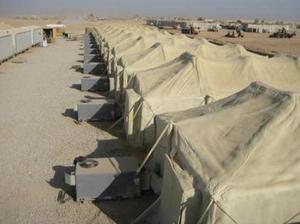
The amount the U.S. military spends annually on air conditioning in Iraq and Afghanistan: $20.2 billion.
That's more than NASA's budget. It's more than BP has paid so far for damage during the Gulf oil spill. It's what the G-8 has pledged to help foster new democracies in Egypt and Tunisia.
Phi Beta Iota: It is always helpful to remember Medard Gabel's graphic on the cost of peace versus war. For what we have spent on the military-industrial-intelligence complex these past ten years, never mind the legalized fraud of Wall Street, we could have eradicated the ten high-level threats to humanity. The US Government lacks both intelligence and integrity. Good people trapped in a very bad system–we need to set them free. An nation's best defense is an educated citizenry that pursues a foreign policy of peace and commerce with truth and trust as core value and core outcome.
Phi Beta Iota: We asked Col Stu Herrington, USA (Ret), Army counterintelligence officer/interrogator with successful interrogation experience in three wars, what he thought of the matter of General Patraeus opening the door on torture, and here is what he thinks–we have to concur.
Can the US Have an Expansionary Fiscal Contraction?
All … the attached essay was written by Simon Johnson, Ronald Kurtz Professor of Entrepreneurship, MIT Sloan School of Management; Senior Fellow, Peterson Institute for International Economics; and co-founder of Baseline Scenario. Johnson used to be Chief Economist of IMF and is, IMO, one of the sanest voices in economics. It summarizes his recent testimony to the Joint Economic Commitee of Congress. The question is — Should we reduce federal debt to slow the build up of private debt? He lays out 4 reasons why such a contractionary fiscal policy will create even worse problems.
Click on Image to Enlarge
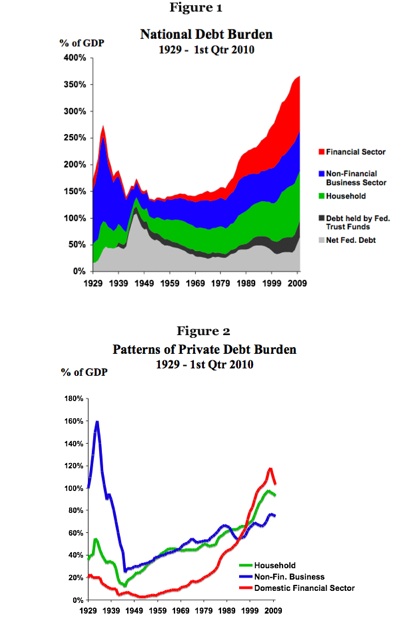
His penultimate paragraph places the real issue — who is going to pay for the liquidation of the private bubble (see chart below, which I compiled from Fed. Reserve data) into context (the red typing is mine to clarify the ambiguity in his double use of debt). Also, I urge you to read his testimony (you can download it from the link indicated below) — it is more detailed and he has a brief discussion about how the cost of the financial meltdown (looming private debt liquidations — particularly the bubbles of debt in the financial and household sectors — which Fig 2 shows has not really begun to bite) are being shifted to the middle class. Note, the rise in the light gray area in Figure 1 is the spike in federal debt that has taken place since the meltdown.
What happened to the global economy and what we can do about it
Could The US Have An “Expansionary Fiscal Contraction”?
By Simon Johnson. My full written testimony to Tuesday’s hearing of the Joint Economic Committee of Congress is available here.
The US has a large budget deficit and a debt-to-GDP ratio that, in most projections, continues to rise over time. Some House and Senate Republicans are arguing strongly that this situation calls for large and immediate cuts to government spending, for example as part of any agreement to increase the federal government’s debt ceiling.
The Joint Economic Committee of Congress held a hearing on Tuesday to discuss whether such spending cuts would be “contractionary” or “expansionary” for the economy in the short-run. My assessment, after participating as a witness at the hearing, is that large immediate spending cuts would tend to slow the economy (a webcast of the hearing is here).




 Libya, Amnesty questions the Hague‘s findings: Are the rebels making up claims of mass rape?