Phi Beta Iota: Our political, policy, and military leaders simply do not know what they do not know. Assuming–desiring–that they have the best of intentions–the reality is that they are not receiving the intelligence (decision-support) that they require to make intelligent decisions. In both Iraq and Afghanistan, because there was political will, trillions have been wasted on “security” instead of sustenance. Haiti, because there were no political will, was a microcosm–20,000 troops with a huge logistics tail when what was really needed were CAB 21 Peace Jumpers able to call in a Reverse TPFID…. Advanced Cyber/IO starts with imagination & intelligence.
Officer won't sign order for troop indoctrination, asks to be relieved of command over repeal of ‘gay' ban in military
Worldnet.com,Posted: December 24, 2010
An Army lieutenant colonel has asked to be relieved of command rather than order his troops to go through pro-homosexual indoctrination following the repeal of the policy, which required homosexuals to keep silent about their sexual preference.
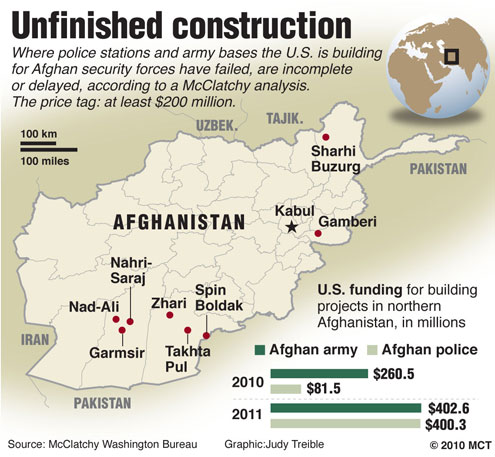
This year will see the 10th anniversary of the war in Afghanistan and, according to current plans, the beginning of British troop withdrawal. A decade into the military campaign, there is no longer even discussion of winning. The initial objective to release the country from the despotic grip of the Taliban and prevent its use as a safe haven for al-Qaida was achieved within months. Since then, it has only ever become harder to discern what victory might look like.
There is some clarity on what would count as defeat. If Nato withdrawal leads to the total collapse of Hamid Karzai's government and a return to Taliban rule, there would be no disguising the humiliation to western powers, nor the increased security threat from jihadi terrorism. Not that President Karzai is an attractive ruler. His administration is corrupt and repressive.
Summary: The author discusses the intellectual but not the ethical underpinings of the failure of US foreign policy and national security since the first Clinton Administration. He touches on alternative policies such as isolationalism, offshore balancing, selective engagement, global dominance, and then settles on offshore balancing as the way to go: pulling back the Army and Marines from overseas, sharply reducing their budgets, and restoring budget to the Air Force and the Navy.
At Peter Thiel’s invitation-only “Breakthrough Philanthropy” event in San Francisco on December 7, which brought together Silicon Valley’s top entrepreneurs with eight of the most visionary non-profits, Patri Friedman, grandson of legendary economist Milton Friedman, presented one of the most radical, imaginative concepts I’ve heard in some time. Here’s the text of his four-minute talk (video below — other Breakthrough Philanthropy speaker videos here). — A. Angelica
Every year, our phones get smarter, our cars safer, and our medical treatments more advanced. We all benefit from startups and established companies competing through constant innovation. So why is it that in one of the most advanced countries in the world, we’re still using the legal technology … of 1787? I mean, if you drove a car from 1787, it would be a horse!
Phi Beta Iota: There is a germ of a good idea here, that of creating viable alternatives for governance and sustenance as a model for others–the spike theory of change. It is however also remarkably utopian given the fact that between Bush Junior and Obama we have gone from 25 to 175 failed states and rising. Imagine Waterworld Somalian style. Ralph Peter nailed it long ago when he pointed out that the only path to wine, women, and wealth for the bulk of the population in failed states was at the point of a gun. Utopians simply do not get the reality that we live in a Whole System and until we can create a World that Works for All, these lovely ideas are nothing more than liberal speculative fancies. This web site and everyone associated with it are in the aggregate commited to restoring America the Beautiful, a Republic with liberty and justice for all. Seasteading–and geodesic domes–are great ideas that will only be beneficial if we can create a prosperous world at peace.
Two years into the Obama presidency and the economic data is still looking grim. Don’t be fooled by the gyrations of the stock market, where optimism is mostly a reflection of the ability of financial corporations—thanks to massive government largesse—to survive the mess they created. The basics are dismal: Unemployment is unacceptably high, the December consumer confidence index is down and housing prices have fallen for four months in a row. The number of Americans living in poverty has never been higher, and a majority in a Washington Post poll said they were worried about making their next mortgage or rent payment.
In a parallel universe lives Peter Orszag, President Barack Obama’s former budget director and key adviser, who even faster than his mentor, Robert Rubin, has passed through that revolving platinum door linking the White House with Wall Street. The goal is to use your government position to advance the interests of your future employer, and Orszag and Rubin’s actions in the government and then at Citigroup provide stunning examples of the synergy between big government and high finance.
Institute for Science and International Security (ISIS)
Phi Beta Iota: US Supervisory Control and Data Acquisition (SCADA) computer systems are still on the Internet and still very vulnerable to internal and external interference, as well as the standard 50% “errors and omissions” that come with sloppy computer work so characteristic of US vendors. Many sounded the alarm in 1990 (Winn Schwartau, Peter Black) through 1994 (Robert Steele, various field grade officers at the Air War College) but no one wanted to listen. The US is as close to a complex melt-down (political-legal, socio-economic, ideo-cultural, techno-demographic, natural-geographic) as we have witnessed in our lifetime.
Although other papers have been written since then, the three “originals” in the author's view are Major Gerald R. Hust, “Taking Down Telecommunications”, School of Advanced Airpower Studies, 1993); Major Thomas E. Griffith, Jr., “Strategic Attack of National Electrical Systems”, School of Advanced Airpower Studies, 1994; and H. D. Arnold, J. Hukill, and A. Cameron of the Department of the Air Force, “Targeting Financial Systems as Centers of Gravity: ‘Low Intensity' to ‘No Intensity' Conflict”, in Defense Analysis (Volume 10 Number 2, pages 181-208), 1994.