Michel Bauwens: Evolving Toward a Partner State in an Ethical Economy

Communities of Practice, Policies
Michel Bauwens

Evolving Towards a Partner State in an Ethical Economy

Reality Sandwich, 4 April 2012

In the  emerging institutional model of peer production, most visibly in the free software industry, we can distinguish an interplay between three partners, i.e.

1) a community of contributors that create a commons of knowledge, software or design;

2) an enterpreneurial coalition that creates market value on top of that commons;  and

3) a set of “for-benefit institutions' which manage the ‘infrastructure of cooperation'.

There is a clear institutional division of labour between these three players.

The contributors create the use value that is deposited in the shared innovation commons of knowledge, design and code.

The for-benefit institution enables and defends the general infrastructure of cooperation which makes the project ‘collectively' sustainable. For example the Wikimedia Foundation collects the funds to support the server space without which access to the Wikipedia would become impossible.

The enterpreneurial coalition makes the individual contributors ‘sustainable', by providing an income, and very often they provide means for the continued existence of the for-benefit associations as well.

Can we also learn something about the politics of this new mode of value creation, something that would be useful not just for these particular communities, but to society in general? Is there perhaps a new model of power and democracy co-evolving out of these new social practices, that may be an answer to the contemporary crisis of democracy? My answer will be an emphatic yes, and stronger yet, I will argue that we are witnessing a new model for the state. A ‘P2P' state, if you will.

Let's look at the mechanics of power and the politics of commons-oriented peer production by looking at the three players involved in this new institutional set-up.

Headlines Only:

1. The post-democratic logic of community

2. The relation between the community and the enterpreneurial coalition

3. The democratic logic of the for-benefit institutions

4. Towards a Partner State

5. A value crisis of the capitalist economy

6. The prefiguration of a new social model

7. Towards a civilization based on economies of scope, not scale

. . . . . . .

The only thing left to do is to have an answer to the crucial question: how does global governance look like in P2P civilization? How can we transform  the global material Empire which at present dominates world affairs for the benefit of a few,  and replace the ineffectual global institutions that are present inadequate to deal with global challenges?

Read full article.

Phi Beta Iota:  Those of us committed to a prosperous world at peace, in which governance is characterized by intelligence and integrity, all see the insanity of artificial scarcity and embedded corruption.  What is emergent and increasingly visible (i.e. comprehensible) to the public at large is the alternative model of Open Source Everything, a Non-Zero approach to both the material and the intangible.  The above can be readily expanded to embrace the eight communities (academic, civil society, commerce, government, law enforcement, media, military, and non-governmental/non-profit)–all of them have vital resources and perspectives that must be integrated if we are to achieve Panarchy–self-governance with intelligence and integrity at all levels on all issues.

See Also:

2012 PREPRINT FOR COMMENT: The Craft of Intelligence

THE OPEN SOURCE EVERYTHING MANIFESTO: Transparency, Truth & Trust

Robert Steele: Earthquakes From Oil and Gas Drilling

03 Economy, 03 Environmental Degradation, 05 Energy, Commerce, Corruption, Earth Intelligence, Government, IO Impotency
Robert David STEELE Vivas

One can only look on in anguish as the US Government continues to betray the public trust for lack of intelligence and integrity.

The headlines about earthquakes being related to oil and gas drilling have been common for some time now.  Despite the fact that the federal government has noticed the connection at very low bureaucratic levels, the fact is that the politicized government persists in ignoring the precautionary principle and continues to betray the public trust by not stopping all activities associated with increasing earthquakes.

Earthquakes are now coming to the East Coast just as they are about to become much more frequent, intense, and consequential on the East Coast.

One can only pray that at some point the public will demand an honest government capable of making informed decisions with integrity.

Shale Shocked: “Remarkable Increase” In U.S. Earthquakes “Almost Certainly Manmade”

Federal Study Ties Oil and Gas Industry to Earthquakes

Survey says increase in quakes may have man-made cause

See Also:

Worth a Look: Book Review Lists (Negative)

2012 PREPRINT FOR COMMENT: The Craft of Intelligence

THE OPEN SOURCE EVERYTHING MANIFESTO: Transparency, Truth & Trust
Joshua Kilbourn: ShadowStats Truth on Unemployment versus USG Lies

03 Economy, Corruption, Government
Josh Kilbourn

John Williams – Unemployment Rate at a Staggering 22.2%

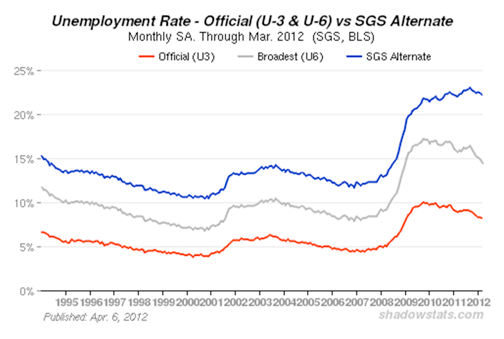
John Williams, of Shadowstats, notes that manipulated government statistics are not changing the fact that the true SGS Unemployment Measure now sits at a staggering 22.2%.  Williams also demonstrates that despite the hype from Wall Street about a recovery, parts of the economy remain collapsed.  Here is what Williams had to say about the situation:  “Adding the SGS estimate of excluded long-term discouraged workers back into the total unemployed and labor force, unemployment—more in line with common experience as estimated by the SGS-Alternate Unemployment Measure—notched lower to 22.2% in March from 22.4% in February.”

Click on Image to Enlarge

John Williams continues:

“The SGS estimate generally is built on top of the official U.6 reporting, and tends to follow its relative monthly movements. Accordingly, the SGS measure will suffer some of the current seasonal-adjustment woes afflicting the base series, such as recent distortions in adjusted reporting of part-time employment for economic reasons.  Nonetheless, there continues to be a noticeable divergence in the SGS series versus U.6.  The reason for this is that U.6, again, only includes discouraged workers who have been discouraged for less than a year.


As the discouraged-worker status ages, those that go beyond one year, fall off the government counting, and new workers enter “discouraged” status.  Accordingly, with the continual rollover, the headline workers flow into the short-term discouraged workers counted in U.6 continue, and from U.6 into long-term discouraged worker status (SGS Measure) at what appears to be an accelerating pace.

Continue reading “Joshua Kilbourn: ShadowStats Truth on Unemployment versus USG Lies”

Event: 28-29 Apr Washington DC International Drone Summit: Killing and Spying by Remote Control

07 Other Atrocities, 10 Security, 11 Society, DoD, Military, Peace Intelligence

Join us in Washington, DC on April 28 and 29 for an “International Drone Summit: Killing and Spying by Remote Control” hosted by CODEPINK, Reprieve, and the Center for Constitutional Rights.

US drone strikes have killed an estimated 3,000 people around the world, including hundreds of civilians, without any judicial process or meaningful oversight, and without any transparency or accountability. The summit's dual objectives are to better inform the public about the reality and significance of the US government's expanding use of both killer and surveillance drones, and to facilitate networks and strategies to resist this expansion.

The Saturday, April 28 program is open to the public and brings together human rights advocates, robotics technology experts, activists, lawyers, scholars and journalists, and shares the stories of people whose families and lives have been directly impacted by remote-controlled drone strikes. This is an all day event with multiple panels beginning at 9am at Mount Vernon Place United Methodist Church, 900 Massachusetts Ave. NW, Washington, DC. See this site for updates on the program, and register here today!

The Sunday, April 29 program is a strategy session for organizations and individuals to network and plan advocacy efforts focused on various aspects of drones, targeted killings and expanding US covert wars. If you are interested in attending this session, please email Ramah Kudaimi at rkudaimi(@ symbol)gmail.com.

Learn more.

Winston Wheeler: Lies, Damn Lies, & Panetta-Pentagon Criminal Insanity

Budgets & Funding, Corruption, DoD, Government, Military
Winslow Wheeler

Cost growth in the last year in DOD's acquisition system was $74 billion, 34 percent more than the $55 billion presumed to occur in the sequester in January; while the time frames are different (see discussion below), so much for Secretary of Defense Panetta's asinine rhetoric that sequester would be a “Doomsday.”

Analysis of two recent acquisition reports is available at Time's Battleland blog at http://battleland.blogs.time.com/2012/04/09/lies-damn-lies-and-pentagon-budget-numbers/

and below.

Cost growth in the last year in DOD's acquisition system was $74 billion, 34 percent more than the $55 billion presumed to occur in the sequester in January; while the time frames are different (see discussion below), so much for Secretary of Defense Analysis of two recent acquisition reports is available at Time's Battleland blog at http://battleland.blogs.time.com/2012/04/09/lies-damn-lies-and-pentagon-budget-numbers/ and below.

Lies, Damn Lies, and The Pentagon's Latest Budget Numbers

By Winslow Wheeler | April 9, 2012 | +
Leon Panetta in Drag

There's a pair of must-reads just out for anyone paying attention to the Pentagon's acquisition nightmare: one is a routinely scheduled, but important, report from the Defense Department; the other comes from one of the very few entities doing even minimal oversight of the Department of Defense these days, the Government Accountability Office.

Reviewing the reports separately results in a muddled picture of how the Pentagon buys its weapons. Happily, each report fills some of the data missing in the other. But, the two reports still leave some gaping holes, while providing a false impression of progress in the way the Defense Department buys weapons.

The two reports are GAO's annual review of major hardware acquisition, Defense Acquisitions: Assessments of Selected Weapon Programs, and DoD's new Selected Acquisition Report (SAR), both released March 30. What follows is my own After-Action Report – including the gaps, contradictions, and false assurances – after studying the data they do – and don't – contain.

The Death Spiral is Alive and Well

Continue reading “Winston Wheeler: Lies, Damn Lies, & Panetta-Pentagon Criminal Insanity”

Patrick Meier: Does the Humanitarian Industry Have a Future in The Digital Age?

Blog Wisdom, Civil Society, Collective Intelligence, Commerce, Commercial Intelligence, Cultural Intelligence, Earth Intelligence, Geospatial, Gift Intelligence, Government, info-graphics/data-visualization, InfoOps (IO), International Aid, IO Impotency, Methods & Process, microfinancing, Mobile, Non-Governmental, Peace Intelligence, Threats
Patrick Meier

Does the Humanitarian Industry Have a Future in The Digital Age?

I recently had the distinct honor of being on the opening plenary of the 2012 Skoll World Forum in Oxford. The panel, “Innovation in Times of Flux: Opportunities on the Heels of Crisis” was moderated by Judith Rodin, CEO of the Rockefeller Foundation. I've spent the past six years creating linkages between the humanitarian space and technology community, so the conversations we began during the panel prompted me to think more deeply about innovation in the humanitarian space. Clearly, humanitarian crises have catalyzed a number of important innovations in recent years. At the same time, however, these crises extend the cracks that ultimately reveal the inadequacies of existing humanita-rian organizations, particularly those resistant to change; and “any organization that is not changing is a battle-field monument” (While 1992).

These cracks, or gaps, are increasingly filled by disaster-affected communities themselves thanks in part to the rapid commercialization of communication technology. Question is: will the multi-billion dollar humanitarian industry change rapidly enough to avoid being left in the dustbin of history?

Crises often reveal that “existing routines are inadequate or even counter-productive [since] response will necessarily operate beyond the boundary of planned and resourced capabilities” (Leonard and Howitt 2007). More formally, “the ‘symmetry-breaking' effects of disasters undermine linearly designed and centralized administrative activities” (Corbacioglu 2006). This may explain why “increasing attention is now paid to the capacity of disaster-affected communities to ‘bounce back' or to recover with little or no external assistance following a disaster” (Manyena 2006).

Continue reading “Patrick Meier: Does the Humanitarian Industry Have a Future in The Digital Age?”