Josh Kilbourn: 51 Months of Recession – Report Card

03 Economy, Civil Society, Commerce, Corruption, Government, Media
Josh Kilbourn

51 Months After The Start Of The Recession, Here Is The Report Card

Tyler Durden

ZeroHedge, 04/06/2012

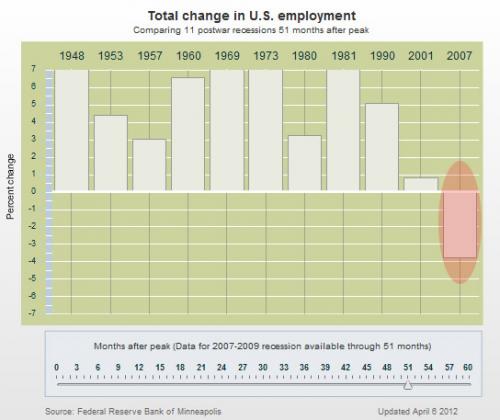
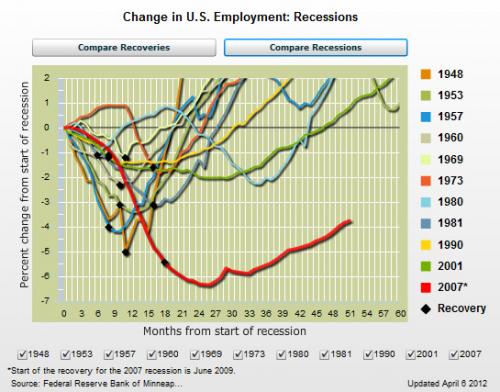
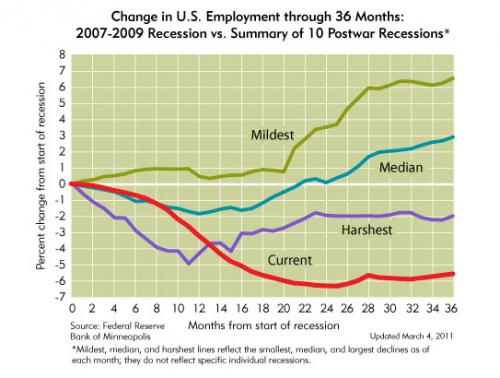
Recovery? What Recovery? 4 years after central banks have progressively injected over $7 trillion in liquidity into the global markets (and thus, by Fed logic, the economy), and who knows how many trillion in fiscal aid has been misallocated, to halt the Second Great Depression which officially started in December 2007, the US “recovery” is the weakest in modern US history! How many more trillions will have to be printed (and monetized) before the central planners realize that fighting mean reversion by using debt to defeat recore debt, just doesnt't work? Our guess – lots.

Incidentally, the US has now generated 3 million jobs since the trough of the recession in September 2010, until which point it had previously lost 8 million. Unfortunately, since the real labor force has grown by 4.6 million over the same period, or at the conventionally accepeted 90,000 labor pool entrants per month for 51 months, despite what the BLS may say, because America is after all growing, this means that the Obama administration has created a negative 1.6 million jobs net of demographics, which in turn have cost the US a modest $5.1 trillion in new debt, or an even modest $3.1 million in debt for every job lost.

Chart 1 – the current “recovery” in the context of all previous ones:
Click on Image to Enlarge

Chart 2 – Min, Max and Average… and now
Click on Image to Enlarge

Chart 3 – in bar chart format

Click on Image to Enlarge

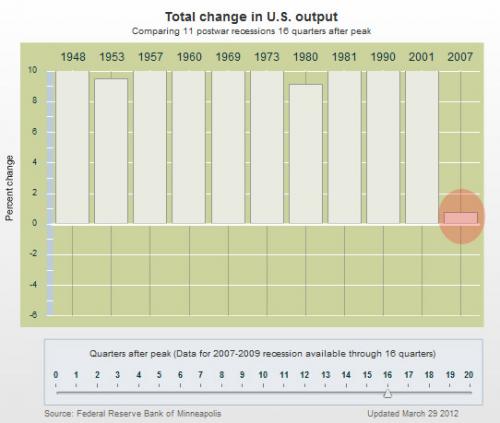
Chart 4 – There is good news: 16 quarters after the start of the recession, US output has turned positive. Just barely.
Click on Image to Enlarge

Phi Beta Iota: What is one to do when the government, with the full complicity of the two parties that monopolize power through various illegitimate means, the full complicity of the five major media corporations whose “mouthpieces” bury their intelligence along with their integrity, all lie to the public? Have we really become a nation of idiot sheep?  At what point is the government impeachable for lies to the public?

See Also:

THE OPEN SOURCE EVERYTHING MANIFESTO: Transparency, Truth & Trust

Journal: Reflections on Integrity UPDATED + Integrity RECAP

Steve Aftergood: Scientific Accomplishment vs. Scientific Secrecy

Corruption, Government, Law Enforcement, Military
Steven Aftergood

DALE CORSON AND SCIENTIFIC FREEDOM

Dale R. Corson, a nuclear physicist who died last week, is best remembered as the Cornell University President who peacefully led his campus through the turmoil and upheaval of the Vietnam era.  But he also played an influential role in deliberations over the role of secrecy in scientific research.

Dr. Corson chaired a 1982 committee of the National Academy of Sciences that produced a landmark study entitled “Scientific Communication and National Security,” which became known as the Corson Report.

In sober and measured tones, the Corson Report pushed back against calls for increased secrecy in government-funded science:

“Current proponents of stricter controls advocate a strategy of security through secrecy. In the view of the Panel security by accomplishment may have more to offer as a general national strategy. The long-term security of the United States depends in large part on its economic, technical, scientific, and intellectual vitality, which in turn depends on the vigorous research and development effort that openness helps to nurture…  Controls on scientific communication could adversely affect U.S. research institutions and could be inconsistent with both the utilitarian and philosophical values of an open society.”

President Reagan cited Dr. Corson in National Security Decision Directive 189, “National Policy on the Transfer of Scientific, Technical and Engineering Information,” which seemed to affirm that fundamental research should remain unrestricted to the maximum extent possible.  In fact, however, that directive imperfectly reflected the input of the Corson Report, noted Harold C. Relyea in his book “Silencing Science: National Security Controls and Scientific Communication.”

Still, many of the issues identified by Dr. Corson and his colleagues, and the concerns they expressed, remain current today and have not reached an unequivocal resolution, as evidenced most recently by the latest U.S. government policy on dual use biological research.

Continue reading “Steve Aftergood: Scientific Accomplishment vs. Scientific Secrecy”

Sepp Hasslberger: Putting Ground Transport Deep Underground

05 Energy, Communities of Practice, Earth Intelligence
Sepp Hasslberger

Evacuated tube travel to replace trains, planes and automobiles?

“Some people spend their life watching the tube, but Daryl Oster is spending his trying to get people to travel in one.”

“To be fair, Evacuated Tube Travel might be even bigger — Oster is proposing uisng magnetic levitation to send car-sized capsules through giant long vacuum tubes at speeds of up to 4,000 miles per hour.”

“The passenger vehicle is pressurized and has plenty of air, but moves through the airless tube on a magnetic track and all movement is controlled by manipulating the magnetic forces that are at play between the track and the capsule, according to Discovery.”

“Oster and his team are selling licenses for the rights to build the tracks and tubes, but says the ultimate network will need both private and public funding. He also plans to start a Kickstarter campaign in hopes of raising funds for a documentary about ETT.”

Phi Beta Iota:  We are long overdue for putting ground transport as well as utilities deep underground but this will require greater intelligence with integrity about structural resilience and human early warning in the face of earthquake potential.  This could also spawn greater attention to underground small cities, with the surface areas gradually redirected to recovering agricultural land and localized renewable energy platforms.

Robert Steele: Open Source Everything

Advanced Cyber/IO, Communities of Practice, Cultural Intelligence, Ethics, Hacking, Liberation Technology
Robert David STEELE Vivas

The “Open Source Everything” (OSE) meme is not new — I'm just the first person to put it into a strategic context and bring it all together in a book, THE OPEN SOURCE EVERYTHING MANIFESTO: Transparency, Truth & Trust (2012).

Below are a few of the leading online posts in this area.  OSE is a cultural shift, and the primary attribute of Epoch B panarchic self- and hybrid-governance.

Drupal: Open Source Everything (24 Slides)

EVENT: Open Source Bridge (26-29 July 2012, Portland OR)

EVENT: Open World Forum (11-13 October 2012, Paris FR)

Open Source Everything (100 Free Open Courseware, 2008)

Open Source Everything (Doug Rushkoff, 2008)

Open Source Everything (BSL Blog, 2007)

Open Source Everything (Spiritual Link, 2006)

Open Source Everything (Electrical, Graphic, 2011)

OPEN SOURCE EVERYTHING, EVEN PUNK ROCK (Heather Haley, 2012)

Open Source Everything – Including Cars (2009)

Open Source Everything Project

Open Source Everything (Public Sphere Project)

Open Source Everything Simulator- coders and artists (Physics, 2010)

Open Source Open World (Large Graphic, 2010)

Open Source University, Open Source Civilization (TED Blog, 2012)

The Next Paradigm Shift: Open Source Everything (A Wright, 2008)

VIDEO: Open Source Everything (CalTech, 2009)

Ben Fry, co-founder of Processing and director of Seed Phyllotaxis Lab and�Carlos Ulloa, founder and creator of Papervision3D and HelloEnjoy talk about their software as well as their views on the future of open source and collaboration.

David Isenberg: Revolution at State? Or Lipstick on the Pig?

Advanced Cyber/IO, Analysis, Budgets & Funding, Earth Intelligence, Ethics, Future-Oriented, Government, InfoOps (IO), Intelligence (government), International Aid, Key Players, Methods & Process, Peace Intelligence, Policies, Strategy, Technologies, Threats
David Isenberg

Revolution @State: The Spread of Ediplomacy

Executive summary

The US State Department has become the world’s leading user of ediplomacy. Ediplomacy now employs over 150 full-time personnel working in 25 different ediplomacy nodes at Headquarters. More than 900 people use it at US missions abroad.

Ediplomacy is now used across eight different program areas at State: Knowledge Management, Public Diplomacy and Internet Freedom dominate in terms of staffing and resources. However, it is also being used for Information Management, Consular, Disaster Response, harnessing External Resources and Policy Planning.

In some areas ediplomacy is changing the way State does business. In Public Diplomacy, State now operates what is effectively a global media empire, reaching a larger direct audience than the paid circulation of the ten largest US dailies and employing an army of diplomat-journalists to feed its 600-plus platforms. In other areas, like Knowledge Management, ediplomacy is finding solutions to problems that have plagued foreign ministries for centuries.

The slow pace of adaptation to ediplomacy by many foreign ministries suggests there is a degree of uncertainty over what ediplomacy is all about, what it can do and how pervasive its influence is going to be. This report – the result of a four-month research project in Washington DC – should help provide those answers.

2012-04-03 Hanson_Revolution-at-State (PDF 34 pages)

Robert Steele

ROBERT STEELE:  Fergus Hanson of Australia has done a truly superb job of describing the considerable efforts within the Department of State to achieve some semblance of electronic coherence and capacity.  What he misses–and this does not reduce the value of his effort in the slightest–is the complete absence of strategy or substance within State, or legitimacy in the eyes of those being addressed.  If the Department of State were to demand the pre-approved Open Source Agency for the South-Central Campus, and get serious about being the lead agency for public intelligence in the public interest, ediplomacy could become something more than lipstick on the pig.   The money is available.  What is lacking right now is intelligence with integrity in support of global Whole of Government strategy, operations, tactics, and technical advancement (i.e. Open Source Everything).

See Also:

2012 THE OPEN SOURCE EVERYTHING MANIFESTO: Transparency, Truth & Trust

2012 PREPRINT FOR COMMENT: The Craft of Intelligence

Open Source Agency: Executive Access Point

Preparing America's Foreign Policy for the Twenty-first Century

Review (Guest): No More Secrets – Open Source Information and the Reshaping of U.S. Intelligence

Review: No More Secrets – Open Source Information and the Reshaping of U.S. Intelligence

Robert Steele: Citizen in Search of Integrity (Full Text Online for Google Translate)

Robert Steele: Itemization of Information Pathologies

Berto Jongman: Overview of Hacktivism and Anonymous as Influence

Advanced Cyber/IO, Commerce, Corruption, Ethics, Government, Hacking
Berto Jongman

Anonymous unmasked: The collective's disruptive influence

By CATHERINE SOLYOM

The Gazette, 31 March 2012

Hack the planet – save the world.

That’s become the rallying cry of an army of keyboard warriors known as Anonymous, which in the last 18 months has targeted everyone from the Tunisian government to the Boston police, the Vatican to Sony, Public Safety Minister Vic Toews to PayPal, blocking their websites or retrieving embarrassing files and emails for the world to see.

See and Use Interactive Map of Hacktivist Attacks

MONTREAL – The elusive “hacktivist” collective, identified only by its logo of a headless man in a suit or its Guy Fawkes masks, has hacked into the Syrian defence ministry and Bank of America. It has eavesdropped on Scotland Yard and the FBI. And it has outed alleged white supremacists across Canada, including a couple in Quebec City.

With over 15 million page views on its main news website and more than 560,000 Twitter followers, it’s clear the world is paying attention to this nascent form of politics – and for good cause.

Continue reading “Berto Jongman: Overview of Hacktivism and Anonymous as Influence”