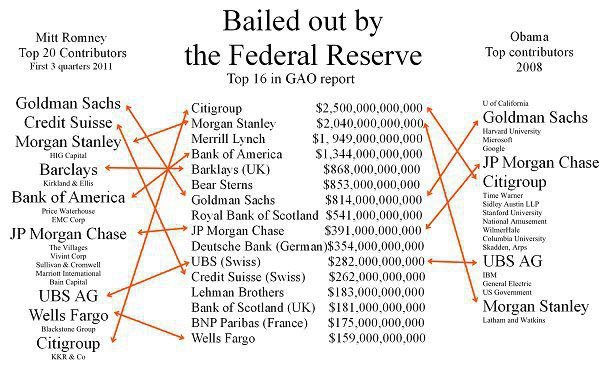
Source and More Data
Continue reading “Graphic: GAO Audit In One Graphic – Banks Buying Politicians”

The truth at any cost lowers all other costs — curated by former US spy Robert David Steele.
Source and More Data
Continue reading “Graphic: GAO Audit In One Graphic – Banks Buying Politicians”

An executive order with ample reason for concern
The executive order signed by Obama March 16, 2012, authorizes widespread federal (and often military) control and manipulation of the national economy and resources “under both emergency and non-emergency conditions” as well as the right to install “government owned equipment” in private industrial facilities.
It is understandable that reasonable precautions and preparations should be taken for defense and emergency conditions. The question here is what is “reasonable” and democratic – and to what extent does THIS kind of preparation actually make sense when compared, for example, to developing decentralized energy and industrial capacity which is less susceptible to attack. (We won't even mention here the development of nonviolent “civilian based defense” as advocated by Harvard historian Gene Sharp http://en.wikipedia.org/wiki/Civilian-based_defense to make a country ungovernable by a domestic dictatorship or foreign power.)
I recommend that you read over the whole executive order. However, for your convenience, I've excerpted particularly interesting parts of it below.
Continue reading “Tom Atlee: An Executive Order of Grave Concern”

The New Rules Of Innovation: Bottom-Up Solutions To Top-Down Problems
In his new book, Vijay Vaitheeswaran argues that we’re thinking about worldchanging innovation all wrong: It’s not going to come from where we expect it.
Arnie Cooper
www.fastcoexist.com, 19 March 2012
The world is currently standing “on the cusp of a post-industrial revolution.” So writes Vijay Vaitheeswaran in his new book, Need, Speed and Greed: How the New Rules of Innovation Can Transform Businesses, Propel Nations to Greatness and Tame the World’s Most Wicked Problems, out March 13. Vaitheeswaran, a 20-year veteran correspondent for The Economist and adviser to the World Economic Forum, wrote the book, he says, as a way to inspire bottom-up solutions to top-down problems like resource depletion, climate change, and growing income inequality. We spoke with Vaitheeswaran about the importance of disruptive technologies, social entrepreneurship, and embracing China’s rise.
Co.Exist: As you point out in your book, modern humanity has arrived at the first phase of an unprecedented “innovation revolution,” yet many are being left behind. Why is that and what are we gonna do about it?
Vijay Vaitheeswaran: First, I think it’s a wonderful time to be alive. Shockingly, this might be the best time to be in the bottom billion because of transformations like mobile telephony and micro-credit. But it’s getting much harder to be in the middle class in places like America. The principal reason for this, I think, is that educational systems are increasingly out of touch with the needs of the ideas economy. The current education system that our and other countries developed was suited to the industrial revolution, a one-size-fits-all model for education that treats people as commodities. But we’re in an innovation age where creativity, individual initiative, willingness to think out of the box and disrupt established business or even lifestyle patterns is much more important than simple manual tasks that produce the next widget. So I think the great challenge for developed economies like the U.S. is to reinvent education. The challenge for each one of us is to keep relearning how to learn.

Huh?
A decade after the attacks, our national security regime continues to grow ever more punitive and secretive
Karen Greenberg
Salon.com, 19 March 2012
By now, you’d think we’d be entering the end of the 9/11 era. One war over in the Greater Middle East, another hurtling disastrously to its end, and the threat of al-Qaida so diminished that it should hardly move the needle on the national worry meter. You might think, in fact, that the moment had arrived to turn the American gaze back to first principles: the Constitution and its protections of rights and liberties.
Yet warning signs abound that 2012 will be another year in which, in the name of national security, those rights and liberties are only further Guantanamo-ized and abridged. Most notably, for example, despite the fact that genuinely dangerous enemies continue to exist abroad, there is now a new enemy in our sights: namely, American oppositional types and whistleblowers who are charged as little short of traitors for revealing the workings of our government to journalists and others.
Here and elsewhere, it looks like we can expect the Obama administration to continue to barrel down the path that has already taken us far from the country we used to be. And by next year, if a different president is in the Oval Office, expect him to lead us even further astray. With that in mind, here are five categories in the sphere of national security where 2012 is likely to prove even grimmer than 2011.
1. Ever More Punitive (Ever Less Fair-minded).
2. Ever More Legal Limbo (Ever Less Confidence in the Constitution).
3. Ever More Secrecy (Ever Less Transparency)
4. Ever More Distrust (Ever Less Privacy)
5. Ever More Killing (Ever Less Peace)
Karen J. Greenberg is the director of the Center on National Security at Fordham University Law School and author of “The Least Worst Place: Guantanamo's First 100 Days.”More Karen Greenberg
Read full article with much detail and additional links for each of the five points.
Phi Beta Iota: An intelligent article replete with integrity.
Huh?
Marcus Aurelius: The CIA wants to spy on you through your TV: Agency director says it will ‘transform' surveillance
DefDog: CIA loves Internet of things… for spying on you
Petraeus says that the treasure trove of data connected appliances and devices will be able to gather on a “person of interest” will make it much easier to see what potential terrorists and others are doing inside home and to intercept communications. He also noted that connected household devices with the potential to be turned in the spy tools “change our notions of secrecy.” While the CIA has numerous regulations and laws preventing it from spying on American citizens, it’s apparently a much grayer area when it comes to collecting geolocation data that many devices
broadcast.
Dolphin: CIA Chief: We’ll Spy on You Through Your Dishwasher
Earlier this month, Petraeus mused about the emergence of an “Internet of Things” — that is, wired devices — at a summit for In-Q-Tel, the CIA’s venture capital firm. “‘Transformational’ is an overused word, but I do believe it properly applies to these technologies,” Petraeus enthused, “particularly to their effect on clandestine tradecraft.”
CIA director David Petraeus (seen here playing Wii golf) is really excited about the idea behind the Internet of things. The thing is most excited about isn’t his refrigerator being able to order milk, but the effect that connected appliances and devices will have on “clandestine tradecraft.” In other words, he’s excited about being able to use these devices to spy on people.
Phi Beta Iota: Patraeus was “musing” at an In-Q-Tel conference, so he can reasonably be forgiven for being taken out of context. However, this is just one more stronger signal that the $80 billion a year US Intelligence Community, within which CIA provides armed drones, foreign liaison hand-outs, and very little else, is money wasted. Clandestine tradecraft is about humans. All-source analysis is about integrating a strategic analytic model with history and forecasting to deliver decision-support. It is not about technology except in so far as it supports human cognition. It's a pity the Director of the CIA has not learned that. Technology is not a substitute for thinking, and administration is not a substitute for leadership.
See Also:
2012 PREPRINT FOR COMMENT: The Craft of Intelligence
Fixing WH and IC Steele 2009 1.5 PDF, International Journal of Intelligence and Counterintelligence, Spring 2010; As published; with corrected graphic (best).
2010 Human Intelligence (HUMINT): All Humans, All Minds, All the Time(US Army Strategic Studies Institute, June 2010
2009 Intelligence for the President–AND Everyone Else, as published in CounterPunch, Weekend Edition, February 27 – 1 March 2009
2009 Perhaps We Should Have Shouted: A Twenty-Year Restrospective
Huh?
Bush’s Terror War and the Fixing of Intelligence
On September 11, 2001, within hours of the murderous 9/11 attacks, Bush, Rumsfeld, and Cheney had committed America to what they later called the “War on Terror.” It should more properly, I believe, be called the “Terror War,” one in which terror has been directed repeatedly against civilians by all participants, both states and non-state actors. It should also be seen as part of a larger, indeed global, process in which terror has been used against civilians in interrelated campaigns by all major powers, including China in Xinjiang and Russia in Chechnya, as well as the United States.2 Terror war in its global context should perhaps be seen as the latest stage of the age-long secular spread of transurban civilization into areas of mostly rural resistance — areas where conventional forms of warfare, for either geographic or cultural reasons, prove inconclusive.
. . . . . .
In 2011 an important book by Kevin Fenton, Disconnecting the Dots, demonstrated conclusively that the withholding was purposive, and sustained over a period of eighteen months.8 This interference and manipulation became particularly blatant and controversial in the days before 9/11; it led one FBI agent, Steve Bongardt, to predict accurately on August 29, less than two weeks before 9/11, that “someday someone will die.”9
Continue reading “Mini-Me: From JFK to 9/11 Spotlight Shines on the CIA”
 Public Banking in America
Democratizing Money – Restoring Prosperity
